




The story so far:
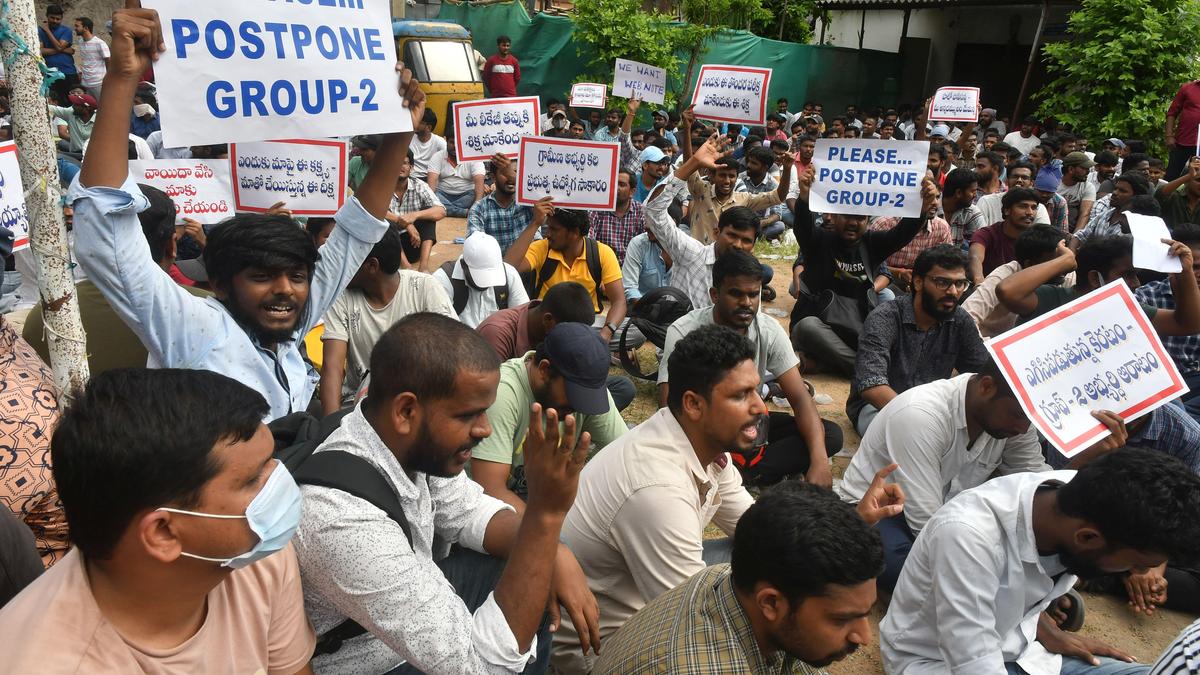
The 2025 national conference of chairpersons of the State Public Service Commissions (PSCs) is being hosted by the Telangana State Public Service Commission on December 19 and 20. Every year, whenever State PSCs conduct examinations for recruitment, they are mired in one controversy or the other. Aspirants often have to seek judicial recourse, due to which the entire process is derailed, leading to a ‘trust deficit’. This is an outcome of systemic lapses, both structural and procedural, which exist in almost all State PSCs. This conference would be an apt occasion to discuss such issues and more.
What is the history of PSCs?
The PSCs in India are a product of India’s struggle for Independence. The entry of Indians into the civil services on the sole criterion of merit was embedded in the demand for ‘self-rule’. The Montagu Chelmsford report accepted the demand and proposed a permanent office free from political influence to regulate service matters. The first Public Service Commission for the Union was formed in 1926. Later the Government of India Act, 1935 provided for the establishment of one PSC for each province. These provisions were continued by the framers of the Constitution, and so today we have a Union Public Service Commission (UPSC) and PSCs in each State to primarily serve the needs of recruitment.
How are these commissions structured?
The UPSC functions in a relatively politically sterile environment. The members are appointed based on merit and rich prior experience in public affairs. Moreover, representation of members from of all zones of the country is ensured. While the Constitution does not mention minimum age or qualifications, most of the appointed members are at least above the age of 55, and enjoy a reputation of being apolitical. On the other hand, State PSCs operate in a politically osmotic environment and the proverbial ‘spoils system’ is visible in the appointment process. The conventional requirements of minimum age, qualifications and public experience are given a short shrift.
The Union government has vast manpower needs. This is matched by financial resources to meet the retirement obligations of the superannuated and the remunerative needs of fresh entrants. It has also created a dedicated ministry, the Ministry of Personnel, Public Grievances and Pensions in 1985, to formulate all policies in the field of personnel management. This ensures regular declaration of vacancies by the government enabling the UPSC to notify, conduct and declare the results of the examinations conducted by it with regularity and precision.
In contrast, the manpower needs of the States are limited and not planned. Often, they lack the financial resources to meet the retirement and recruitment obligations of their employees leading to extension of the superannuation age and postponement of recruitment. Most State governments do not have a dedicated Ministry of Personnel. And therefore, vacancies are not notified regularly by the government which effectively means that State PSCs are not required to conduct the examinations regularly.
How do they work?
The UPSC undertakes a periodical exercise of establishing committees comprising not only of academicians but also civil servants, social activists etc. to recommend changes in the syllabi and achieve a balance between academics and contemporary developments. They are able to tap the best talent from across the country to formulate question papers and also evaluate them. A time tested method of ‘inter-se’ moderation of scores is followed at different levels of the examination to minimise subjectivity. The UPSC ably balances conflicting interests of transparency and confidentiality by being quick to respond to any lapses and making systemic changes so that aspirants do not often have to seek judicial recourse for grievances.
On the other hand, State PSCs do not appoint committees regularly to redraft the syllabus; are constrained to tap academic resources from within the State; and are not able to achieve satisfactory ‘inter-se’ moderation in evaluation. They also have the daunting task of making complex calculations to accurately incorporate not only vertical reservations but also horizontal reservations. Meeting the demands of regional quotas in the form of zonal reservations adds to this complexity. All these lead to continuous litigation in one form or the other delaying the recruitment process.
These are some of the main reasons limiting the efficient functioning of State PSCs and their declining credibility. Often aggrieved students comment that they have lost faith in State Commissions and would like the UPSC to conduct the examinations. Time bound structural and procedural reforms are required to restore faith in State PSCs.
What can be done?
First, manpower planning should be systematised and a separate ministry should be created for personnel management. This Ministry should clearly layout a five-year road map for recruitment so that State PSCs are able to notify and conduct the examination process.
Along the lines of the 41st amendment of the Constitution (1976), which raised the maximum age limit of the members of State PSCs from 60 to 62 years in order to attract meritorious and experienced civil servants, there is a need for another amendment. The minimum age for appointment as a member should be fixed at 55 and the maximum age at 65. The stipulation of minimum age will enable appointment of experienced individuals while increasing the maximum age will enable State PSCs to benefit from the experience of senior civil servants who have retired at 60 for a longer period than under the existing provisions.
This amendment could also specify the necessary qualifications that members need in order to be appointed. For example, in order to be an ‘official’ member, experience as Secretary to a State government or a post equivalent to this rank should be stipulated while for ‘non-official’ members 10 years of practice in a recognised profession like law, medicine, or engineering should be stipulated. A mandatory pre-consultation with the leader of the Opposition before appointment may be considered for non-official members. Thus, a State wide panel of eminent people — those with high standing, integrity, merit and independence — should be constituted and periodically updated.
Secondly, the syllabus should be revised periodically, keeping in view the changing academic scenario and the syllabi for examinations as stipulated by the UPSC. Every proposal for revision should be placed in the public domain and changes can be made after public consultation. Knowledge on State specific areas like regional history, regional economy and regional geography, in which the availability of faculty is limited, should be tested in the objective type format so that there would be no scope for complaint on the grounds of asymmetry of information and value laden correction. Thus, while the preliminary examination may continue in the objective format, the main examination should be a mixture of objective and subjective papers. The process of translation of the questions from English to the regional language should not only involve technology for secrecy but also the human element so that the right meaning is conveyed. Care should be taken to regularly change the pattern of questions so that the role of AI-chat bots, as a source of information for formulating answers, is effectively countered.
Finally, the Secretary of the State PSCs should be a senior officer with prior experience as either Commissioner of School Education or Secretary of the Board of Intermediate education to enable effective supervision of the examination branch of the Commission. Transparency and confidentiality should be balanced on the lines of the UPSC.
If these changes are effected, one would have vibrant Public Service Commissions at the State level on par with the Union Public Service Commission.
The writer is the Founder Director of Brain Tree IAS Hyderabad and has been engaged in teaching public administration for the last 35 years.
Published – November 24, 2025 08:30 am IST