




“No one has been able to capture the breadth of what a landscape architect does,” says Aniket Bhagwat, an Ahmedabad-based landscape practitioner. From the stepwells of Chand Baori, where water collects in a magnificent setting, to the immersive experience of a ‘Terminal in the Garden’ at Kempegowda International Airport T2, landscape architecture has never been only about nature. It’s about reframing the context between the built and unbuilt — earth, water, sky, light, sun, and moon — to nurture and renew relationships between humans and nature. Whether it’s about creating a jungle experience or carving out green spaces, the landscape architect’s role is vast and complex.
While the previous generation was working at a time when the field was barely understood, the current generation has the charge to bring contextual relationships in completely innovative ways, beyond beautiful. Today’s landscape architects are increasingly conscious of raising awareness among urban city dwellers, who have become increasingly distant from nature, by applying the principles of biodiversity and permaculture, creating pollinator-friendly habitats, and cultivating medicinal herbs and food plants.

An aerial view of Oberoi Vindyavilas, Bandavgarh.
With the huge amounts of waste being generated, reusing debris and rejuvenating soil have become paramount. Bhagwat of premier studio Prabhakar Bhagwat lauds the commitment of the new generation, many of whom he has taught. “A whole bunch of the current gen are passionate, focused, and calm; they are in no hurry to go anywhere, pouring their heart into it, and doing one landscape at a time.”
The meaning of sustainable landscapes is rooted in practical concerns. At BIC, VSLA navigated a nala (stormwater drain) to recreate an ecological corridor, enabling biological filtration and improved stormwater quality. Connections between landscape and water, food and healthy soil, gardens and medicine, ‘oxygen’ parks and fresh air, terminals and spiritual contemplation, and native versus exotic species have regenerated a fresh incentive to landscaping.

Image of skywalk.
| Photo Credit:
Oracles
We look at five leading studios that create interventions between the urban landscape and nature. Their projects incorporate skywalks, planted ledges, parks with green tunnels, dedicated township parks with ponds and streams, rooftop gardens, jungle-scapes, and ruinscapes.
Behind the medicinal garden
Varna Shashidhar, VSLA, Bengaluru

Byg Brewski landscape by VSLA.
Established in 2013, VSLA, a multiple award-winning firm (ISOLA, IIA, HUDCO), was recognised by Wallpaper this year alongside international landscape architects. Founder Varna Shashidhar, a Geoffrey Bawa enthusiast, had apprenticed with Sri Lankan architect C. Anjalendran, working out of his famed verandah office. The immersion into cultural landscapes and contextual design (including Anjalendran’s SOS Children’s Villages) rooted Shashidhar in an appreciation of culture and in integrating with the environment. “In India and South Asia, our experience of landscape goes beyond the sensorial.It’s never about the distance between the person and the landscape.” For Shashidhar, this means preserving sacred groves, ecosystems and biodiversity, and conserving lakes and wetlands. It also extends to the resourceful reuse of materials, including demolition debris such as laterite blocks, which she used as paving in her Parra Retreat project in Goa. Her core mission has been to stay contextual by engaging with nature through rituals, play and daily life.
For Shashidhar, landscape architecture means preserving sacred groves, ecosystems and biodiversity, and conserving lakes and wetlands.
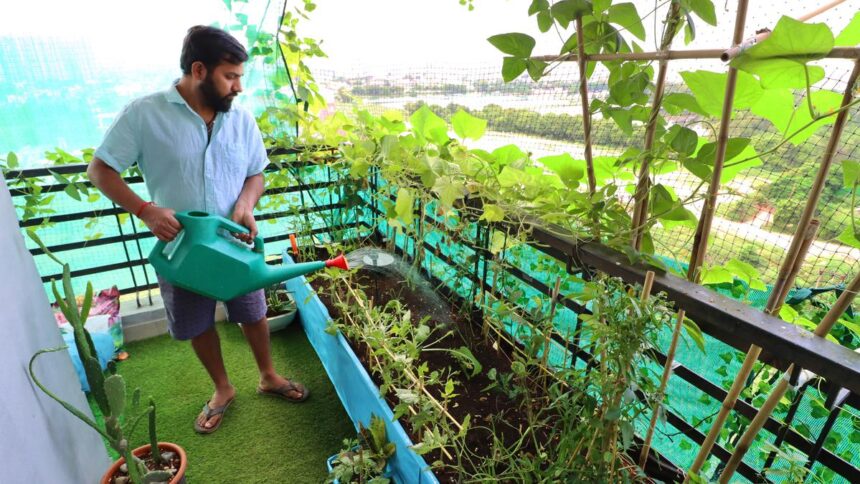
At Neev Academy in Bellandur, she created temporary water landscapes for children, allowing them to observe micro-ecosystems with their own flora and fauna. For an entrepreneur couple in Bengaluru, she designed an oushadi, or medicinal garden. Navigating narrow spaces and minimal soil depths in pre-built urban environments, Shashidhar focuses on creating shared spaces where families can spend time in activities with nature. Her ‘pandemic garden’ for a multi-generational family includes an intensive green roof with 12 inches of soil, where herbs, vegetables and flowering plants are grown. For her, landscape, biodiversity and putting food on the table are all interconnected.

Varna Shashidhar.
| Photo Credit:
M. Vivek
BYG Brewski Hennur, designed by Soumitra Ghosh of Mathew Ghosh across 65,000 sq ft, presented a raw challenge. “Everything was on a slab, hard concrete, no connection to earth. The Hennur neighbourhood is busy, loud and dense. How do you create an almost oasis-like condition in such conditions?” Shashidhar’s solution was to select fast-growing species, mostly medicinal herbs, smartly sourced within 20 km to create prolific greenery that merges with the ruinscape. Herbs can be freshly plucked for drinks.
Of ponds and rewilding
Sujata Kohli, IPDM Services (India) Pvt. Ltd, New Delhi

Tent area at Oberoi Vindhyavilas, Bandhavgarh.
In 1989, when Sujata Kohli started her practice, landscape design was hardly mainstream terminology. A stroke of luck landed her a project doing master planning and landscaping for the British High Commission. “Andrew Slater from the foreign office was very clear they wanted a landscape architect,” says Kohli. There was no looking back.
The benchmark project led her into the coveted circle of diplomatic missions, from New Zealand and Japan to America. Thirteen embassies in her first six years gave her a vast palette and deep understanding of cultural nuances.
To meet the rapid build pace required by IT firms, the company used a combination of slow and fast-growing plants. Nurseries too evolved with the IT boom, growing trees in gunny sacks that could be replanted.
In 1993, Kohli entered hospitality, winning a competition for one of Hyatt Hotels’ refurbishment projects. Then she got called to do a 25-acre landscape for an IT firm in Siruseri, Chennai.

Sujata Kohli
“I’ve learnt mostly on-site. Working with live entities is fascinating,” enthuses Kohli, who accompanied her clients even for the land purchase. In the southern landscape, different from the north, black cotton soil posed drainage problems, so the entire surface drainage was taken to a created water pond, disposing of only the overflow. The water from the pond also helped in irrigating the ground.
To meet the rapid build pace required by IT firms, they used a combination of slow and fast-growing plants. Nurseries too evolved with the IT boom, growing trees in gunny sacks that could be replanted.

Entrance water feature at Oberoi Vindhyavilas, Bandhavgarh.
Her recent landscaping was for Vindhyavilas Oberoi, a jungle resort in Bandhavgarh, Madhya Pradesh. Featured in Time magazine as one of the must-visit places of 2025, the 25-acre property has 19 luxury tents and an infinity pool next to the lake with a natural, wild feel around the gym and spa. “A lot of the work was rewilding, water management and site drainage, making it a functional yet organic solution. In landscapes, there are no boundaries,” concludes Kohli.
Apolitical spaces
Prabhakar B. Bhagwat, Ahmedabad & Mumbai

An overhead view of Palava city.
“No one has been able to capture the breadth of what a landscape architect does,” says Aniket Bhagwat, the third-generation landscape practitioner in the family. His father, Prabhakar Bhagwat, is acknowledged as the first qualified landscape architect of India. Prabhakar Bhagwat entered its 50th year in 2023, a pioneering force behind the landscape profession’s evolution in India.

Sindhu bhavan in Ahmedabad.
From their landmark rejuvenation of the timba basalt quarry into a dense forest across hundreds of acres in Gujarat to their committed research at Landscape Environment Advancement Foundation (LEAF), the 50-person studio, with offices in Ahmedabad and Mumbai, has influenced a sweeping range of interventions. “The amount of change India has seen in these past decades is huge. There is just so much work — offices, housing colonies, homes, IT offices,” says Bhagwat’s firm is designing buildings, parks and public spaces for the smart city of Palava in Dombivli, Maharashtra, planned across 4,500 acres.

Aniket Bhagwat.
For this ardent architect, who queries deeply as to how landscape can bring meaning, gardens and landscapes emerge as repositories of culture, history, sociology and governance: plant and soil meet art and philosophy, memory and nostalgia. “Gardens lead to an understanding of where we are as a people,” he says. “Landscapes offer apolitical spaces of soliloquy to reflect on what we are doing in life — this can be very powerful.”
One of the projects include the landmark rejuvenation that involves transforming the timba basalt quarry into a dense forest spanning hundreds of acres in Gujarat.
Bhagwat steered the Pratiti Initiative with ‘The Parks People’, which includes LEAF, UNM Foundation and like-minded designers, to redesign parks. It began with his belief, ‘Great societies are built by the idea of real patronage’. Between Ahmedabad and Surat, 15 parks have come up over 8 years, through the public-private partnership between the UN Mehta Foundation and the Ahmedabad Municipal Corporation. “These parks are not just funded but maintained for life by UN Mehta, which is very rare,” points out Bhagwat.
Zen expression
Ravi and Varsha Gavandi, Pune

Raised walkway in Nanded city.
Since beginning their practice in Pune in 1990, Ravi and Varsha Gavandi have believed in creating context-specific landscapes, connecting the natural landscape of the site to the lifestyle and aspirations of its people. Sensitive to landscape typologies around Pune, they adopted a functional-aesthetic perspective. “For instance, we used Woodfordia fruticosa in hedge rows, which attracts birds with its tubular red-coloured flowers,” says Varsha.

Ravi Gavandi
Magarpatta township was a turning point in their career in 1999. With the IT boom, new demands arose. In 2003, their first corporate project for Zensar Technologies led to a fresh direction with the client’s ask for a zen expression: simplicity, clean lines and integrated site services. The minimalist designs, which merged Indian and international ethos with holistic site development, set a new trend.
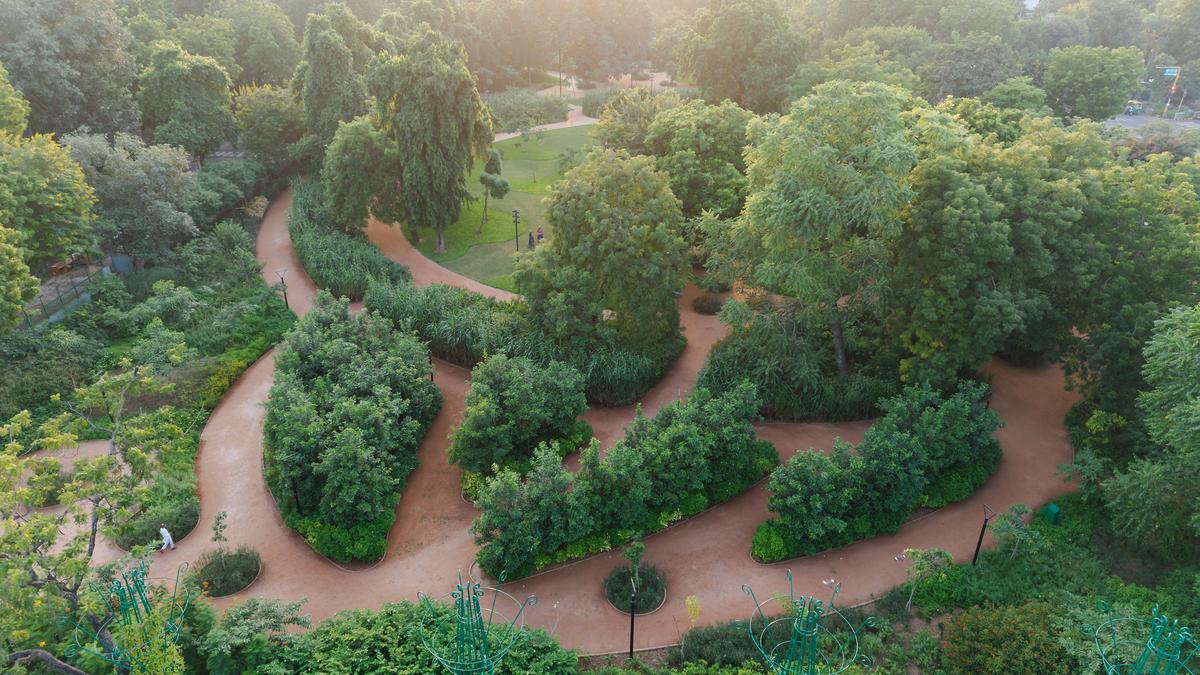
In Nanded City, Pune, with liana and climbers lending a unique character to existing dense vegetation, the park is a separate entity where the township residents can connect with nature.
Varsha says, “In 2009, another layer got added — ecological landscaping. Instead of designing on the site, we started designing with the site.” The first phase of seven acres of Stream Park, conceived around 2009, was completed by 2012 at Nanded City, Pune. It had the design objective to enhance, reinforce and heal the natural landscape.

Varsha Gavandi
The park boundary was decided based on various surveys and ecological assessments. The naturalistic setting incorporates nature-based solutions for cleaning water. Existing land use was incorporated in the proposal, such as a flower farm at the entrance, and the old walking trails used by farm folk. The entrance along an axis terminates in the stream, which is revealed only later in the journey.

Lotus pond and landscaping.
With liana (long-stemmed woody vine) and climbers lending a unique character to existing dense vegetation, the park is a separate entity where the township residents can connect with nature.
Gardens in the sky
Suneet Mohindru, Oracles – Landscape Architecture, Planning and Design, New Delhi

New terminal 1.
In 1997, Suneet Mohindru started his practice, Oracles — a name that implies envisioning the future. His core philosophy is grounded in capturing ethos to create narratives of place. Creating a sense of scale and positioning the experience is key. The Taj Mahal’s dome at 240 feet compares with a 20-storey-high present-day building, but it appears smaller. “We look up at a building, but we immerse in the landscape, touching and even trampling on it! When we enter a property, thoughtful landscape design unravels in layers, one after another, inviting exploration,” says Mohindru.

Suneet Mohindru
Out of roughly 360 entries, Oracles recently won the Outstanding Award for its ‘Skywalks’ project at DLF Cyber City, Gurugram, at the IFLA Asia Pacific Region Congress 2025. The elevated skyways connect buildings across a 16-lane high-speed arterial road — otherwise impossible to cross. With DLF’s brief of “let’s do prototypical bridges”, Oracles proposed three optional concepts — based on the metaphors of waves, connectivity and youth — and all three were selected, resulting in three unique skywalks. Focused on urban greening and mobility, these ‘gardens in the sky’ are a wholly enjoyable experience for walking, social interactions and relaxing.
At DLF Cyber City, Gurugram, the elevated skyways connect buildings across a 16-lane high-speed arterial road — otherwise impossible to cross.
Mohindru’s 2023 landscape design for Delhi Airport’s Terminal 1 was shaped by the challenge of limited outdoor space. The concept drew from the city’s geography, framed by the natural boundaries of the Ridge and the Yamuna — a setting that makes ‘Dilli’ the ‘Dil of Hindustan’.

The skywalk corridor.
Transcending its traditional bounds, the landscapes were devised in and out of the terminal building, wherever nature could claim its lost space, using the flow of water through narrow ledges, creating ‘forests’ around columns, and intermittent boulders and rocks. Mist over elevated lakes and diyas in the waterways complete the ephemeral experience at the terminal.
Word origin
Landscape — views of landforms in the distance — was also a word borrowed by 17th century Dutch painters to describe their new genre of art focused on natural scenery. The Dutch word landschap relates to ‘shape of the land’ as also the English root ‘sceppan’ means ‘to shape’.
Tracking history
Historically in India, architecture has celebrated scenic vistas by framing — be it through the window arches at the Udaipur palace, the pavilions at Hampi or the five-storey stepwell of Rudabai Vav — playing with the grand sense of scale.
The writer is a brand strategist with a background in design from SAIC and NID.