



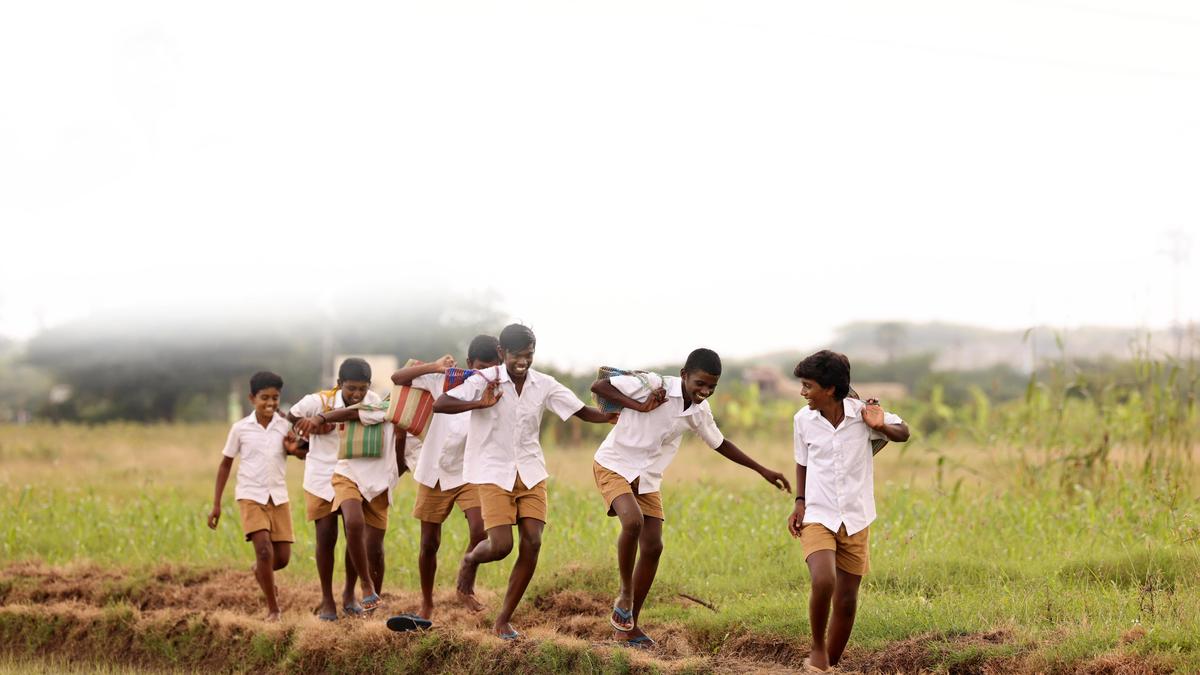

Filmmaker Mari Selvaraj’s rise in Tamil cinema as one of its top filmmakers from humble beginnings and his evolution as a master craftsman is a story by itself. It wouldn’t be a stretch to state that Mr. Selvaraj along with filmmaker Pa. Ranjith filled a yawning gap in Tamil cinema by ensuring that Dalit protagonists and Ambedkarite politics of emancipation formed the central core of their films, serving as an anathema to the persistent normalisation of violence and oppression by dominant castes in the name of valour and history in Tamil cinema.
It has been 13 years since filmmaker Pa. Ranjith burst onto the scene with Attakathi and seven years since Mari Selvaraj’s first film, Pariyerum Perumal, released in theatres to positive reviews and success at the box office, dispelling the notion that films about caste discrimination set in the deep south are akin to a spark in the powder keg. Yet, crucial differences between the two filmmakers haven’t been emphasised enough. Except for Attakathi, Mr. Ranjith largely shies away from making films with significant autobiographical elements while Mr. Selvaraj situates his autobiographical episodes in historical contexts, save for Maamannan.
Unique tone
Mr. Ranjith’s point of view has been informed by a different political tradition in northern parts of Tamil Nadu, where fight for rights would mean large scale political mobilisations, street protests and litigations. However, Mr. Selvaraj’s formative years were spent in what was then a part of the Tirunelveli district, a southern district of Tamil Nadu, that has been a hot-bed of caste-violence and caste-based mobilisation through the 90s, including widespread rioting across neighbouring districts, known as the ‘Thenmaavatta Kalavarangal’. Young and middle-aged taxi drivers hailing from southern districts but making a living in Chennai, Bengaluru or Mumbai could tell you how the smallest of provocations, say, in restrooms, in cinema halls, in public buses (as in Bison: Kaalamaadan), or in tea shops could snowball into a major incident of violence. Irrespective of which community they hail from, most of them find the prevailing environment toxic and are realising that it is not worth contributing to violence and spending one’s life entangled in court cases.
This is perhaps why Mr. Selvaraj’s point of view appears to look like he is striving for a negotiation, often resorting to dialogue even with his worst enemy, despite the fact that Dalit communities in the south of Tamil Nadu often fight back and resist oppression violently. During a visit to Tirunelveli before the 2021 State Assembly elections, this author asked political activists within the Devendrakula Vellalar community about Mr. Selvaraj’s first film Pariyerum Perumal. They were quite critical of the film. “It is not our film. It is a film made for you people,” a political party office bearer said jokingly. He meant that the film was meant to tug at your heart, and not aimed at his throat.
However, Mr. Selvaraj quickly changed his tone in Karnan, featuring Dhanush, in which he wove a story around a painful historical incident of police brutality to etch a rather spirited story about how a regular, everyday youth uses revolutionary violence in pursuit of justice. “This is more our film. We fought back…and now everybody knows that,” the same activist, told me over the phone after the release. In four of the five films that Mr. Selvaraj has made so far, it is clear that he has been struggling to make sense of his personal experience with caste and the social machinations around him. Questions have been asked, not just by those who don’t like the politics in his films, but also by those who take him seriously as a filmmaker.
Questions of conscience
Many have spoken about how Mr. Selvaraj has mastered the art of representation — the way women tie their sarees in his films, how dominant castes strut around and throw their weight in villages and towns, and how the smallest of scuffles could snowball into a conflict involving whole communities. After an uncomfortable outing in Maamannan, which had some decent ideas, Mr. Selvaraj returned to his familiar surroundings with Vaazhai, telling us a story of characters hailing from his world, with episodes from his life. Its message was that caste-based labour exploitation has a role to play in accidents, too.
With Bison: Kaalamaadan, Mr. Selvaraj plonks his protagonist, Kittan, an aspiring Kabaddi player, who is asked to stay out of trouble by his father, in the midst of a raging, violent war between two community leaders — one fighting to ensure that the social balance remains tilted in his community’s favour and the other, fighting to create equilibrium. In Bison, Mr. Selvaraj continues to open himself up to the criticism that his films often tries to appeal to the good conscience of the oppressor castes. A writer who is well-informed about the politics in the south said, “Except for Karnan, protagonists in Mari’s films have sought equality with the oppressor castes by showcasing the struggles of the protagonist and appealing to their good side. However, nobody in Tamil cinema today has been able to capture how the dominant castes try to maintain their dominance in the caste society. He is exceptional in that case.”
While one need not speculate about his motivations, it is true that the idea of seeking parity by appealing to the good conscience of dominant castes sits uncomfortably with the larger Dalit community who remember their struggles in the south differently. It is perhaps understandable that cinema, being an expensive mainstream art, necessitating the need to recoup money in the market, imposes certain restrictions such as creating a sense of balance in representation and so on. The movement that began with Pa. Ranjith and Mari Selvaraj, finds itself at an inflection point: can mainstream cinema be used to build bridges and force a change of mindsets in other communities while telling stories of oppression the way it must be told?
Bison could be seen as a move towards that. By bringing the life and struggles of Manathi Ganesan, a Kabaddi player, on the silver screen, Mr. Selvaraj has shown his intent to celebrate not just those who fight for the rights of people, organise protests and so on, but also heroes from the community who quietly break glass ceilings and set benchmarks, not just for young people within the community but for Tamil society as a whole.
Published – October 31, 2025 08:30 am IST