



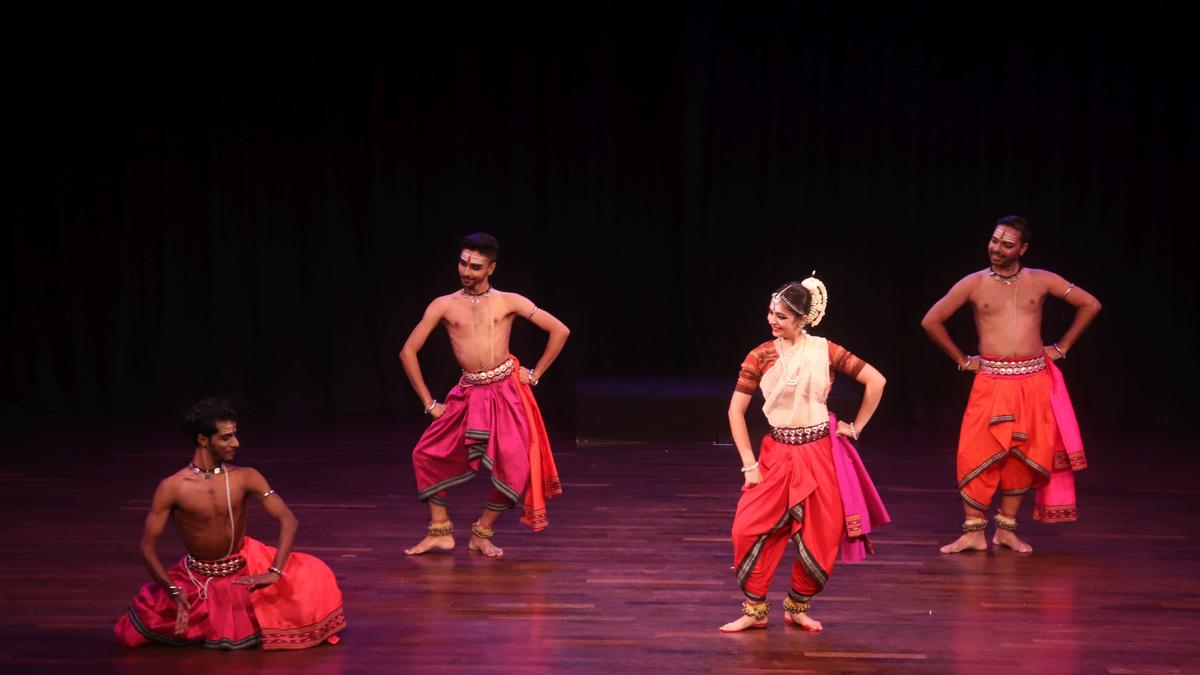


Students of Sharmila Biswas performing ‘Murta Maheswara’ at the Bangalore International Centre.
| Photo Credit: Courtesy: BIC
Odissi dancer-choreographer Sharmila Biswas is known for creating imaginative and unusual productions. She goes beyond the literal, and challenges the idea that classical dance is rigid, narrow and too removed from the present — her recent performance at Bangalore International Centre only proved this.
Even if her choreography occassionally feels like a departure from the norm, she is careful to retain the look and feel of the classical dance form. But Sharmila and her disciples do a few things quite differently. She frequently appears as a sutradhaar, reading the programme notes from a stylised red book. Likewise, when the programme ends, instead of a traditional mangalacharan, she showers a few white flowers on the edge of the stage, before slipping away into the darkness.
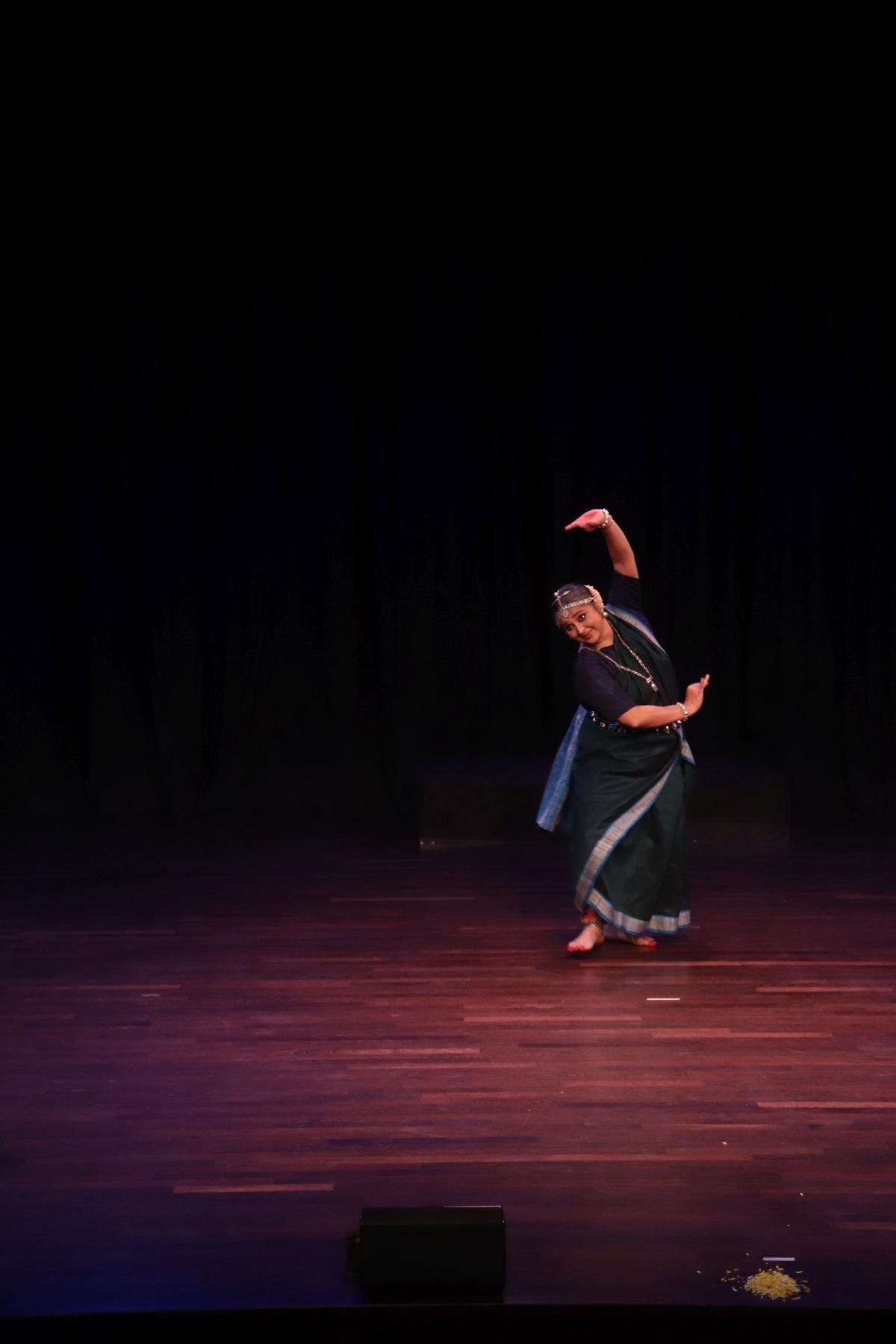
Sharmila Biswas performing at the Bangalore International Centre recently.
| Photo Credit:
Courtesy: BIC
This way, Sharmila does treat enshrined tradition as too heavy a subject but considers it a lived, felt and shared community experience that even allows room for gentle humour and joy.
That joy is hard to miss in a piece such as ‘Gati Vilas’, presented by students Raaginni Hindocha, Koushik Das, Dipjoy Sarkar and Biswajit Mondal from OVM (Odissi Vision & Movement in Kolkata). Next came ‘Murta Maheshwara’, where Shiva is portrayed as the protector of animals — regal as a lion, powerful as a horse, soft as a swan, musical as a cuckoo, graceful as a peacock and as precise as a hawk.
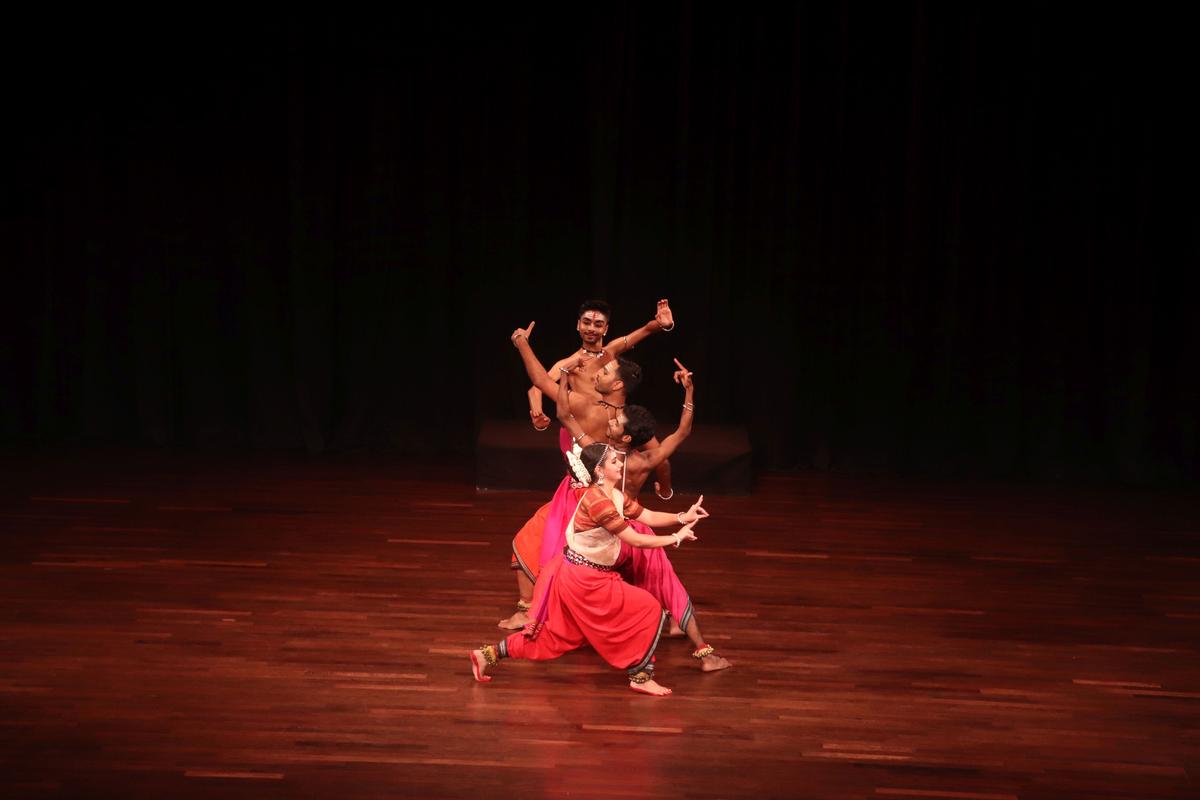
Students of Sharmila Biswas depicted the different attributes of Shiva in the group production titled ‘Murta Maheshwara’.
| Photo Credit:
Courtesy: BIC
Sharmila explains that her dancers at OVM are also familiar with music and theatre, and used them effectively in their dance. “None of this must be obviously visible to the audience, though,” says Sharmila.
A touch of verite
In ‘Vilasini’, she gives us an experience of understanding the mind of an ageing dancer. She starts by narrating the story of Mahari, a retired temple dancer, who one day catches a fleeting glimpse of herself in a few drops of water and starts imagining her younger, beautiful self. She begins to dance again in her courtyard, unmindful of her ageing body. She invites the crowd that has gathered to watch her into her home. Sharmila narrates this story with minimal gestures. As the older dancer, she brings a vulnerable openness and flashes of humour.
In recent years, Sharmila has pared down her costume to an Odia weave, flowers and a touch of silver. Research has been a constant pursuit for Sharmila and it has enabled her to gather stories and material that deepen the context setting and cultural nuances of her dance.
Folk to classical
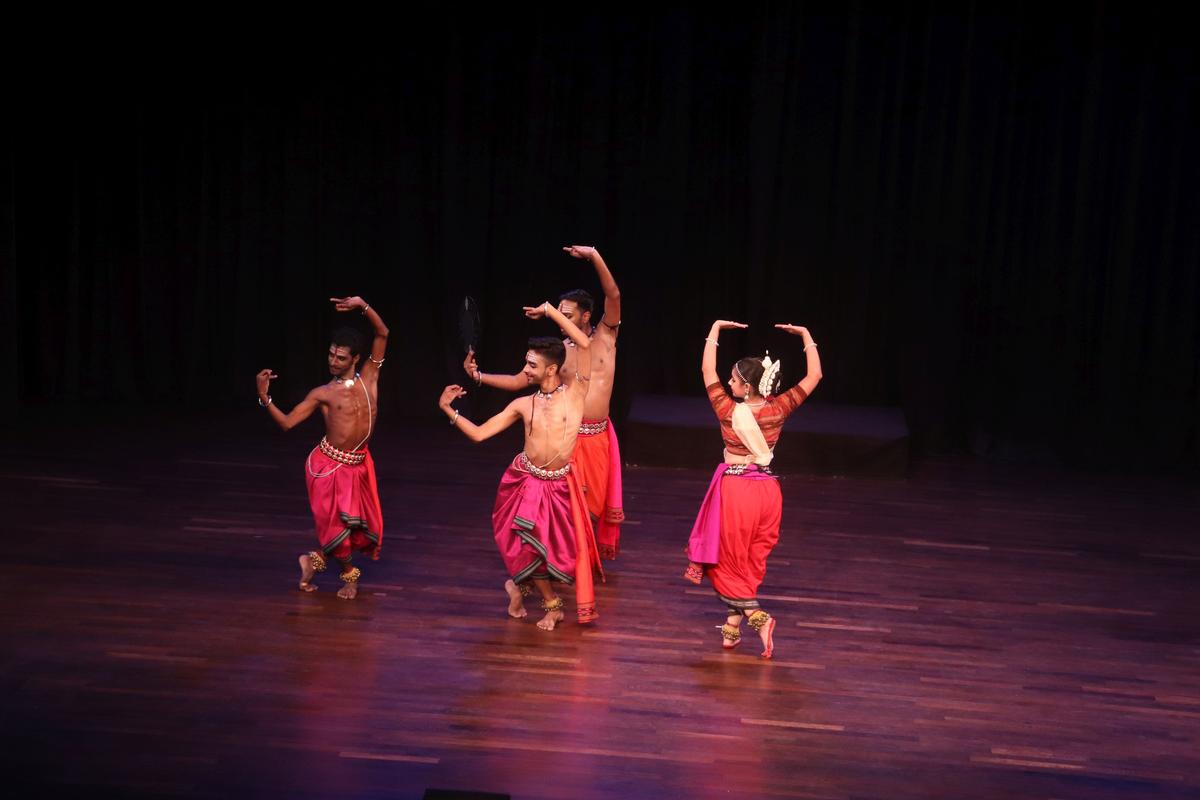
A well-coordinated performance by the students of Sharmial Biswas at the Bangalore International Centre.
| Photo Credit:
Courtesy: BIC
Many of her choreographies use music traditions of Odisha. In a piece such as ‘Dhwani Pratidhwani’, four dancers play with the rhythm, their dance embodying the different percussive styles associated with Shiva — blurring the lines between folk and classical.
By consistently expanding her artistic quest and borrowing from other performing arts, Sharmila, driven by the synthesising mind of a researcher offers fresh perspectives in Odissi.
Published – November 25, 2025 05:32 pm IST