


Events surrounding the dramatic arrest of former Chief Minister M. Karunanidhi in June 2001 have come into focus again in the wake of observations by a Tamilaga Vettri Kazhagam (TVK) functionary about the whereabouts of Chief Minister M.K. Stalin at the time of the incident.
It was a fact that Mr. Stalin, then Chennai Mayor, was not in the city when a team of police officials went to the Oliver Road residence of his father during the intervening night of June 29 and 30 to arrest him in connection with alleged irregularities in the construction of 10 flyovers in Chennai, according to a perusal of materials available with The Hindu archives. Mr. Stalin, whom the police could not trace in the early hours of the day, said he had gone to Bangalore (now Bengaluru) to meet a relative, this newspaper reported on July 1. Once he knew the police were looking for him, he had returned to Chennai and surrendered before Principal Sessions Judge S. Ashok Kumar, who remanded him in judicial custody till July 10.
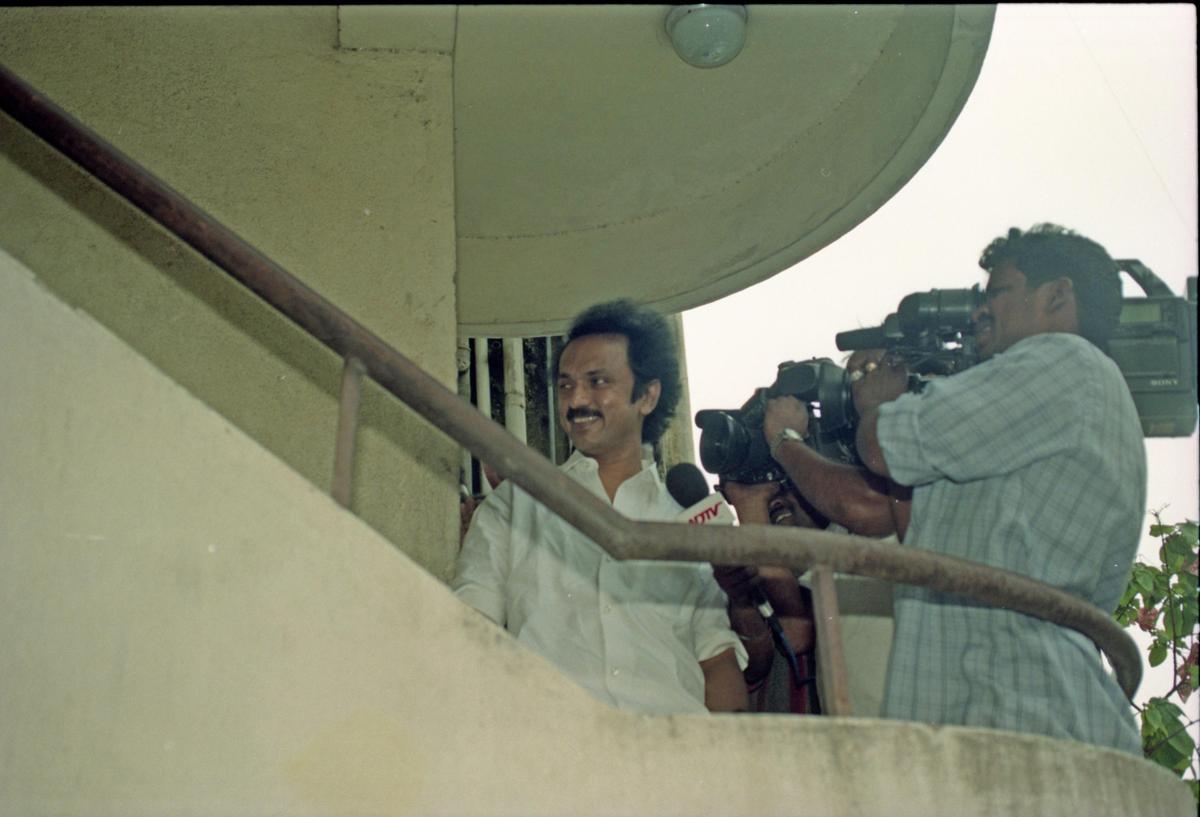
M.K. Stalin, then Chennai Mayor, speaking to the media in Chennai on June 30, 2001
| Photo Credit:
Vino John
Earlier, the police officials, who woke Karunanidhi up from sleep, in the words of The Hindu, “dragged him down the stairs” of the residence at 2 a.m. on June 30 before taking him to the Crime Branch-CID headquarters, which functioned from the Omandurar Government Estate, for interrogation. After a brief halt at the Vepery police station, Karunanidhi was presented at the house of the Principal Sessions Judge on Taylor’s Road, Kilpauk. Later, he was lodged in the Chennai Central Prison, which was then located opposite the Central railway station and on the southern side of the Buckingham Canal.
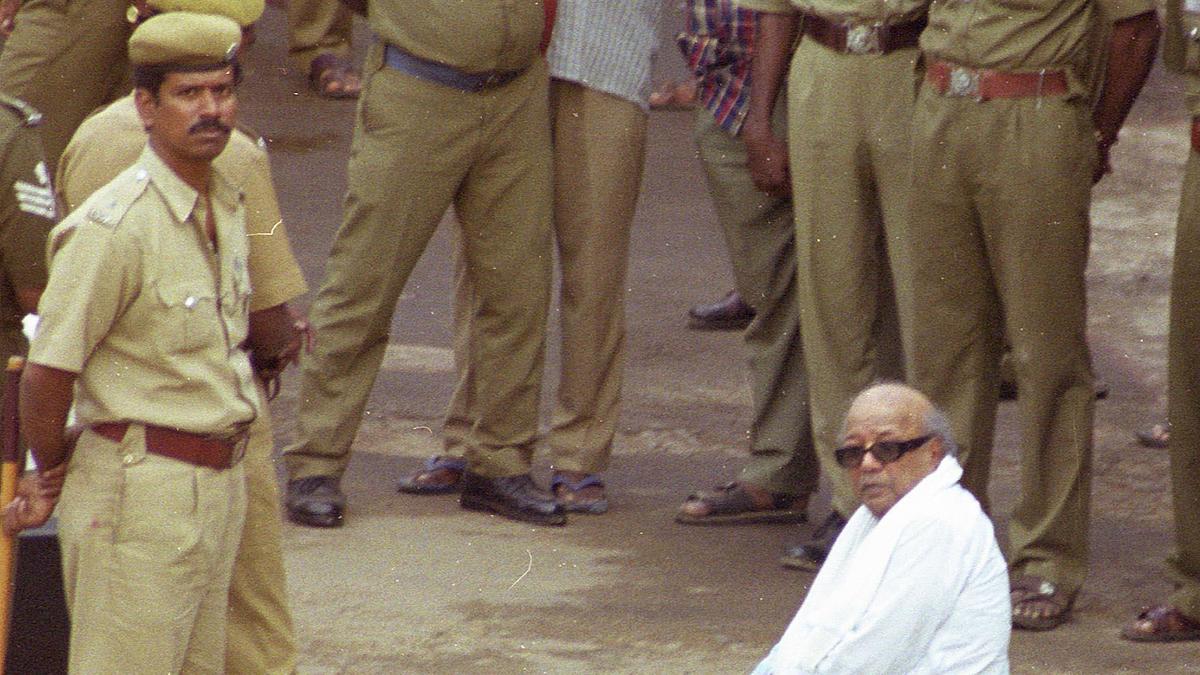
Originally, the authorities had planned to take the former Chief Minister to Vellore. As he had squatted on the ground for about half an hour as a mark of protest, this plan was dropped. Others who were arrested in connection with the case included former Ministers Ko. Si. Mani and K. Ponmudi; former Chief Secretar K.A. Nambiar; and consultant for the flyovers project N.S. Srinivasan. Union Ministers Murasoli Maran and T.R. Baalu, who offered resistance to the police, were roughed up and later arrested, reported this paper.
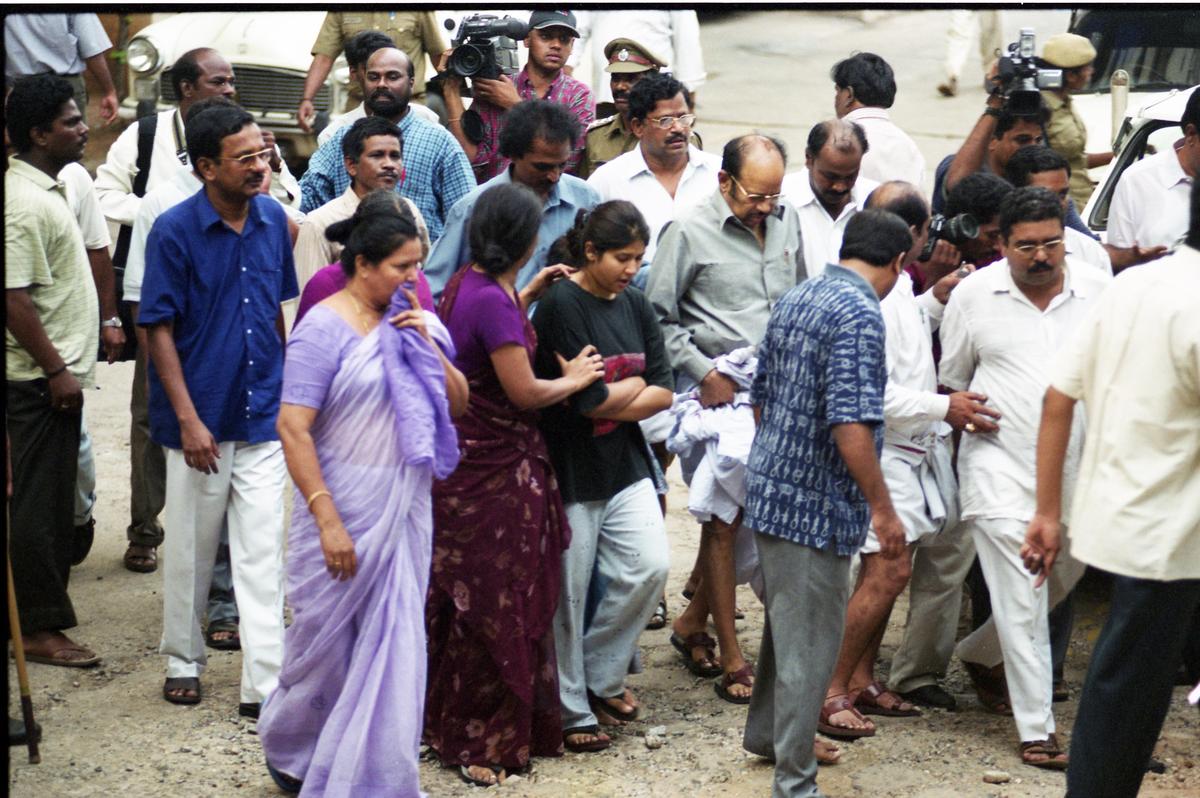
Murasoli Maran seen with family members in Chennai on June 30, 2001, after the arrest of Karunanidhi and Mr. Stalin
| Photo Credit:
Vino John
In his interaction with reporters, the then chief of the DMK, whose legs had swollen by the time he had entered the prison, gave an account of how the police had conducted themselves at his residence. They “had barged into his bedroom. They did not show the arrest warrant. They said it was not necessary. They pushed me, they dragged me. They tore my shirt. When we (the previous DMK government during 1996-2001) arrested her (Jayalalithaa), we had treated her respectfully,” Karunanidhi observed then.
When the police van carrying the former Chief Minister arrived at the Central Prison around 7 a.m., his party cadres gathered in full strength to protest his arrest. When Karunanidhi walked into the jailer’s room, DMK sympathisers lined up along the Stanley viaduct bridge and the Canal bank adjoining the jail complex, raising abusive slogans against the police and the AIADMK government. The “riot” police swung into action and lathicharged them.
It was around 11.15 a.m. that Mr. Stalin was also taken to the jail complex. Wailing DMK men and women, who were present there, asked the police to arrest them as well, but they were all chased away. After keeping the then Mayor for over three hours outside the prison cell, the police had informed him that he was being shifted to the Madurai Central Prison for “administrative purpose”. Instantly, he sat in dharna, demanding a “written statement”. After the statement was furnished, he agreed to being shifted to Madurai.
“As the smiling Mr. Stalin left, waving to the crowds of partymen, the police decided to lodge Mr. Karunanidhi in the Chennai prison. Both the Mayor and the former Chief Minister, have not had food. Karunanidhi only had buttermilk,” according to Durga Stalin, wife of Mr. Stalin, who wept as she came out of the prison complex.
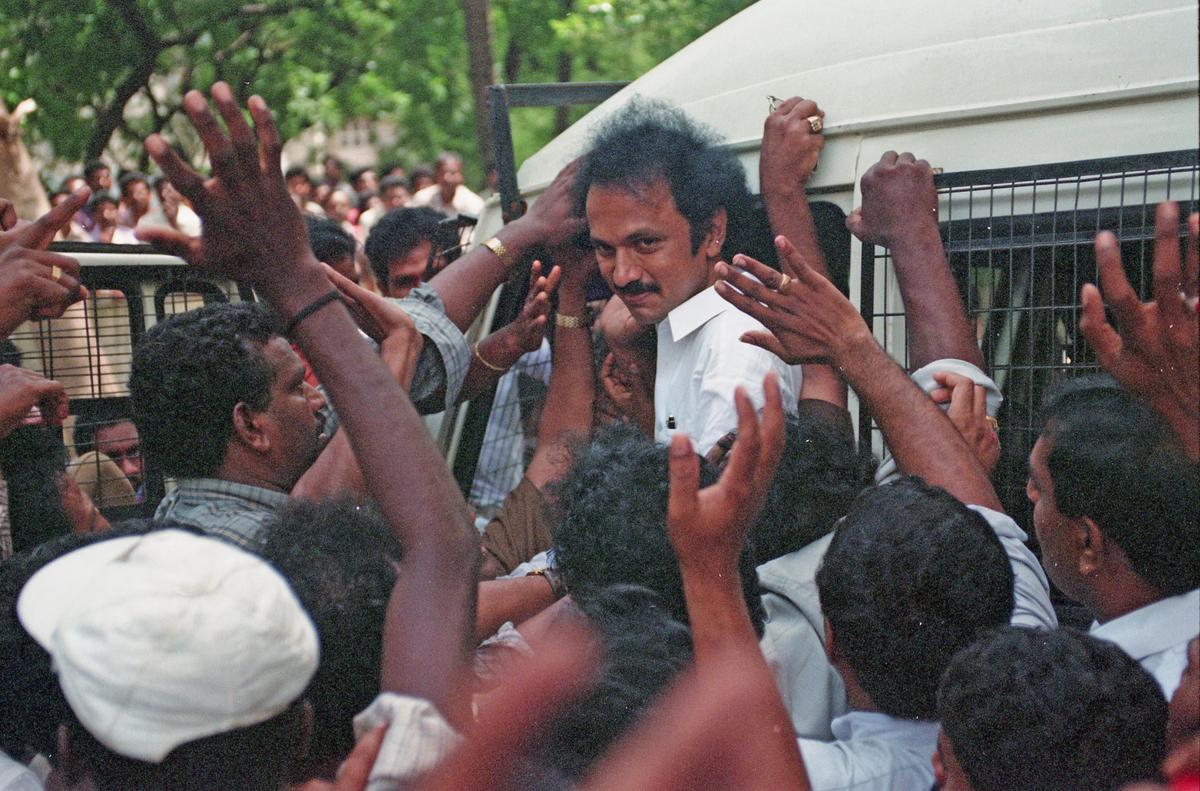
Mr. Stalin being taken in a police van in Chennai on June 30, 2001
| Photo Credit:
Vino John
Outrage over arrests
On July 1, 2001, The Hindu, in its editorial on the front page, stated as follows: “The arrest of the former Tamil Nadu Chief Minister and DMK president, Mr. M. Karunanidhi, effected in a post-midnight operation that brought back memories of the dark days of the Emergency, smacks of political vendetta and deserves to be condemned in the strongest of terms, whatever may have been the justification for the action itself.”
Expectedly, the arrest led to a huge political row. Even Jayalalithaa’s allies such as the Tamil Maanila Congress (Moopanar), Pattali Makkal Katchi, Congress, and the Left parties deplored the manner of the arrest.
A team of leaders of the Bharatiya Janata Party-led National Democratic Alliance (NDA), led by George Fernandes, visited Chennai and, within 24 hours, submitted to the then Prime Minister Atal Bihari Vajpayee its report on July 2 and showing photo clippings of the former Chief Minister in jail.
In the meantime, Governor M. Fathima Beevi came under fire from the Opposition, which had demanded her recall as a measure of “rectifying the Constitutional breakdown”. The BJP-led government at the Centre received the Governor’s report at about 9 a.m. on July 1. But the Union Cabinet found it “unsatisfactory” as the Governor had failed “to give an objective and independent assessment” of the situation associated with and arising from the arrest, and decided to recommend to the President her recall. Before it could formally convey its decision, Beevi decided to quit her post. In Karnataka, the State unit of the BJP had staged a demonstration in Bengaluru, demanding the imposition of the President’s rule in Tamil Nadu. Bus services from Karnataka to Tamil Nadu were suspended for a few days then.
Release on ‘humanitarian grounds’
On the evening of July 4, the AIADMK government chose to free Karunanidhi in the wake of Chief Minister Jayalalithaa’s order to release him on “purely humanitarian grounds”. An official release said, “taking into consideration the advanced age” of the DMK leader, the release had been ordered. “However, the case against him will continue,” the release added. Karunanidhi saw the development as a victory for “Tamil brethren all over the world”.
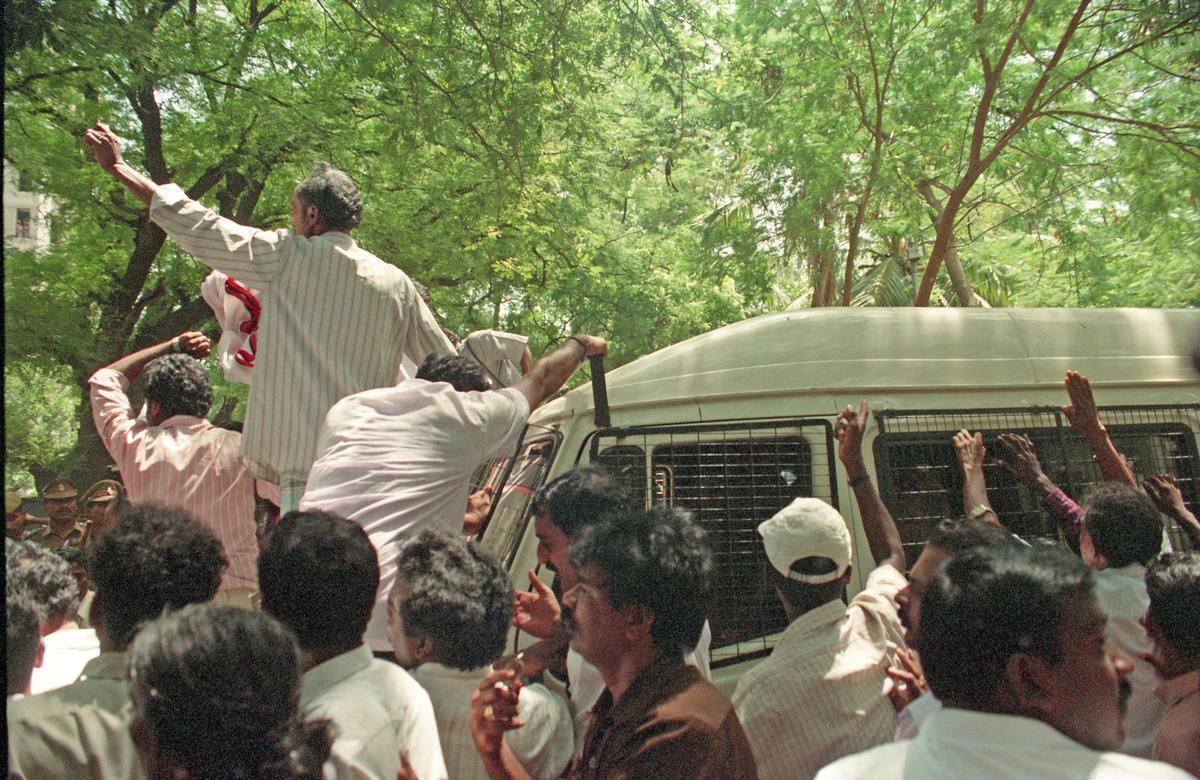
DMK cadre surround the police van carrying Mr. Stalin in Chennai on June 30, 2001
| Photo Credit:
Vino John
On the same day, Ms. Durga visited her husband at the Madurai prison and spent nearly an hour with him in the entry room after obtaining permission from the authorities. Fruits, biscuits, and mineral water were brought for Mr. Stalin. When told by journalists that her father-in-law was being released on “humanitarian grounds”, she shot back: “Where did all humanism go when the police barged into the house in the dead of night and dragged him out of bed? Where did all such humanitarian gestures go when the police misbehaved with the womenfolk in the house?”
On July 7, Mr. Stalin was released on conditional bail this morning, and as happened in the case of his father, he was also given a tumultuous welcome by hundreds of DMK volunteers. It was a matter of time that others too were released. Recalling the events years later, Mr. Stalin told a Tamil television channel that as long as the AIADMK was in power till 2006, not even a chargesheet was filed in the case, which, according to him, was “hollow”.