




The 2025 Bihar Assembly elections delivered a result many had expected, but the intensity of the victory surprised several observers. Caste alignments and alliance partners continued to matter, yet welfare delivery emerged as a central, though not exclusive, factor shaping the verdict.
The National Democratic Alliance’s (NDA) governance record and leadership, combined with the well-timed and highly visible rollout of welfare schemes, blurred the line between routine governance and election-focused initiatives. Evidence from a post-poll survey conducted by PollsMap reinforces this: welfare schemes in Bihar reached people on an impressive scale, and voters knew whom to credit, shaping their political perceptions and choices.

Welfare penetration
Welfare penetration during the Janata Dal (United)-led government was extensive. Going by survey responses, more than four-fifths of households benefited from the Har Ghar Bijli Yojana, and nearly seven in ten received support from the Har Ghar Nal Ka Jal Yojana.
Women-focused initiatives also reached a large number of households. Roughly one-third of households benefited from the Balika Poshak Yojana, which provides school uniforms for girls, and about one-fifth availed the Swayam Sahayata Bhatta Yojana, offering a monthly allowance of ₹1,000 for unemployed youth seeking work.
A key political turning point in this election was the Mukhyamantri Mahila Rojgar Yojana, launched shortly before the election, which provided a direct cash transfer of ₹10,000 to women. Nearly three in five respondents reported that they or someone in their household had benefited from this scheme, highlighting its rapid and widespread reach.
Beyond the immediate financial support, the scheme also reminded voters of Nitish Kumar’s long record of working for women through education support, bicycles, and other programmes. This mix of new and past benefits strengthened support, especially among women, for the ruling alliance.
Survey findings also indicated that the reach of these schemes was broad. Beneficiaries were spread across marginalised communities, rural households, and low-income groups, showing that the distribution was widespread.
Credit attribution
Crucially, what strengthened the ruling NDA alliance even further was the clarity of credit attribution. Around seven in ten beneficiaries attributed the schemes to the State government, while about a quarter assigned credit to the Union government. Importantly, credit given to the Centre did not result in any political loss, since the JD(U) was part of the NDA at both the State and central levels. This clarity of credit sharply enhanced the ruling coalition’s political advantage from welfare delivery.

The data reveal an association between benefiting from schemes and voting behaviour. Beneficiaries of all the schemes showed higher support for the NDA compared to non-beneficiaries. The effect was especially pronounced in schemes with the highest reach.
For the Mahila Rojgar Yojana (57% beneficiaries), 54% of beneficiaries voted for the NDA, compared with 35% of non-beneficiaries — an exceptionally large 19-percentage point advantage. For Har Ghar Bijli (83% beneficiaries), 49% of beneficiaries supported the NDA versus 34% of non-beneficiaries — a 15-point advantage.
For Har Ghar Nal Ka Jal (69% beneficiaries), 51% of beneficiaries backed the NDA compared with 37% of non-beneficiaries — a 14-point advantage.
Future promises
Beyond existing welfare schemes, voters’ choices were also shaped by promises of future benefits, which likely functioned as prospective welfare initiatives. Survey data show that Tejashwi Yadav’s promise of one government job per household influenced a substantial portion of respondents, with one-third (36%) reporting it affected their vote ‘a lot’ and another 23% saying ‘somewhat’.
Mr. Tejashwi’s job promise resonated across caste groups. While majorities of Mahagatbandhan’s (MGB) core supporters — Yadavs (52%) and Muslims (60%) — said it influenced their vote ‘a lot’, significant shares of other communities were also affected: over a quarter of Kurmi-Koeri and other OBC voters, and three in ten Dalits, reported strong influence of this promise on their vote choice.
Although a smaller share, 13% of upper-caste voters also said the promise influenced their voting decision ‘a lot’.
Among those highly influenced by this promise, nearly two-thirds (62%) voted for the MGB, while about one-fourth backed the NDA. As the influence of the promise weakened, the MGB’s support declined and NDA support rose, peaking among those who said the promise did not influence at all.
Caste-wise, 86% of Yadavs and 75% of Muslims, for whom the promise had a strong impact, voted for the MGB. Among non-M-Y communities, 22% of Kurmis and Koeris, and nearly half of Dalits who strongly felt about the promise, also supported the alliance. This shows that the promise not only reinforced the core support but also attracted some support from beyond it.
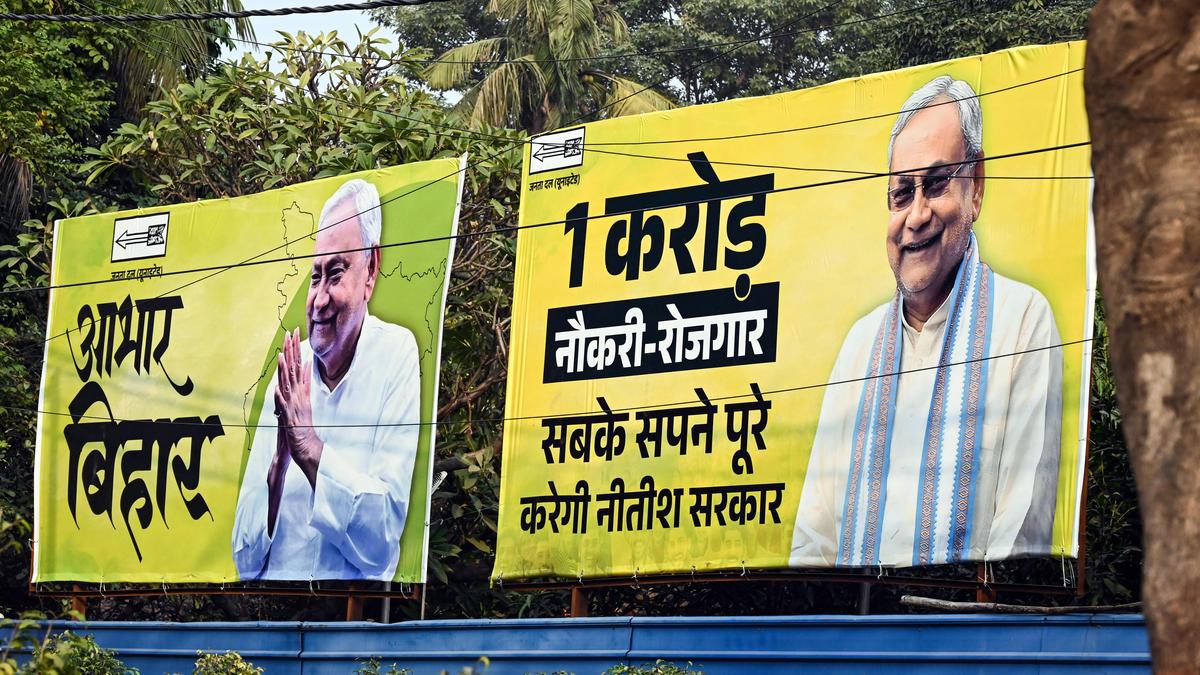
Similarly, the JD(U)’s commitment to create one crore government jobs for youth resonated strongly, influencing six of every ten respondents (28% ‘a lot’ and 32% ‘somewhat’). These findings indicate that even as voters evaluated existing schemes, aspirational promises played a complementary role, reinforcing the ruling alliance’s broader appeal.

Among voters who said JD(U)’s employment promise mattered ‘a lot’, a little over three-fifths voted for the NDA, while about one-fifth supported the MGB. The NDA support declined modestly as the influence decreased, though not nearly as steeply as the drop in MGB support across the categories of Mr. Tejashwi’s promise. This suggests that while Mr. Tejashwi’s promise mobilised MGB-leaning voters, the JD(U)’s promise helped consolidate the NDA’s base.
The welfare paradox
Just over half (53%) felt that government schemes were merely election-time freebies that did little to change people’s lives, while nearly four in ten (37%) viewed them as a right of a citizen. And yet, they admit having benefited from the schemes. Views on pre-election cash transfers were even more critical: over 70% believed that giving money just before voting is wrong, while only about one-fifth saw nothing wrong with it.
Yet, when we examine actual voting patterns, the impact of these schemes becomes apparent. Among those who saw welfare as election-time freebies, a majority still voted for the parties delivering them: 34% backed the MGB and 54% supported the NDA. Those who considered welfare a citizen’s right were slightly more evenly split, with 39% voting for the MGB and 41% for the NDA.
This suggests that even voters with a critical or realistic understanding of the political purpose behind welfare measures were often persuaded to support the parties implementing them. This contradiction is also visible in the case of the ₹10,000 Mahila Rojgar Yojana. Sixty-nine percent of its beneficiaries believed that pre-election transfers were wrong, suggesting that while they benefited, they were aware of the political intent behind their timing.
Non-beneficiaries expressed similar views, indicating that concerns about electoral manipulation extended across groups regardless of personal gain.
Proper implementation of a few key schemes added an important layer to the dynamics of the 2025 Bihar election. While it was not the only factor behind the NDA’s victory, effective welfare delivery strengthened the ruling side’s position.
Even where voters questioned the timing or intent of new announcements, they still recognised benefits that reached them. This wide reach and clear credit attribution helped reinforce existing political support, contributing to the NDA’s victory.
Vibha Attri is a researcher at Lokniti. Views expressed are personal