




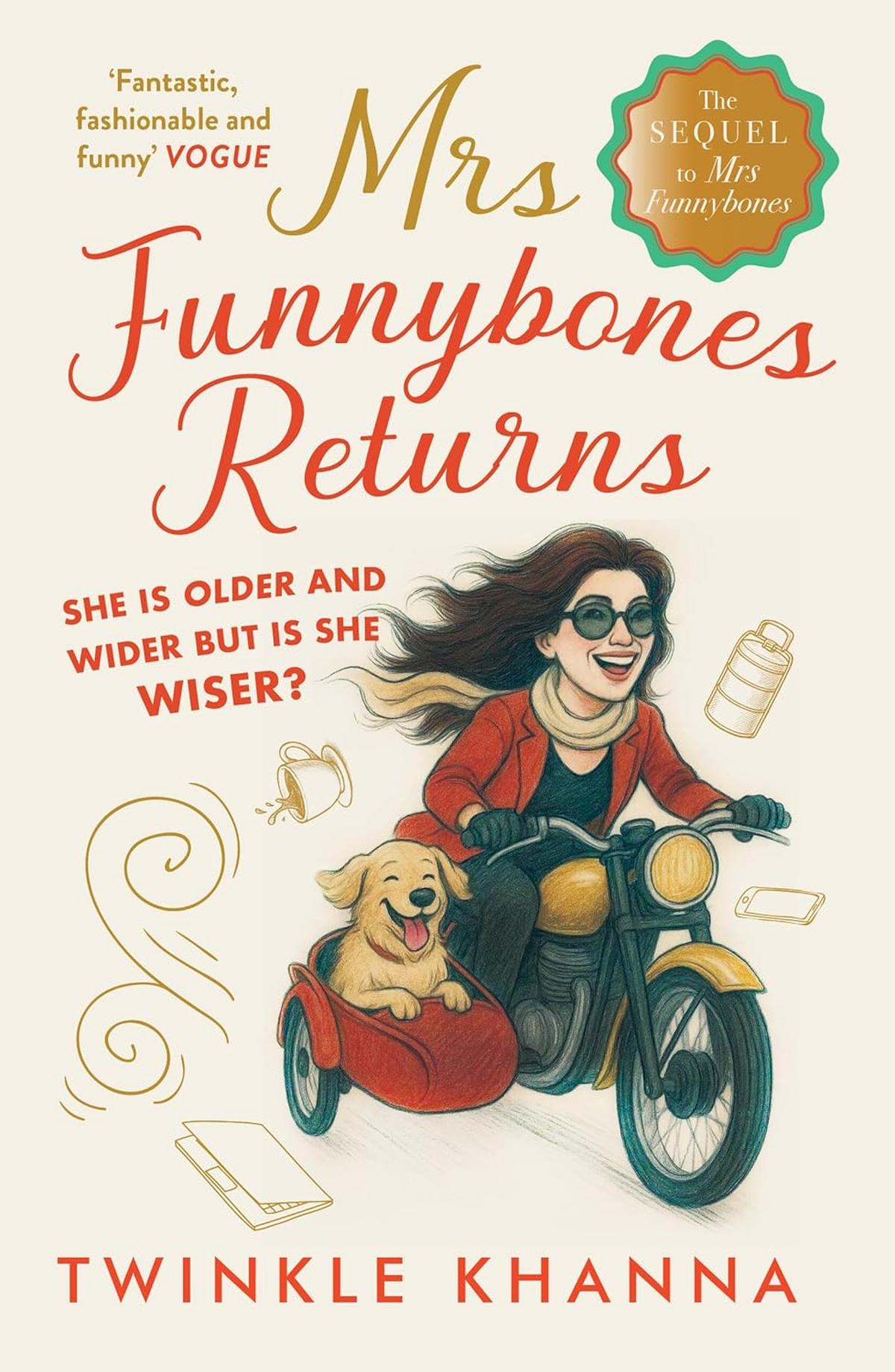
In her new heartwarming and hilarious new collection, Mrs Funnybones Returns, author Twinkle Khanna delves into issues both personal and political in a voice completely unique to her. Khanna is a gifted observer and chronicler of elite urbane family life in India. This time, through her columns and stories, politics and polarization bubble up in everyday dinner table conversations at home. Side-stepping the self-serious scholarly tone often used to writing on social change and gender issues, through her signature wit and candour, Khanna navigates the unfair and relentlessly rigid nature of womanhood in India. In our conversation, she reflects on a decade of change in India, her writing process, and the power of laughter at a time of division.
When you take a step back and look at the collection, is there a thread that ties all the stories together?
When I started thinking about this collection, I wanted to show how India has changed over the past decade—and layer that with how I’ve changed too. My family offered a point for reflection and analysis: I lost loved ones; my daughter grew up; my son became a young adult. Managing the writing of time across all these columns was a technical challenge. I wanted to bridge the past decade—politics, elections, technology—within these pieces. I approached the collection the way I would make my daughter have an antibiotic—I will start with saying it is sweet, and I will make sure the first dose is a sweet syrup. Some columns were chosen to make you laugh and draw you in, others to make you reflect. The book starts lighthearted, but as you go along, it deepens into themes of loss, grief, and mortality. And hopefully, it ends with optimism.
Can you tell us a bit about how the collection accumulated? How long did it take to put this together?
I resisted doing a sequel for a long time. My editor, Chiki Sarkar, keeps saying that the Funnybones voice comes easily to me, and I take it for granted compared to my fiction. Perhaps, I resisted the sequel because of this. But over time, I realized these columns—and the first Mrs Funnybones—meant a lot to people. When I was touring to launch Welcome to Paradise, I met a young woman who called the last Funnybones book her bowl of kheer as it offered comfort. Another reader even took the book to Afghanistan while covering the war. That’s when I understood these columns were more than entertainment for myself or others—it was connection. That’s when I decided to work on a collection.
Mrs Funnybones returns at a complex time in India—new technologies, new socio-political cleavages, or perhaps new ways to manifest old grievances. I noticed how the stories capture the way these larger changes creep into our families. The book feels more political than your past work; you write about rituals and godmen. In a time of deepening divides, can laughter survive and bridge gaps?
If laughter doesn’t bring us together, what hope is there? Humour is a unifying thread. We lost somebody recently and I went to pay condolence. I noticed how there is always someone whose job is to make family members laugh. And the family needs it; they require that release. If laughter can join you in your lowest moments, why not when you see the world differently? You can’t convert someone, but you can connect with them. I don’t believe differing views make anyone inferior. I always wonder: what can I learn from this person? For me, laughter is that bridge. Can somebody else use laughter as a bridge? Yes, you can but your jokes have to be pretty good.
I am writing a book on ‘Indian Uncles’ and found the character of Uncle Biren hilarious and insightful. I am excited to see how other readers react to him. Where did he come from?
Uncle Biren is an amalgamation—a bunch of uncles from my family and acquaintances. I have Punjabis and Gujaratis at home, which makes all family gatherings very lively. The Gujaratis are ruling the roost these days, full of pride. My mother-in-law’s side is Kashmiri, I have family from the Hindu and the Ismaili world –these experiences reach my columns.
Your first Mrs. Funnybones (2015) was released before you studied at Goldsmiths. How did that academic experience shape your columns and this collection?
When I was going to university, my editors Neelam Raj and Chiki worried about how the training would impact my columns. They worried that I would write in a pedantic manner. I did online courses at Oxford before Goldsmiths, and while the training changed how I approach fiction, my process for the columns has remained the same. I have a skeleton for how I write the columns. First, I pull together ideas, research, notes. Then, I go walking around the garden, play with my dogs, and the connections emerge. Earlier, I used to sit at my desk and wait for the connections to be made. But I am too old now and my neck hurts if I keep sitting at my desk. So, I potter about, and the connections clarify. But nothing about my training changed the writing of the columns. Maybe, because I had been doing it for so long and it was such a set process, it did not need alteration.
What’s next—I heard you were writing speculative fiction?
I’m 30,000 words into my next novel. It is my world right now. That’s all I can say!
I found the stories on motherhood and your own father very moving. Between the time your columns started and the release of this book, how have gender roles within families evolved in contemporary India?
Honestly, not much has changed. I was 39 when the columns started; now I’m 52. Through this time, the fabric of our society and family life have remained the same. Although, our aspirations have shifted; women have more of a voice. But deep-rooted conditioning persists. Women take on the work of care because of how we view our own roles, no one is forcing us. The new generation is far freer of this baggage. Change will come through how we raise our children, and how we demonstrate small changes within ourselves.
How do you write so candidly about ageing? There is no awkward self-consciousness in those pieces.
I’ve always felt sixty in my head! Ageing never terrified me—it felt liberating. Even in my thirties, I planned for grey hair, short nails, and riding a scooter in Goa. I viewed agening as a phase that would free me from many responsibilities. I also realized that by writing about my own ageing, I can take control of my own narrative, instead of letting society or someone else decide what ageing means for how I look or how desirable I am. My body is desirable to me, even if it is failing apart. Writing helps me work through these dilemmas, loneliness, fear. That’s when I realized I’m truly a writer and nothing else: when I could write my way through a problem.
Published – November 28, 2025 01:17 pm IST