


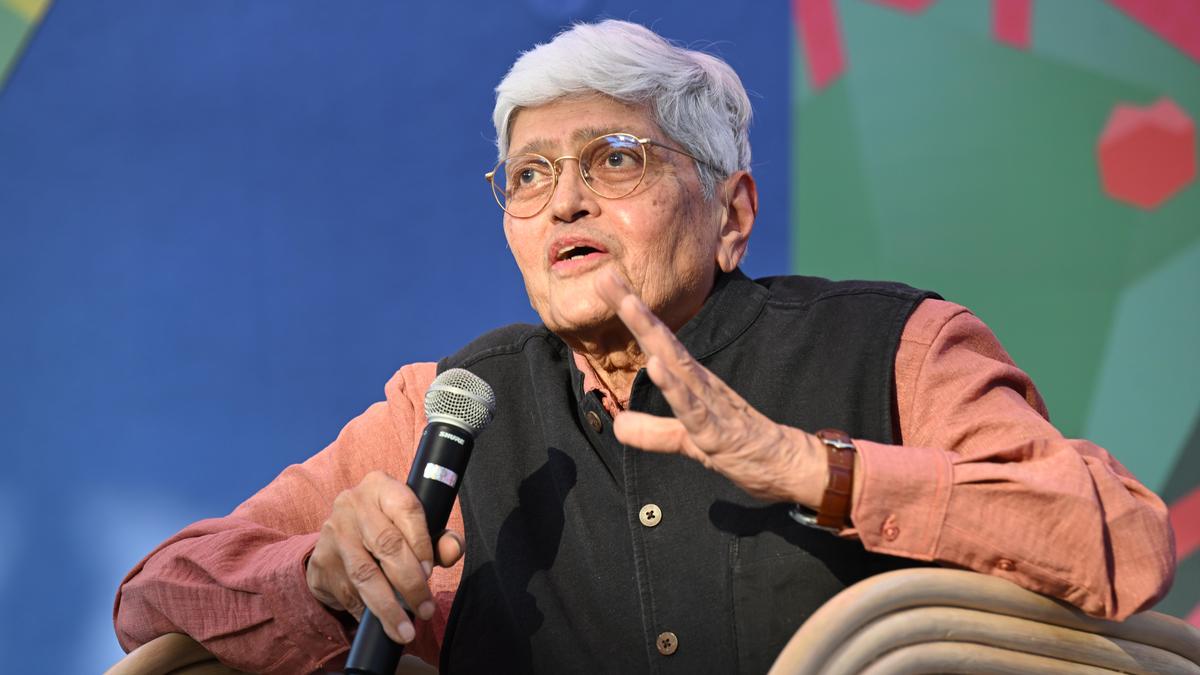

Former Governor of West Bengal and author of The Undying Light: A Personal History of Independent India Gopalkrishna Gandhi speaking at the 14th edition of the Bengaluru Literature Festival at Freedom Park in Bengaluru on December 7, 2025.
| Photo Credit: ALLEN EGENUSE J.
Writer and former diplomat Gopalkrishna Gandhi recalled that he had Jawaharlal Nehru in mind when he began writing The Undying Light, noting that Nehru’s words, “The light has gone out of our lives… yet the light will never go out,” form the core of the work.
Although the book features many familiar names, “the three Ji’s” as he called them (Gandhiji, Nehruji, and Rajaji), Mr. Gandhi emphasised that The Undying Light also honours many unsung contributors to India’s democratic and social fabric.
Speaking at the Bengaluru Literature Festival, Mr. Gandhi highlighted Rajagopalachari’s early warnings about elections being overtaken by money power and other observations that have since been proven true.
“Elections, the life-breath of democracy, have run headlong into corruption,” he remarked.
The session also revisited the political and moral courage of Jayaprakash Narayan. Mr. Gandhi noted that J.P. Narayan was unlike almost any other leader of the freedom struggle, a rare figure who gave his faith to Mahatma Gandhi but ‘did not give his intellect’ and who fearlessly spoke truth to power.
Speaking about the President’s role and the authority it holds, Mr. Gandhi recalled two prominent individuals who occupied the office: Dr. Rajendra Prasad and K.R. Narayanan. He cited Mr. Narayanan’s remark in an interview: “The President has no authority, only influence, and that influence must align with public opinion when public opinion is right.”
Reflecting on India’s collective memory of its presidents, Mr. Gandhi observed that if one were to ask any random gathering to name a President of India, “without exception, they would name A.P.J. Abdul Kalam.”
There was something remarkable about him, he said. Mr. Gandhi added that he did not fully know why Kalam evoked such universal affection before suggesting that it perhaps lay in his gentle contradictions: “that a man with a name like Abdul Kalam could play the veena, and that he could be a vegetarian being a Kalam.”
Mr. Gandhi also spoke about why he himself never contested elections. Answering why he declined a 2014 request from the Aam Aadmi Party (AAP) to run against Narendra Modi, he described AAP as “a painful disappointment”.
Reflecting on his diplomatic years in South Africa, Mr. Gandhi said his time there taught him how deeply India matters to the world. His most humbling moment, he recalled, was when Nelson Mandela gently reminded him of a freedom fighter Mr. Gandhi had omitted in a speech he delivered there.
As the session drew to a close, Mr. Gandhi remarked, “What India needs is a government that is open to criticism and critics who are open to self-criticism.”
Published – December 07, 2025 11:33 pm IST