




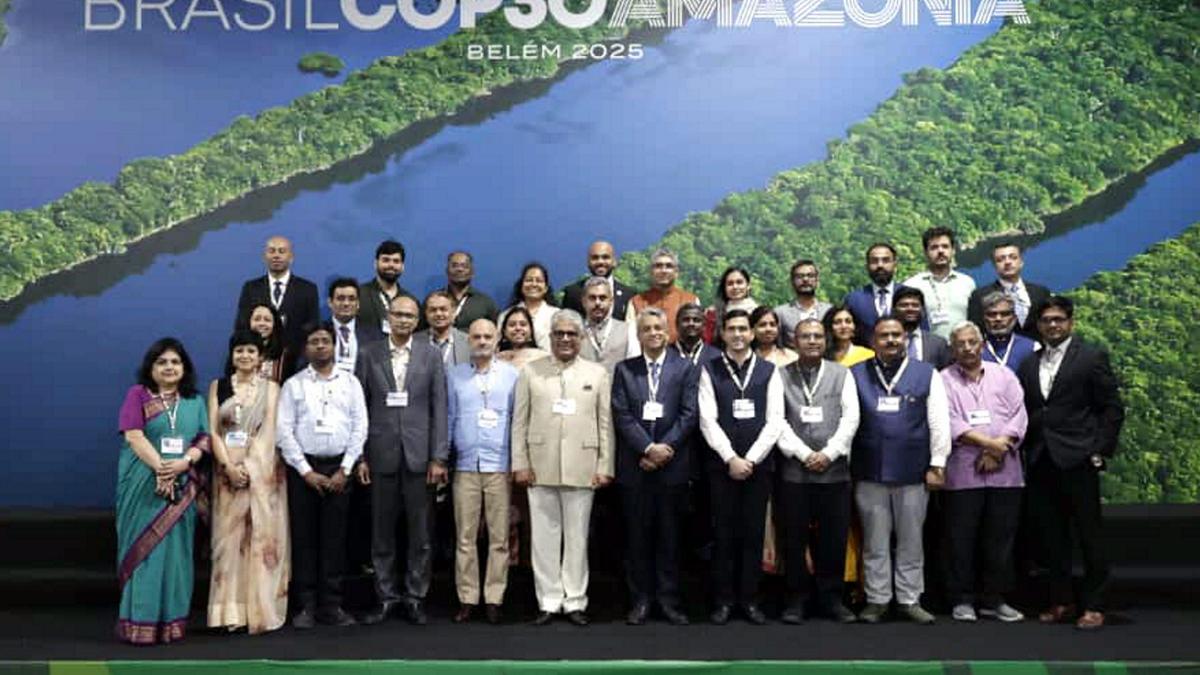

Indian delegation, led by Environment Minister Bhupender Yadav, at the COP30 Climate Summit in Amazonian city of Belem, in Brazil.
| Photo Credit: PTI
India, in tandem with a group of developing countries, has asked for the establishment of a ‘just transition mechanism’, a day before talks at the ongoing climate summit are expected to conclude. It has stressed that finance for adapting to climate change was not an “optional add-on” but an “essential investment” and that, currently, it was inadequately funded for the latter.
Established at COP27 (in 2022) and operationalised at COP28 (in 2023), the so-called Just Transition Work Programme is intended as a dedicated forum to create jobs for those who currently work in fossil fuel-dependent industries towards livelihoods in renewable energy sectors.
Also Read | India seeks energy security of island nations, pitches for solar power
“Just transition necessarily includes strengthening resilience and adaptive capacity, creating employment, protecting livelihoods, eradicating poverty, ensuring food security, and providing social protection. Countries must be able to design and implement their own sustainable development pathways consistent with their national priorities and circumstances,” Environment Minister, Bhupender Yadav, said in a statement, on Thursday (November 20, 2025).
He said that a future ‘Global Goal on Adaptation’, envisaged as a system of metrics to define countries’ ability buffer against the havoc already wreaked by climate change, should be “country-driven and nationally determined and that countries ought to be given the flexibility to define and measure progress using national systems, capacities, and data realities.”
These statements come even as uncertainty remains on whether the COP Presidency, led by Brazil senior diplomat Andrei Lago, will succeed in getting countries to agree on a broad political statement – called a cover text – that will headline the main consensus points that countries have been debating in Belem.

Divisions continue to remain, primarily on whether developing countries would agree to language supporting a pathway or a roadmap signalling the end of the use of fossil fuel. On the other hand, developed countries resist language that says they are mandated to provide low-cost finance to developing countries to help them achieve these ends.
“Many Parties (countries) have highlighted their differing starting points and varied development needs. This reinforces the need for nationally determined, demand-driven transition pathways, rather than any uniform or prescriptive approach… global equity must remain central. Developing countries require sufficient policy space to bridge development gaps, address systemic vulnerabilities, and ensure the well-being of their people according to their stage of development and national conditions,” he added.
Published – November 21, 2025 12:38 am IST