



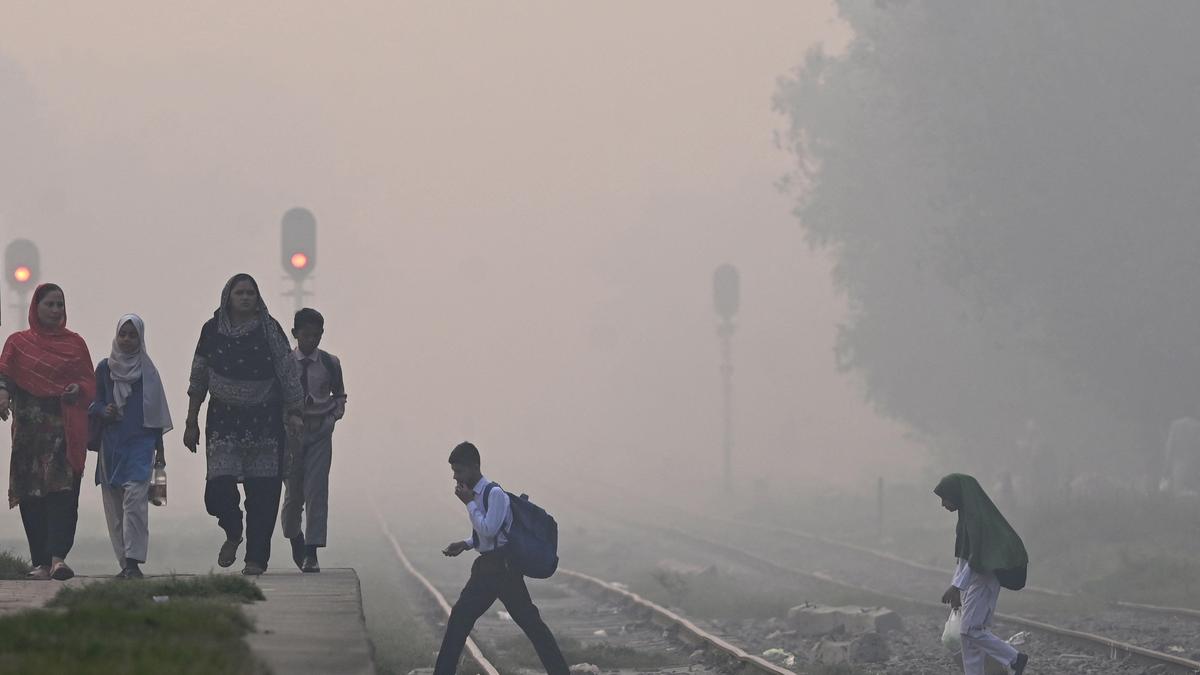

School children walk across a railway track amid dense smog in Lahore on October 29.
| Photo Credit: AFP
The story so far: Delhi is in the spotlight once again for its consistently deteriorating AQI levels. And like every year there has only been a knee-jerk reaction to the problem, rather than a sustainable solution. The Commission for Air Quality Management has gradually switched from stage 1 and 2 to stage 3 of the Graded Response Action Plan, and advisories have been issued for citizens who battle serious health risks. However, there is a dire need to understand the collusion of natural and man-made reasons for air pollution, for Delhi’s air pollution crisis goes beyond India’s sovereign borders.
What is happening in South Asia?
In November 2024, eastern and northern Pakistan and north India faced a severe pollution event that came to be known as the ‘2024 India-Pakistan Smog’. Lahore and Delhi virtually competed on the scale of the most polluted city with the highest AQI reading globally. ‘Brown clouds’ formed in swathes over the cities distinctly visible in satellite images. While Lahore was faced with the worst AQI, Delhi’s air gradually deteriorated due to a shift in wind patterns that carried pollutants across borders and within the region.
Now in 2025, Delhi is once again followed by Lahore. The Dawn from Karachi reported that local pollution and smoke drifted in from India due to low-speed winds.
Bangladesh also has a significant share in the air pollution crisis. Dhaka is witnessing worsening AQI in the range from moderate to very poor during the winter season, as reported by the U.S. thinktank Atlantic Council. Likewise in the capital of Nepal, AQI remains alarmingly high every year, between moderate and unhealthy.
What are the reasons?
The Greenpeace 2023 World Air Quality Report underlined that poor air quality in South Asia is due to anthropogenic sources such as industrial and vehicular emissions, and burning of solid fuel and wastages. The shared air pollution across the Indo-Gangetic Plain and beyond, with tier-1 cities facing the consequences, can be accounted by for factors such as the fixed topography of the region. Although separated by cartography, the regional topography of South Asia causes fixed ventilation of natural air and dispersal of pollutants. A trans-national and regional haze surfaces due to the complex composition of air particulates. Alongside the natural geography, there is a transnational and regional commonality — the failure in managing such crises due to abysmal political will.
The World Bank report on ‘Air Pollution and Public Health in South Asia’ in 2023 informed that nine out of the world’s 10 cities with the worst air pollution are in South Asia. Sri Lanka, Maldives and Bhutan are known to be relatively less affected by transregional air pollution in the region of South Asia. This interplay of factors shows that mitigation requires attention to not only short-term solutions but also long-term strategies that focus on strong decarbonisation measures and structural reforms in agricultural practices and industry emissions across national borders.
Is this a crisis of development?
Air pollution is related to larger issues of development and its adverse consequences for the environment. A World Bank study estimates that high AQI levels in India results in about 3% of its GDP being spent on healthcare and lost labour capital. The Lancet Health Journal highlighted that in 2019 India’s GDP reduced by 1.36% due to premature morbidity and mortality as a result of air pollution. A steep rise in the sale of automobile vehicles, lack of public transport, negligible support for non-vehicular mobility, and building concrete structures at the expense of urban greenery are some of the reasons which lead to deteriorating air quality. A 2023 UNEP report shows how current patterns of consumption and production are driving climate change, which in turn drives the air pollution crisis. Thus, the World Health Organization (WHO) accurately recognises that air quality significantly affects life expectancy, public health, economic productivity, and environmental justice. These sordid AQI figures are the result of poorly thought- out development. The consequences are visible not only in north India. Experts warn of worsening air in Mumbai and other cities on the southeast coast.
What next?
A more nuanced model of governance with strong political will to curb the sources of the crisis; a caring human development model addressing the needs of the working class and farmers; and a more regionally informed model are some of the imperatives needed to find sustainable solutions. A recent study by IIT Bhubaneshwar highlighted the importance of a broader regional airshed scale management strategy to tackle air pollution, rather than merely addressing the issue in piecemeal.
Only with stronger policies that involve varied stakeholders from across borders and states, can one evolve a meteorological mindset to uproot the sources of air pollution.
Dev Nath Pathak is associate dean, faculty of social sciences at South Asian University. Vibha Bharadwaj is a research scholar at Christ University, Bangalore.
Published – November 21, 2025 08:30 am IST