



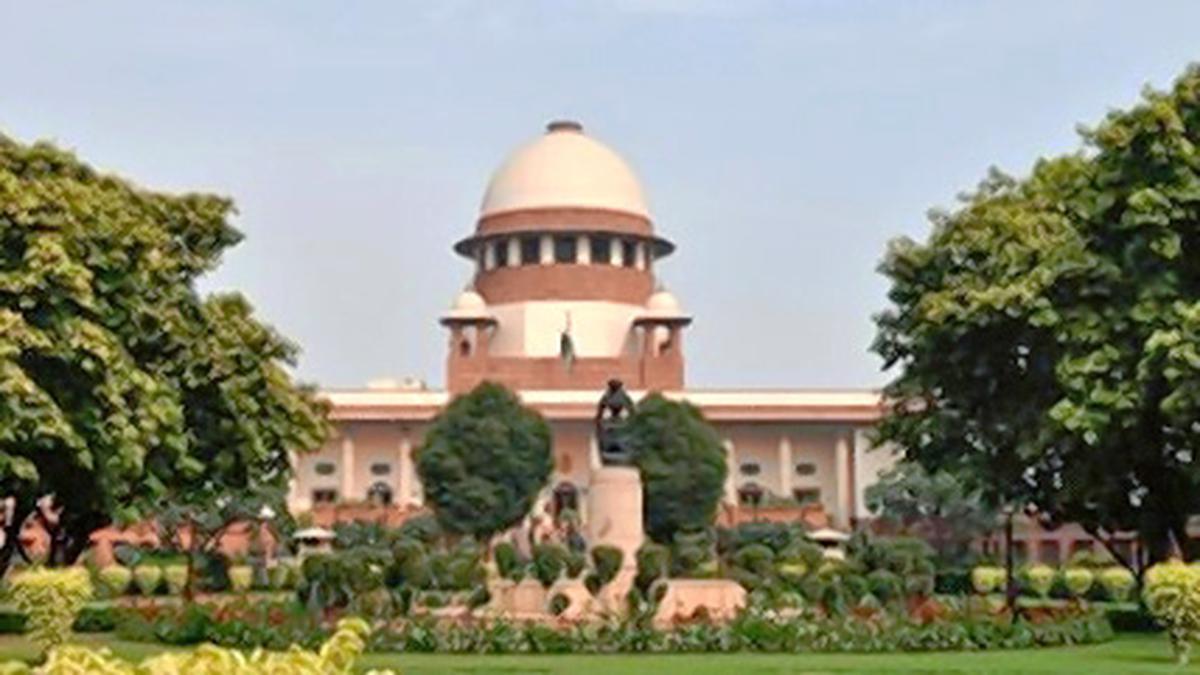

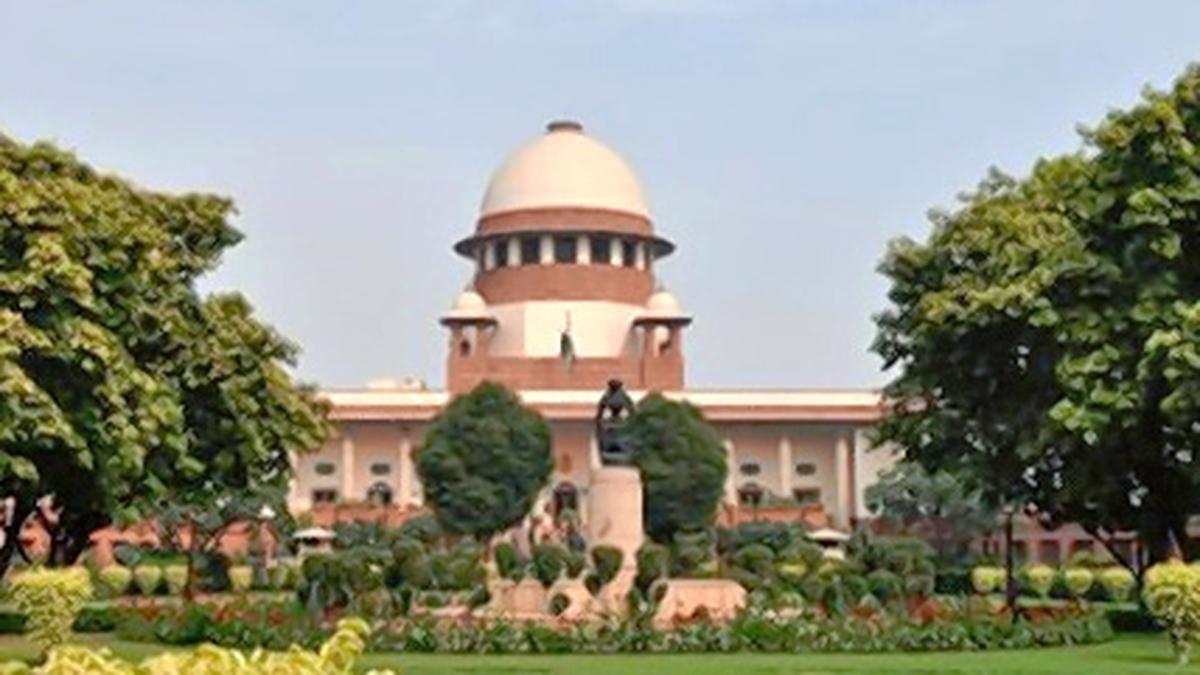
A view of the Supreme Court of India in New Delhi. File
| Photo Credit: Sushil Kumar Verma
The Centre’s lack of response to a judicial direction to install CCTV cameras in the offices of agencies like CBI, ED and NIA to prevent custodial torture prompted the Supreme Court on Tuesday (November 25, 2025) to ask if the Union government is taking the apex court “very lightly”.
It has been five years since a Supreme Court judgment made it mandatory for the police and central probe agencies to fix and maintain CCTV cameras in police stations and offices of central law enforcement agencies with powers of “interrogation”.
The court was shocked to discover that custodial cruelty has far from faded with reports about 11 custodial deaths in eight months in Rajasthan.
A Bench of Justices Vikram Nath and Sandeep Mehta chose to suo motu re-examine the level of compliance shown by States, Union Territories and the Centre to the 2020 judgment of the apex court.
However, the Bench, on Tuesday (November 25, 2025), found that the response to its concern from the States and UnioN Territories was at best lukewarm, with only 11 of them condescending to even file compliance reports. The Centre did not file one.
“The Union of India is taking the court very lightly. Why?” Justice Nath asked.
Solicitor General Tushar Mehta, for the Centre, vehemently denied, saying “not at all… The Union is not taking the court lightly, ‘very’ or any other way. We will file an affidavit”.
Justice Mehta corrected him, saying “not an affidavit, but compliance”. Justice Mehta referred to the custodial death statistics from Rajasthan, “nobody will tolerate that now”.
Mr. Mehta agreed, but submitted that CCTVs outside police stations could also prove counter-productive. He seemed to be presenting the security point of view.
Justice Mehta said police stations were live-streamed in the United States. The Solicitor replied that there were also “private resort-type jails in America”.
“Mr. Mehta is being sarcastic,” Justice Nath noted.
The court pointed to more open correction centres or jails to shrink over-crowding and reduce the financial burden of running prisons.
The top law officer said he would consult the American system. Justice Mehta responded that the ideas already enumerated in India were quite sufficient. The Solicitor General was given further time to file a response. The court ordered that the directors of the three Central agencies and principal home secretaries of the remaining States and Union Territories would have to personally respond if compliance is not filed before the next hearing on December 19.
In 2020, a three-judge Bench headed by Justice Rohinton F. Nariman (now retired), in Paramvir Singh Saini versus Baljit Singh, had directed the Centre to compulsorily install CCTV cameras and recording equipment in police stations as a deterrent against custodial torture.
The court had ordered similar surveillance in the offices of central agencies such as the National Investigation Agency, Central Bureau of Investigation, Directorate of Enforcement, Narcotics Control Bureau, Department of Revenue Intelligence, Serious Fraud Investigation Office, and “any other agency which carries out interrogations and has the power of arrest”.
The CCTVs and recording equipment, the apex court had reasoned in 202, would be used as a safeguard to protect the fundamental right to dignity and life.
“As most of these agencies carry out interrogation in their office(s), CCTVs shall be compulsorily installed in all offices where such interrogation and holding of accused takes place in the same manner as it would in a police station,” Justice Nariman, who authored the judgment, had directed.
Published – November 25, 2025 12:55 pm IST