





It’s perhaps one of those convenient paradoxes; Yashasvi Jaiswal obliquely owes his international debut to Shubman Gill, yet it’s the latter who is, in a roundabout way, holding up the left-hander’s progress as an all-format powerhouse.
Ahead of the two-Test tour of the Caribbean in July 2023, Gill had almost exclusively opened the batting in each of his first 16 matches since his debut in Melbourne in December 2020 – the only time in 30 instances when he didn’t open was in the second innings of the Mumbai Test against New Zealand in December 2021, when he made a breezy 47 at No. 3.
With India opting to move on from Cheteshwar Pujara after the abortive World Test Championship final against Australia at the Oval in June, Gill put his hand up, requesting captain Rohit Sharma and head coach Rahul Dravid to hand him the No. 3 position occupied for so long with such distinction by the battler from Saurashtra. Once the management group acquiesced, they had to find an opening partner for the skipper.
That search ended with Jaiswal, a First Class veteran of four and a half years even though he was only 21. Having made the move from Rajasthan to Mumbai as a 12-year-old to chase his cricketing dreams, he forced the authorities to sit up and take notice with a series of monumental knocks. He was the Player of the Tournament at the Under-19 World Cup in South Africa in 2020 when India lost to Bangladesh in the final and in his first full First Class season in 2021-22, he hammered three successive hundreds during Mumbai’s march to the title round.
Jaiswal had promise, potential and domestic performances. How would he shape up at the international level?
Showcasing a facet of his batting hitherto a well-kept secret, Jaiswal ground out a memorable, eight-and-a-half-hour 171 in his first Test innings, in Roseau, when he put on 229 for the opening wicket with fellow-Mumbaikar Rohit. It took Gill a little while to find his feet at No. 3 – he has since dropped down to No. 4 in his new avatar as the captain – but Jaiswal has been unstoppable at the top of the order, seldom enjoying a barren stretch of note.
In a remarkable statistic, Jaiswal is the only player to have featured in each of India’s 28 Tests since his debut. He has amassed upwards of 2,500 runs at an excellent average of 49.23; five of his seven centuries have been 150-plus efforts and in February last year, he became only the third Indian after Vinod Kambli and Virat Kohli to score double-centuries in consecutive Tests. Apart from three gigantic knocks in India, his hundreds have come in Roseau, Perth, Leeds and the Oval. Jaiswal has shown that he is as much at home in unfamiliar conditions overseas as he is in India.
A ferocious stroke-maker who has beautifully fused the chutzpah of the brazen modern-day batter with the old-school grind that opening the batting in Tests sometimes demands, Jaiswal is hard to bowl to with any ball, anywhere in the world. Unlike several of his contemporaries to whom the turning ball is an unfathomable puzzle, Jaiswal handles spin with aplomb, using his feet and long levers to great effect.
But where he has become undroppable in Test cricket, Jaiswal is still to establish himself in the two limited-overs sides. And for no fault of his.
Which is where the Gill factor comes into play, again. In the 12 months during which he represented the country in Twenty20 Internationals, Jaiswal hardly put a foot wrong. Between 8 August 2023 and 30 July 2024, he hammered 82 fours and 38 sixes in 22 T20I hits, stacking up an average of 36.15 at the enviable strike-rate of 164.31. He went with the Indian side as the reserve opener, behind Rohit and Kohli, to the T20 World Cup in the Americas in June last year without getting a game, then played three matches each in Zimbabwe and Sri Lanka the following month. Since being dismissed for 10 against the Lankans in Pallekele in the last of the three matches in that series, Jaiswal has been watching on from the sidelines, desperate for a chance to add to his already impressive credentials.
What’s Gill got to do with it? Earlier this year, when he was recalled to the 20-over outfit after 13 and a half months, for the Asia Cup in the UAE, Gill was also named Suryakumar Yadav’s deputy, ostensibly to ready him to take over as the captain after the World Cup early next year. Gill’s inclusion meant the newly formidable opening pairing of Abhishek Sharma and Sanju Samson had to be split. Abhishek’s destructive left-handedness ensured he stayed on as Gill’s partner while Samson was pushed down the order to an unfamiliar position where he isn’t very comfortable. While Abhishek has gone from strength to strength and Gill hasn’t cracked a half-century in 12 innings since his comeback, Samson has played himself out of the XI, Jitesh Sharma’s pedigreed middle-order ball-bashing edging out the Kerala wicketkeeper-bat for the time being.
Had India’s decision-makers, primary among them head coach Gautam Gambhir and chief selector Ajit Agarkar, not worked out a succession plan with Gill as the fulcrum, it’s possible that Jaiswal would have gate-crashed the party, forming a fearsome left-handed tandem alongside the equally breathtaking Abhishek. But currently, there is no place for him in the top three – either Suryakumar or the outrageously gifted Tilak Varma has largely occupied the No. 3 position – which means he must bide his time before he can break back into the T20 XI.
Until the One-Day International series against South Africa last week, Jaiswal had played just one 50-over international, against England in February. He wouldn’t have got a look-in for this series either, had it not been for the neck injury Gill suffered in Kolkata which kept him out of the next Test in Guwahati as well as the three-match 50-over series to follow. Gill isn’t just the preferred first-choice opener, alongside Rohit, he is also the captain of the team. With Rohit and Kohli showing no signs of slowing down, the door by and large isn’t open for Jaiswal the 50-over batter to display his wares, unless there are exigent circumstances such as the one that kept Gill out of Ranchi, Raipur and Visakhapatnam.
Different players react differently to being benched, for whatever reason. Being left out becomes even harder to digest when the consensus is that that’s not on the back of form or fitness concerns. It’s easy to play the victim card and blame the whole world and its cousin for all the misfortune. At the end of the day, that’s self-defeating but it is the simpler, more tempting option to embrace.
The driven, however, use that as the spur, the motivation, the stepping stone to greater things. It’s not a straightforward process, not by a long way, but given the astonishing strength in depth of India’s white-ball resources, it’s imperative that one is switched on attitudinally to be able to grab the odd chance that comes their way.
Jaiswal appeared a little overkeen and desperate to leave an impression in the first two games in Ranchi and Raipur respectively, only managing 18 and 22. Learning from his mistakes and benefitting from the wisdom and tough love of Rohit, with whom he opened exclusively in his first 14 Tests, Jaiswal made a strong statement in the decider in the port city of Visakhapatnam, where he initially dropped anchor before cutting loose to thoroughly entertain a packed audience.
The denizens of one of the cleanest cities in the country had turned up in their thousands, sporting jersey Nos. 18 (vast majority) and 45 and making no secret of who they had come to watch. Neither virtuoso disappointed; Rohit was majestic as ever in dancing to 75 and Kohli was at his subliminal best. Batting with greater freedom and authority and imperiousness than for a long time – perhaps an offshoot of back-to-back hundreds – the former skipper cut a magnificent spectacle with the most magical unbeaten 65.
Jaiswal knew he wouldn’t be the main act, not when sandwiched between these two giants. But he wasn’t keen on being the showstopper. His designs were different, his intentions clear as crystal – to get runs under his belt, to keep himself relevant and in the reckoning, to ensure that while he might not yet be the automatic selection he would like to be, he continues to be the frontrunner as and when an opportunity presents itself.
In a series where 349 and 358 hadn’t been safe, South Africa’s 270 didn’t pose India the greatest threat, but a seaming, bouncing ball at the start of their chase most certainly did. Marco Jansen and Lungi Ngidi, then Ottneil Baartman before he was taken to the cleaners, got the ball to nip around and beat the left-hander on the outside edge more than once, but Jaiswal wasn’t going to succumb to temptation, he wasn’t going to allow his ego to get the better of him.
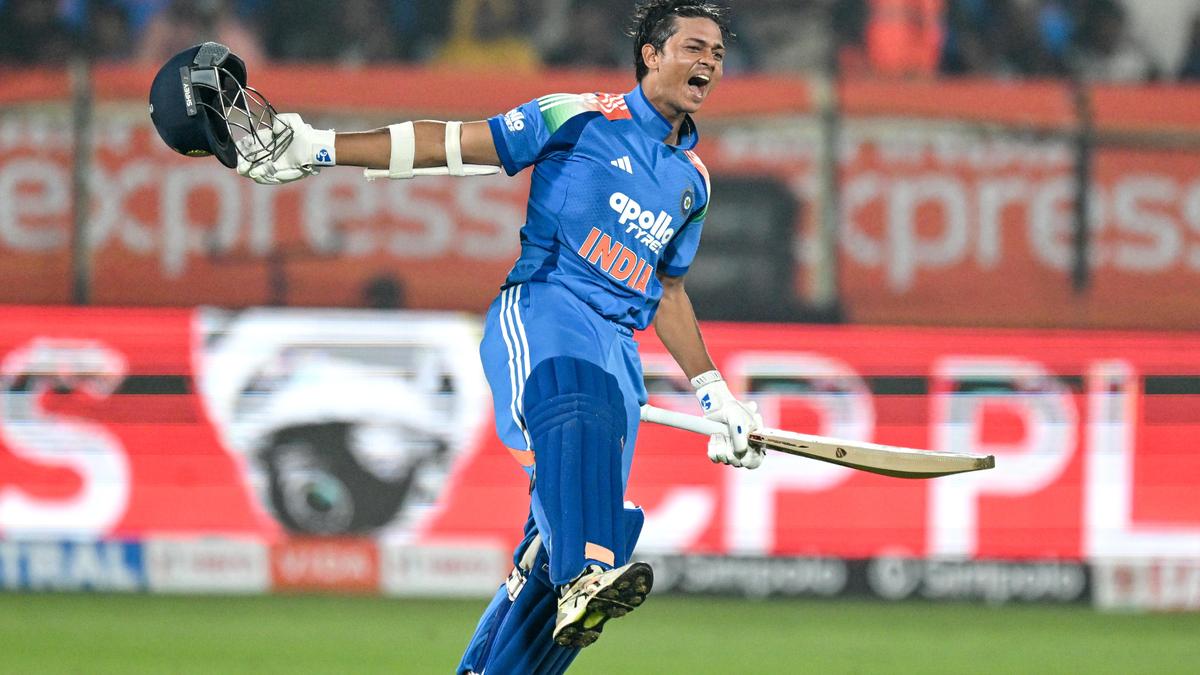
As Rohit scored at his customary brisk rate, Jaiswal knew he could afford to take his time. He put the odd play-and-miss routine behind him, refusing to take the bait until the ball stopped misbehaving, the hardness went out and he could trust the conditions. His maiden fifty came off 75 deliveries, and he needed just 36 more balls to convert it into a maiden century, joining an elite list of Indian batters with international tons in all three formats. A special achievement, considering he has only played 55 matches for the country.
In all probability, Jaiswal will again be left out when New Zealand travel to India next month for three ODIs but it’s a price he is willing to pay – not that he has a choice – because he knows his time will come, soon. He will use that interval to spruce up his game, work on his mind and improve his catching and game-involvement, hopefully. As for the thread tying him to Gill, that will only become stronger in the next few years.