




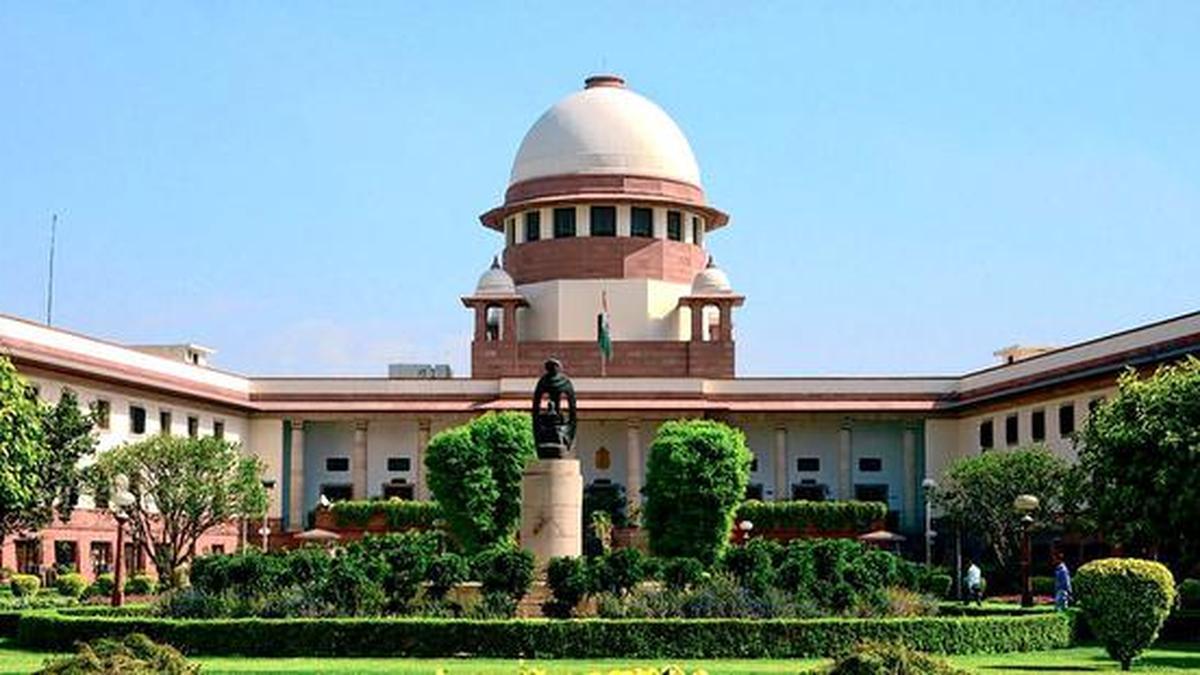

A five-judge Bench of the Supreme Court on Thursday (November 20, 2025) answered the 16th Presidential Reference the country has witnessed by opining that the judiciary cannot fetter Governors and the President to ‘one-size-fits-all’ time-tables to dispose of State Bills or usurp their functions by assuming ‘deemed consent’ of the proposed laws at the expiry of a court-ordered time frame.
Also read: Presidential Reference hearing updates
“Such a usurpation of the gubernatorial function of the Governor, and similarly of the President’s functions, is antithetical not only to the spirit of the Constitution, but also specifically, the doctrine of separation of powers – which is a part of the basic structure of the Constitution,” a Bench of Chief Justice of India B.R. Gavai, Chief Justice-designate Surya Kant, Justices Vikram Nath, P.S Narasimha and A.S. Chandurkar underscored.

However, the court clarified that the President and Governors cannot resort to “prolonged and evasive inaction” by sitting endlessly on State Bills awaiting their approval. This would amount to a deliberate attempt to thwart the people’s will expressed through the proposed welfare laws passed by State legislatures.
None of the five judges claimed authorship of the 111-page opinion, fashioning it as the ‘Opinion of the Court’.
The Reference under Article 143 of the Constitution came merely a month after a two-judge Bench of the Supreme Court, in a judgment in the Tamil Nadu Governor case on April 8, plugged a constitutional silence by fixing a three-month time limit for Governors and the President to dispose of State Bills pending with them.
Addressing a preliminary objection raised by Tamil Nadu and Kerala that the Presidential Reference was only an “appeal in disguise” against the binding April judgment of the court, the Bench said nothing stopped it from clarifying “general questions of law referred to it by the President”.
The Bench termed the set of 14 questions posed by the President on May 13 as a unique “functional reference” touching upon the day-to-day functioning of constitutional functionaries and the interplay among State legislatures, Governors, and the President.

“It is an institutional responsibility, to tender its opinion on this functional reference sought by the highest constitutional functionary of the country. The court cannot shirk away from its responsibility to iron out constitutional creases,” the Bench said.
It clarified that a Governor has actually three options before him under Article 200 – to grant assent to the Bill, reserve it for the consideration of the President, or withhold assent and return the Bill to the State legislature with comments if it is not a Money Bill. A Governor cannot stall a Bill without returning it to the State Assembly along with his reasons for doing so.
“It would be against the principle of federalism and a derogation of the powers of the State legislatures to permit the Governor to withhold a Bill without following the dialogic process… Dialogic process is a part of the system of checks and balances and federal system that our Constitution envisages,” the Reference Bench advised.
The court opined that a Governor was not bound by the aid and advice of the Council of Ministers while exercising his function under Article 200. He had discretion to choose any of the three options – to assent, reserve a Bill for the consideration of the President or withhold assent or return the proposed law to the State legislature with comments.

“If the Governor was bound by the aid and advice of the Council of Ministers, all Bills would be granted assent, rendering the option of referring to the President, or returning with comments, nugatory,” the court reasoned.
The Bench propounded that the Supreme Court cannot judicially review the merits of the decision taken by the Governor under Article 200. “However, in glaring circumstances of inaction that is prolonged, unexplained, and indefinite, the Court can issue a limited mandamus for the Governor to discharge his function within a reasonable time period,” it said.
But the restricted review of the Governor’s inaction would not entail subjecting him personally to judicial proceedings. The Governor enjoyed absolute personal immunity from court proceedings under Article 361 of the Constitution.
“Imposing” timelines on the President and Governors to deal with all Bills pending with them for assent through judicial orders would be akin to taking a “one-size-fits-all” approach, especially in the absence of any constitutionally prescribed schedule or manner of exercise of powers by Governors or the President under Articles 200 and 201. The court rationalised that some Bills may deal with complex issues and require longer consideration.

“Secondly, at the expiry of this one-size-fits-all timeline, it creates a right for judicial redressal, prima facie rendering the act of the Governor or President suspect upon the expiry of such timeline,” the court justified.
In direct contradiction to the April 8 judgment, the Reference Bench said the President need not consult the Supreme Court on every State Bill referred to her by Governors for consideration. It would be left to the discretion of the President to take the advice of the Supreme Court under Article 143.
Further, the Bench clarified that the courts had no power to review the merits of Bills.
“It is impermissible for the courts to undertake judicial adjudication over the contents of a Bill, in any manner, before it becomes law… The people’s will expressed through the legislative branch is only definitive and conclusive upon receiving the assent of the Governor or the President, as the case may be,” the court noted.
Published – November 20, 2025 10:30 pm IST