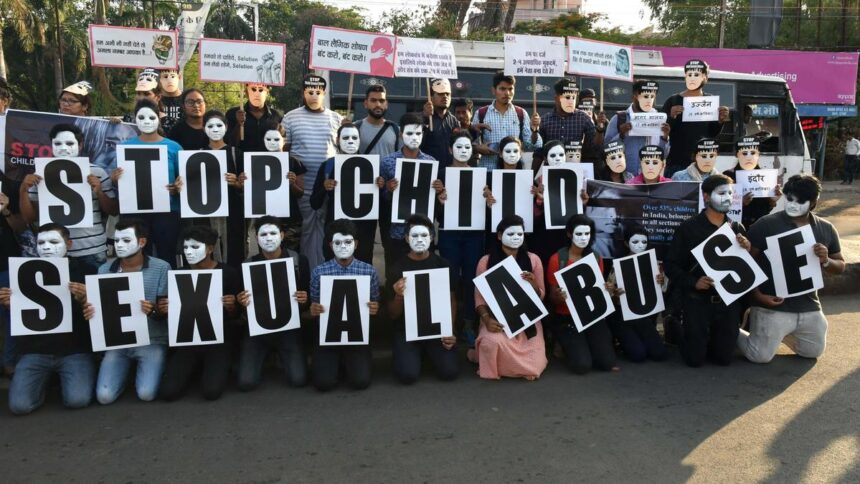






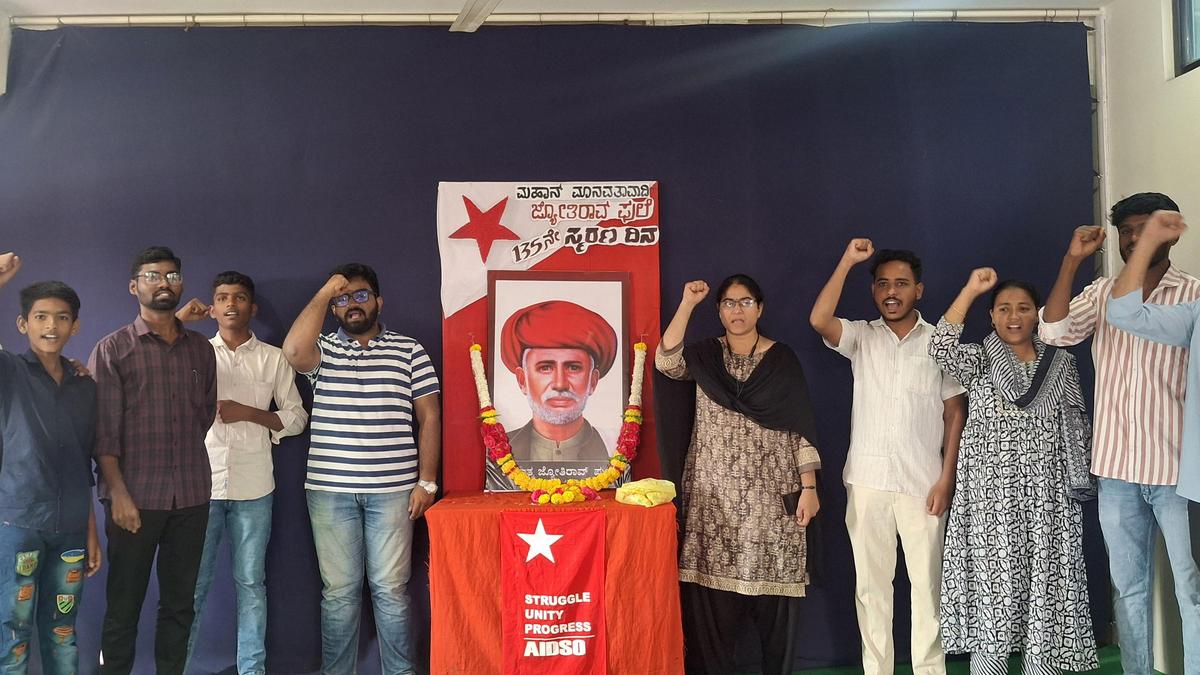
AIDSO activists taking part in the 135th death anniversary of social reformer Mahatma Jyotirao Phule in Kalaburagi on Friday
| Photo Credit: ARUN KULKARNI
Commemorative programmes marking the 135th death anniversary of social reformer Mahatma Jyotirao Phule were held in Ballari and Kalaburagi on Friday, with speakers highlighting Phule’s pioneering role in expanding education to women, Dalits and other marginalised sections at a time when learning was restricted to privileged castes.
At events organised by the AIDSO district committees in both the cities, speakers recalled Phule as a revolutionary thinker who fought British policies that imposed taxes on the poor while denying them access to education.
They emphasised that Phule had insisted that education must be universal, inclusive and capable of reaching all sections irrespective of numbers or social standing.
In Ballari, AIDSO district president K. Eranna said that Phule worked tirelessly to bring the “light of knowledge” to those trapped in the darkness of caste-based exclusion.
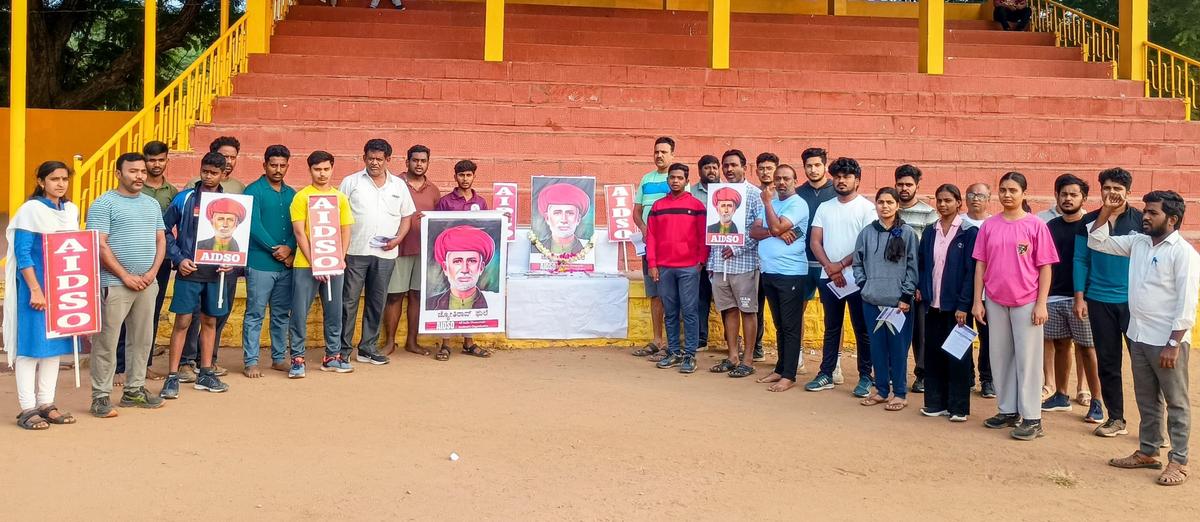
AIDSO activists taking part in the 135th death anniversary of social reformer Mahatma Jyotirao Phule in Ballari on Friday.
| Photo Credit:
SPECIAL ARRANGEMENT
“Only education can help build critical thinking and self-respect,” he said and noted that Phule was the first to open schools for the most oppressed communities despite facing personal hardships.
He added that Phule had sharply criticised the colonial government before the Hunter Commission for failing to educate the masses while offering university education only to a privileged few.
Similar sentiments were echoed at the Kalaburagi event, where AIDSO State president K.S. Ashwini said that Phule’s ideals remained relevant even two centuries after his birth.
“Phule argued that without raising the moral and social consciousness of millions, national progress is impossible. His message must reach every corner of society,” he said.
Speakers at the Kalaburagi programme also criticised what they termed a “continuation of exclusionary policies” saying that the State government’s new Karnataka Public Schools (KPS) Magnet School initiative can lead to the closure or merger of more than 40,000 government schools, many of them in rural areas serving marginalised communities.
Activists in both the districts argued that merging village schools into larger magnet schools at the gram panchayat level will distance poor students from accessible education.
They said that more than 800 schools have reportedly been identified in the first phase, allegedly with funding from foreign banks.
“Denying education to the poor is against the ideals of Phule. Raising a collective voice is the true tribute to him,” Mr. Eranna said.
Published – November 28, 2025 07:47 pm IST