



Should an artist refine his craft for art’s sake, or can he adapt it to suit audiences who respond with applause and make the work commercially viable? And what happens when that applause begins to blunt the craft itself? Kaantha, the Tamil film written and directed by Selvamani Selvaraj and produced by Dulquer Salmaan and Rana Daggubati, poses these questions through a narrative that moves from psychological drama to whodunnit, while consistently acknowledging the art of cinema.
After a brief prologue signalling what lies ahead, Kaantha opens like a love letter to filmmaking. It unfolds in Madras of the 1940s and 1950s, following the making of a film within a film. Dulquer Salmaan’s presence may momentarily recall Mahanati, in which he played Gemini Ganesan. Cinematographer Dani Sánchez López and costume designer Archana Rao, both part of that National Award-winning production, return here as well.
Kaantha (Tamil)
Director: Selvamani Selvaraj
Cast: Dulquer Salmaan, Bhagyashri Borse, Samuthirakani, Rana Daggubati
Runtime: 163 minutes
Storyline: When an aspiring female actor is caught in the tussle between a star and his mentor, things take a murky turn.
Kaantha is a different beast from Mahanati, the web series Jubilee or any other drama that tapped into the early decades of Indian cinema. The early portions acknowledge the legends of early Tamil and Telugu cinema but the story sets out to do more than just celebrate cinema. It probes into the addictive nature of fame and how it dictates power dynamics.
TK Mahadevan (Dulquer) is a superstar with consecutive blockbusters and a rags to riches story. His relationship with his mentor, referred to as ayya or sir (played by Samuthirakani) has soured to the extent that the two cannot have a face-to-face conversation on set even when they are compelled to collaborate. Studio owner Martin (Ravindra Vijay) has to recover his fortunes and the master director and his protege have no choice but work together.
Selvamani builds the tension gradually in an early sequence that shows the soured relation between the mentor and his star protege. Within that broad contour is the ever-relevant mirroring of how stardom dictates the script. What was once supposed to be the story of a woman now gets a different title and the hero wants a new climax. He doesn’t hesitate to ghost direct the film. Caught in this tussle between two established film personalities is a first-time leading lady, Kumari (Bhagyashri Borse). And, she is not a meek spectator.

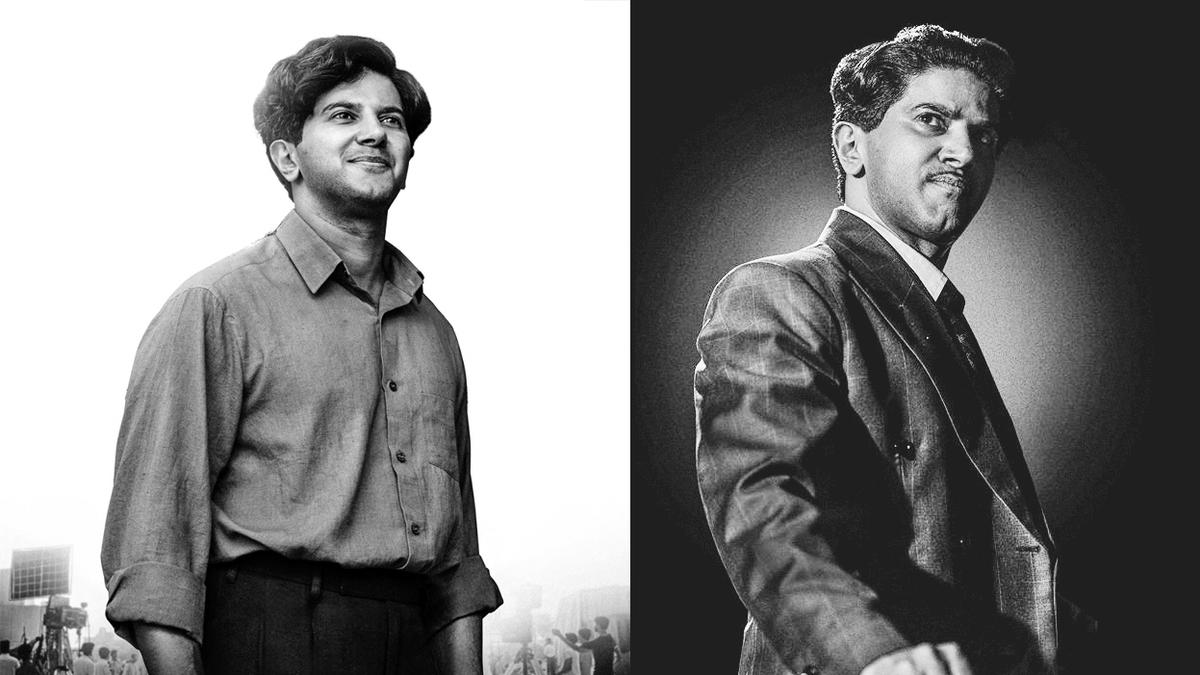
If Mahadevan is sketched as a narcissist with shades of grey, Kaantha gradually peels back the layers of ayya, giving the drama a tougher edge. Dani Sánchez López’s visuals shift between colour for the contemporary era, black-and-white for the past, and a different black-and-white aspect ratio for the film-within-the-film. These transitions in palette, texture and framing become seamless as the story settles. The mood lighting and shadows in the black-and-white portions heighten the psychological tension, leaving room for mystery. Jakes Bejoy’s background score and Jhanu Chanthar’s music support the shifting tone, while Ramalingam’s art direction recreates the studio world. Costumes by Poojita Tadikonda, Archana Rao and Harmann Kaur evoke both 1950s cinema and the fashion of the time.
Kaantha builds its world and its characters without hurry, allowing the central trio to take shape. Dulquer Salmaan moves between a more theatrical, lyrical performance on the film set and the controlled charm of a star who knows how to tilt a narrative in his favour with tact. Samuthirakani’s restrained mentor contrasts with Bhagyashri Borse’s wide-eyed aspiring actor, who plays her part with clarity and restraint. She is the surprise of the film, utilising the opportunity to showcase her potential.
The strongest sections unfold between these three characters as the film examines stardom and the inner workings of a studio. The latter half shifts into neo-noir territory. There was room here for a tighter whodunnit, even as the film explored the clash between a mentor who believes cinema must endure and a protégé trapped in the bubble of fame.
There are sharp moments when a police officer known as Phoenix (Rana Daggubati), famed for his bravado, takes charge of an investigation with a casual irreverence. In one scene, when a character calls Mahadevan a nadippu chakravarthy (king of acting) and notes he played 16 roles in a film, Phoenix quips: “Were other actors not available?” The remark mirrors how a cynical outsider might view cinema, in contrast to artistes who push themselves to make an impression.

It is in the third act that Kaantha begins to lose momentum. Although suspicion falls on several members of the film crew, the culprit is not difficult to identify. Rana Daggubati clearly enjoys playing his laid-back police officer, yet the character occasionally feels at odds with the period setting.
The film regains its footing in the final stretch, where it sharply contrasts art and reality. For a moment, it even recalls Om Shanti Om. Mirrors appear at crucial points, allowing the star to bask in his own image and, later, recoil as uncomfortable truths stare back at him. Dulquer handles these shifts with precision, delivering some of his most assured work.
The supporting characters, however, are given limited space. The dynamics between Mahadevan and his wife, for example, could have added depth. A media baron, a loyal driver, an assistant director and Kumari’s friend — a fellow refugee from Burma — each play important roles in the plot but remain under-explored.
Kaantha is sincere and compelling in parts, which helps balance the portions that feel less fully realised.
Published – November 14, 2025 05:15 pm IST