



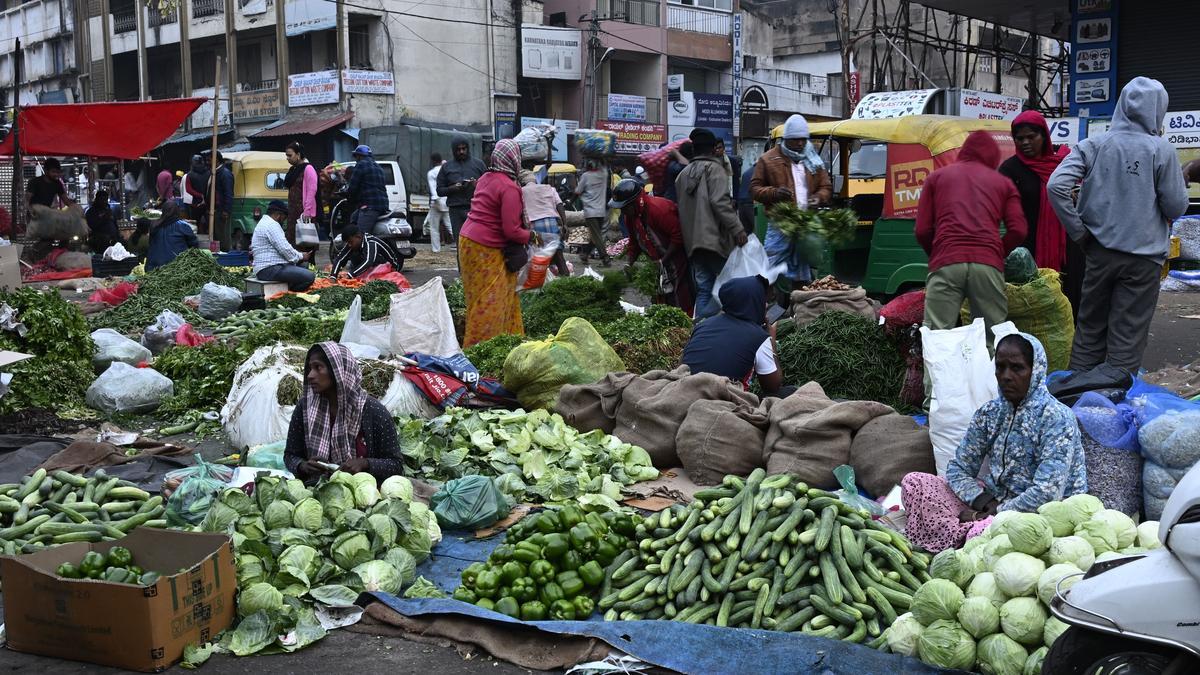

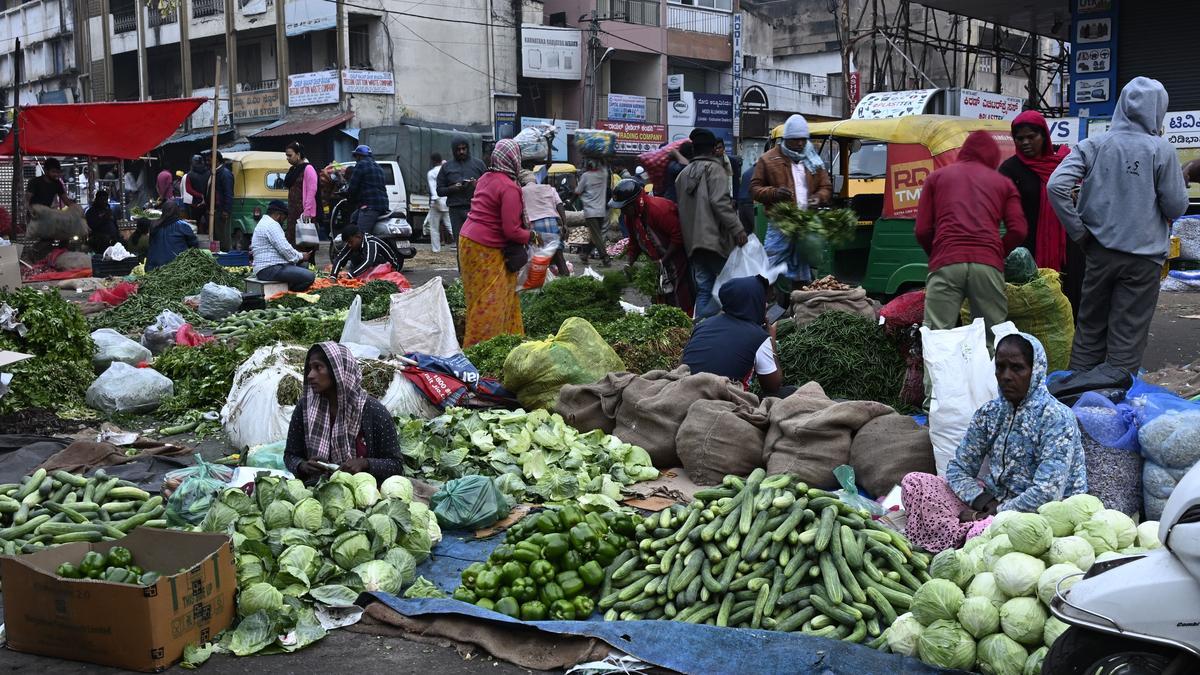
The study examined the flow of 27 major vegetables between wholesale and retail markets in Kalaburagi from April 2020 to April 2022. File
| Photo Credit: The Hindu
When vegetable farmers bring their produce to the market, they earn less than half of what urban consumers finally pay. The gap is not due to quality, effort, or production cost. It is the result of a marketing chain that pulls value away from both farmers and households through layers of intermediaries and a system where neither side knows what a fair price looks like.
A study from the Central University of Karnataka (CUK) at Kalaburagi points to a way out. The research, conducted by Sagar Gajre under the guidance of Associate Professor Ganapati B. Sinnoor, argues that the solution lies in a cooperative model similar to the Karnataka Milk Federation (KMF). The model would allow vegetable farmers to sell directly to consumers, stabilise prices, and create a predictable market for a sector long caught between waste and volatility.
The study examined the flow of 27 major vegetables (beetroot, bitter gourd, bottle gourd, brinjal, cabbage, capsicum, carrot, cauliflower, cluster beans, coriander leaves, cucumber, drumstick, fenugreek, French beans, green chilli, lady finger, mint leaves, radish, ridge gourd, spinach and tomato) between wholesale and retail markets in Kalaburagi from April 2020 to April 2022. It found that farmers received less than 50% of the consumer price across most categories. The gap widened during festival seasons and months of high demand, where profits climbed for traders but not for growers.
Many-layered surveys
To track how prices move across the market, wholesale prices were recorded in the morning at the APMC Market and the Kanni Market when farmers brought in fresh produce. Retail prices were gathered through the day from permanent shops, pushcart vendors, and local markets across the city.
Mr. Gajre also surveyed 384 vegetable farmers across the district. They pointed to a mix of structural problems. More than 80% reported a lack of cold storage and post-harvest facilities, which forces them into distress sales. Roughly 75% said high transport costs eat into earnings and push them to rely on rented vehicles that delay their arrival at city markets.
The chain of intermediaries, which swallowed a major share of the profit, stretched across multiple layers. Most farmers sold first to commission agents at the APMC yard, who passed the produce to wholesalers and retailers. More than 85% felt they had little bargaining power and often accepted whatever price they were offered. Daily price swings and limited access to real-time information added to the uncertainty. About 60% said sudden crashes could wipe out profits in a single day.
The study also stepped into the homes of Kalaburagi to understand how families buy their vegetables. A survey of 384 households revealed that about 48% had tried ordering vegetables online, while 52% had never tapped an app. But most expressed willingness to try direct delivery of fresh produce if a reliable platform existed.
Hybrid system
Based on these findings, the study proposes a hybrid direct marketing system built on the logic that made KMF a success. Village-level collection centres would receive produce from farmers in a transparent system. Cooperative vehicles would move the vegetables to a central hub for sorting, grading, and light processing. From there, a farmer-led organisation would run a network of retail outlets and an online platform for home delivery. The model suggests vegetable vendors could operate small branded cooperative outlets across neighbourhoods and handle last-mile delivery for app-based orders.
“There is already the Horticultural Producers’ Cooperative Marketing and Processing Society (HOPCOMS), but it has not grown into a system strong enough to protect either farmers or consumers. It needs to evolve into a structure similar to KMF,” the researchers said. The researches suggest that the government begin with a pilot in Kalaburagi and scale it up after fine tuning it.
(eom)
Published – November 22, 2025 11:44 am IST