




As Baby Kamala in films and Kumari Kamala on stage, she wove magic with her dance, which was marked by perfection and finesse. She was the ideal narthaki and a true ambassador of India’s art and culture, having performed worldwide.
She lived a full life, pursuing her passion for the art. When she passed away recently in the US, several senior dancers and admirers posted pictures and video clips from old films, and described Kamala as the inspiration for them to learn Bharatanatyam too. Unfortunately, there is very little documentation of her work that is available.

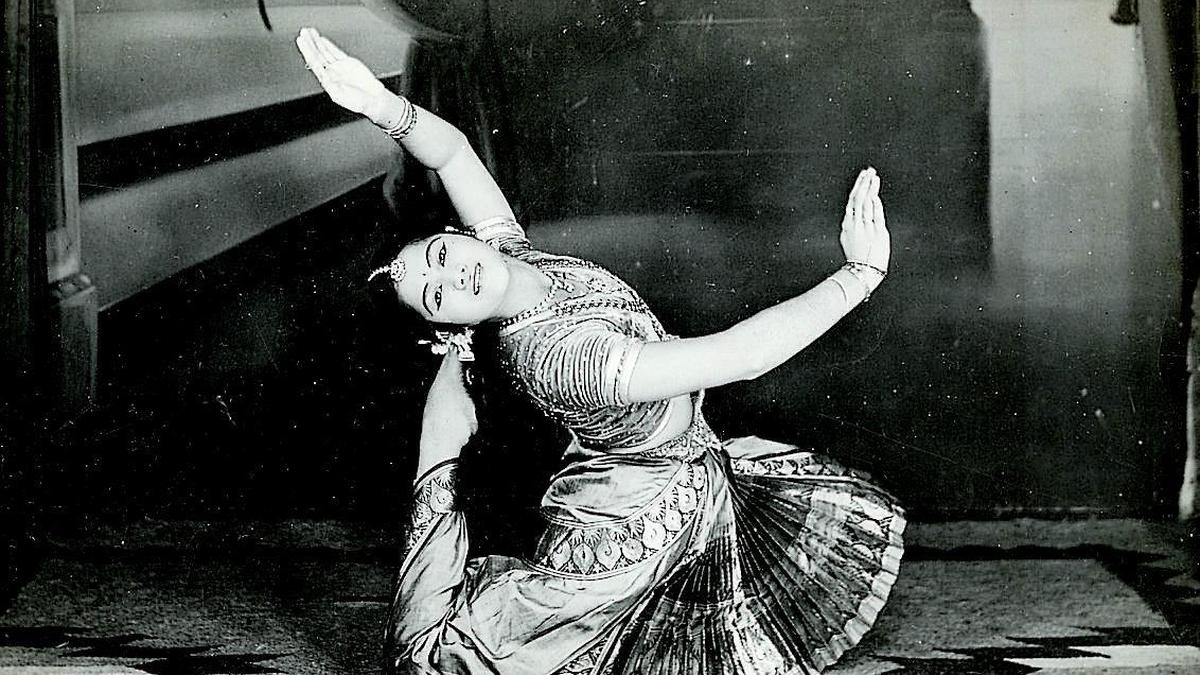
Kamala during one of her performances.
| Photo Credit:
The Hindu Archives
She was one of the last links to the transformative decades when sadir was reborn as Bharatanatyam and reclaimed as a classical art on the public stage.
“The timing was perfect, the conditions ideal. And her age was just right,” says musician, writer and scholar Sujatha Vijayaraghavan. Under the tutelage of Guru Vazhuvoor Ramiah Pillai, Kamala bloomed into one of the foremost exponents of the bani. “Grace and fluidity marked her nritta while subtlety and poetry defined her abhinaya. From the instant she made her entry from the wings till she concluded with the mangalam, she held the audience in a spell,” she adds.
S. Rajeswari, who sang for Kamala’s dance programmes for 20 years after the duo of K.R. Radhakrishnan and S.K. Rajarathnam Pillai, recalls the wonderful rapport they shared. “We drew inspiration from one-another to improvise on stage. She was a genius. She was liberal in her praise and would give due credit to me and members of her orchestra. She was well-versed in music, having learnt from vidwan Ramnad Krishnan. She could sing well, and has even cut some song discs,” she recalls.
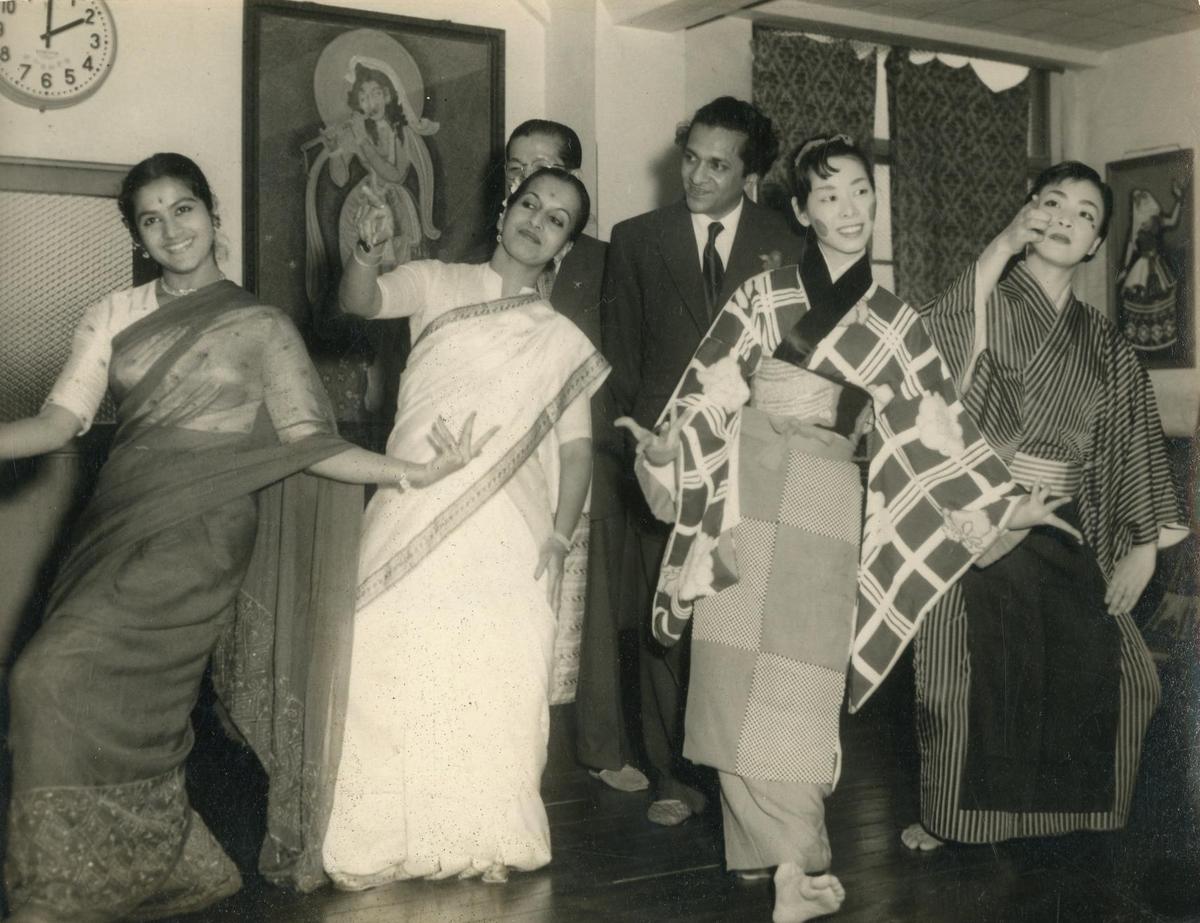
(Left to right) Damayanti Joshi, Kamala Laxman and Pt. Ravi Shankar (centre back) and two Japanese dancing ‘Otemoyan’, a comic Japanese dance, in Tokyo. Indian dance troupe at the Yomiuri Kaikan visited the Sakakibara Asian Dance School. The dancers from India taught the Japanese some of the simple Indian dances while the Japanese girls taught them several Japanese dances.
| Photo Credit:
The Hindu Archives
The singer also remembers how stardom never took away Kamala’s humaneness. “Once, when my child suddenly took ill on the day of the programme, she asked her mother to take care of my son. Everyone was moved to tears by our heartfelt presentation of a viruttam pleading for Muruga’s grace, followed by her famous ‘Ka va va’ on that troubled evening. She then cancelled the next day’s programme, after promising the organisers that she would perform soon. We fulfilled that commitment.”
Respect for tradition
Veteran Bharatanatyam exponent, Sudharani Raghupathy, says that seven decades ago, Kamala’s art influenced every young dancer. “When I was in my early teens, she wanted to see me practicing the Husseni swarajati in Kittappa Pillai’s class. Although she was senior and famous, she had that curiosity to know about other artistes and had great respect for tradition and the Thanjavur Quartet. I have known and watched her for years. She was outstanding, and I am yet to meet someone like her.”
“Three greats in dance — Kamala, Balasaraswati and Vyjayantimala — performed continuously for 27 years in the grand slot of The Music Academy. Their performances were eagerly looked forward to, and drew a full-house,” says renowned Bharatanatyam artiste and scholar Nandini Ramani. “In those days, Kamala would drive down to the Academy in full Bharatanatyam aharya for her performances. Her pyjama costumes were unique, make-up dignified and she would wear fresh flowers.”
“Kamala would often come home to ask my father, V. Raghavan, about the lyrics, meaning and deeper layers in compositions,” Nandini shares.
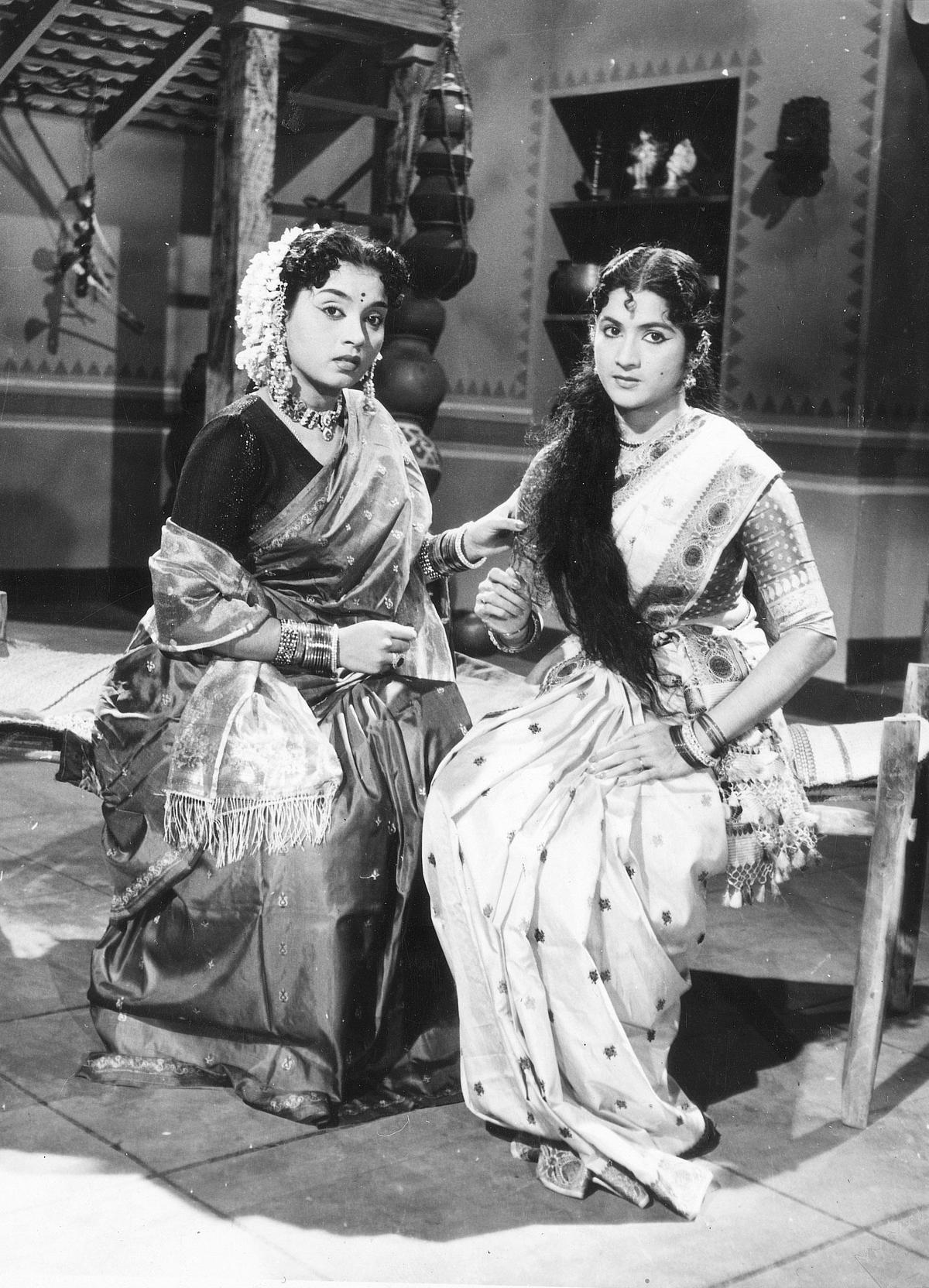
Kumari Kamala in Konjum Salangai.
| Photo Credit:
HINDU PHOTO ARCHIVES
Kamala’s forefront jump — like a deer leaping with complete joy — offered a special experience to the audience. She and Ramiah Pillai, who was like a majestic lion roaring the jatis, would together create magic. “I think she was among the first to introduce interesting, standalone dramatic episodes in dance narratives — for instance, Rukmini writing to Lord Krishna — during the second half of a Bharatanatyam concert. It was thrilling to watch her perform these with her sisters — Rhadha and Vasanthi.”
She was the first person to choreograph Tyagaraja’s ‘Nauka Charitam’ — it was beautifully choreographed and had inspiring music. Kamala always had very good vocal accompanists. “Once she became popular in films, her approach to the art had a touch of ‘janaranjakam’, but she always maintained its dignity and divinity,” adds Nandini.
Jayanthi Varma learnt her first ‘taiyya tai’ adavu at Kamala’s house in Sri Nagar Colony, Madras, and later at her sprawling bungalow in Poes Garden. She was a patient and thorough teacher. She would take us students to perform dance-dramas in India and abroad. “I learnt from her for a decade, before she moved to the US, and we missed her amazing artistry. I have had the good fortune of filming ‘Marainduvarum Marabugal’, where she has spoken extensively on the contribution of the past masters,” elaborates Jayanthi.
A generous mentor
Dancer and storyteller Ramaa Bharadvaj calls Kamala an affectionate and generous mentor. “Not only did she teach me and my twin without taking any fees, after every performance tour, she would place an envelope of currency notes in our mother’s hand and say, “This is for the children’s education”. Even at the peak of her career, she was particular about creating opportunities for us to grow.”
Speaking about Kamala’s teaching methodology, Ramaa, who learnt with her from 1970-1978, shares that her guru did not allow students to prostrate at her feet. “We could create, discuss and express freely. She never criticised other dancers in the presence, or demanded our loyalty. I always say that she knew so much about dance, but nothing about the politics of dance.”
Doctor and dancer Srinidhi Chidambaram, who trained under her from age four-to-nine, remembers frisbee sessions in her garden, the impulsive drives for ice-cream and her impressive dance hall. “Who would have ever imagined that this playful and carefree person was actually the legendary Kamala?”
“She wore her fame and artistry lightly. But her watchful eyes corrected every stance and glance, and she taught us to befriend the stage from such a young age that we all knew no stage fear. We also learnt that the show must always go on, despite a faltering orchestra or a fallen earring. She left Chennai without a goodbye. It remains as a wound of abandonment till day.”
Published – November 26, 2025 03:06 pm IST