




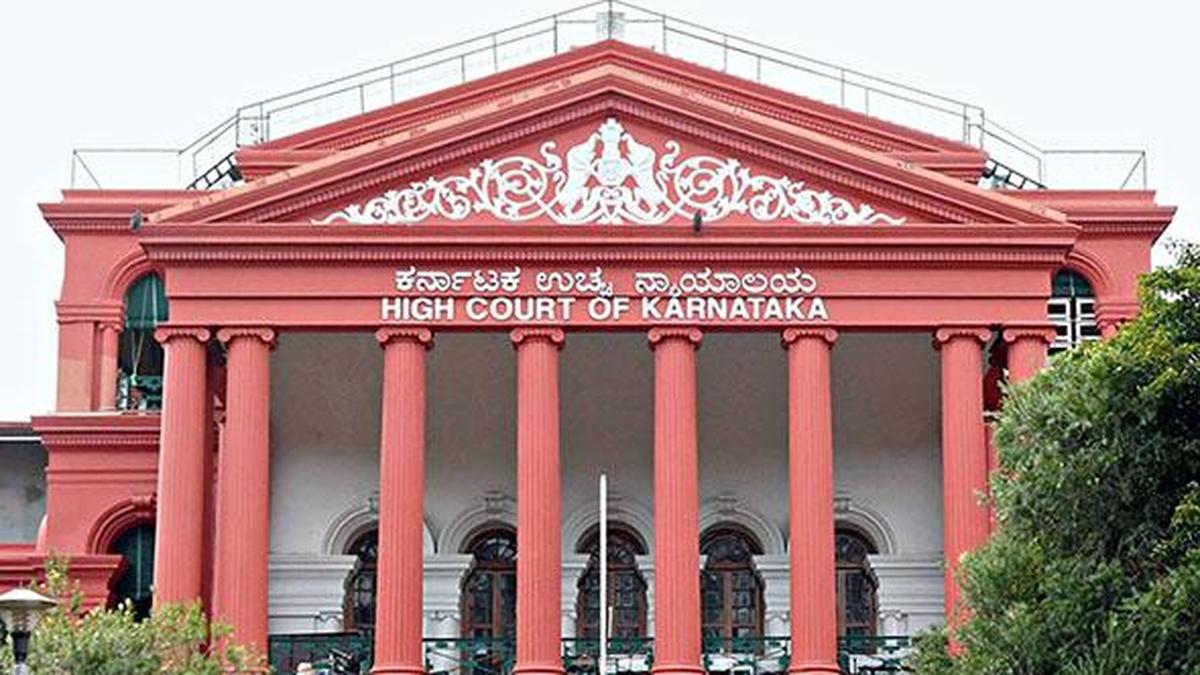


The High Court of Karnataka
| Photo Credit:
Reiterating stringent requirements in law for invoking prohibitory orders to bar a person from entering certain areas, the High Court of Karnataka on Tuesday quashed the Dharwad Deputy Commissioner’s (DC) order prohibiting Sri Adrushya Kadeshwara Swami, seer of Kaneri Mutt, Kolhapur in Maharashtra, from entering Dharwad district between November 3, 2025 and January 3, 2026.
The Deputy Commissioner’s order, if examined on the touchstone of the principles delineated by the apex court as well as different High Courts under the Section 144 of the Criminal Procedure Code (Cr.P.C), which is now Section 163 of Bharatiya Nagarik Suraksha Sanhita (BNSS), “it becomes evident that the DC’s order is wholly indefensible and thus, unsustainable”, the High Court observed.
Petition by seer
Justice M. Nagaprasanna made these observations while allowing the petition filed by the seer, who had questioned legality of the order passed by the DC on November 4 under Section 163 of the BNSS.
The prohibitory order was passed after Jagathika Lingayat Mahasabha, Dharwad district, gave representation to the DC for banning entry of the petitioner-seer to Dharwad district citing the ban imposed for his entry to Vijayapura district after the seer allegedly made some abusive remarks against a group of Lingayat seers. The High Court on October 17 had uphold the ban imposed by Vijayapura district DC on October 15 and the apex court did not interfere with High Court’s order.
On analysing the judgments of the apex court and various High Courts on the similar prohibition orders issued by the authorities against various individuals, including political personalities and religious leaders from past many years across India based on the possibility of them making inflammatory speeches that could cause disturbance in the society, Justice Nagaprasanna pointed out that the Dharwad DC’s order lacked many legal ingredients.
96 hours available
Pointing out that the power to issue prohibitory orders ex-parte can be exercised only on an emergent situation and on the basis of an apprehension in real time and not imaginary, the court pointed that the DC did not issue notice to the petitioner-seer even though 96 hours was available to issue a notice to him as the DC received representation on October 30.
“The order [of DC] fails to record the existence of any emergent situation that could conceivably justify a restraint enduring for as long as two months. The mere fact that the statute permits a maximum duration of two months, does not bestow upon the authority a license to exercise such power in a cursory and cavalier manner as reflected in the present case. There is an absence of any record for subjective satisfaction on the part of the DC, that an ex-parte order was warranted,” the court observed.
Contrary to SC’s order
Though the Supreme Court had made it clear that ban order issued by Vijayapura DC against the petitioner-seer’s entry “should not form the basis of externment from any other district”, Dharwad DC relied on the same order, which was given along with the representation, Justice Nagaprasanna pointed out.
Published – November 25, 2025 08:56 pm IST