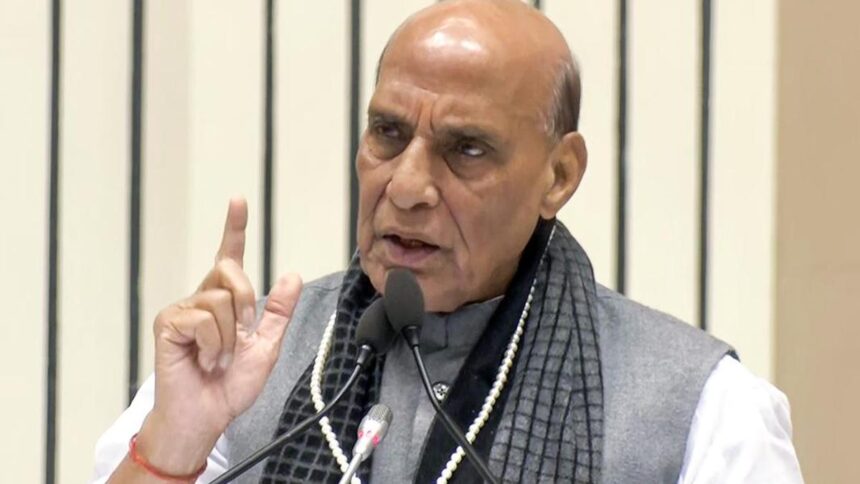




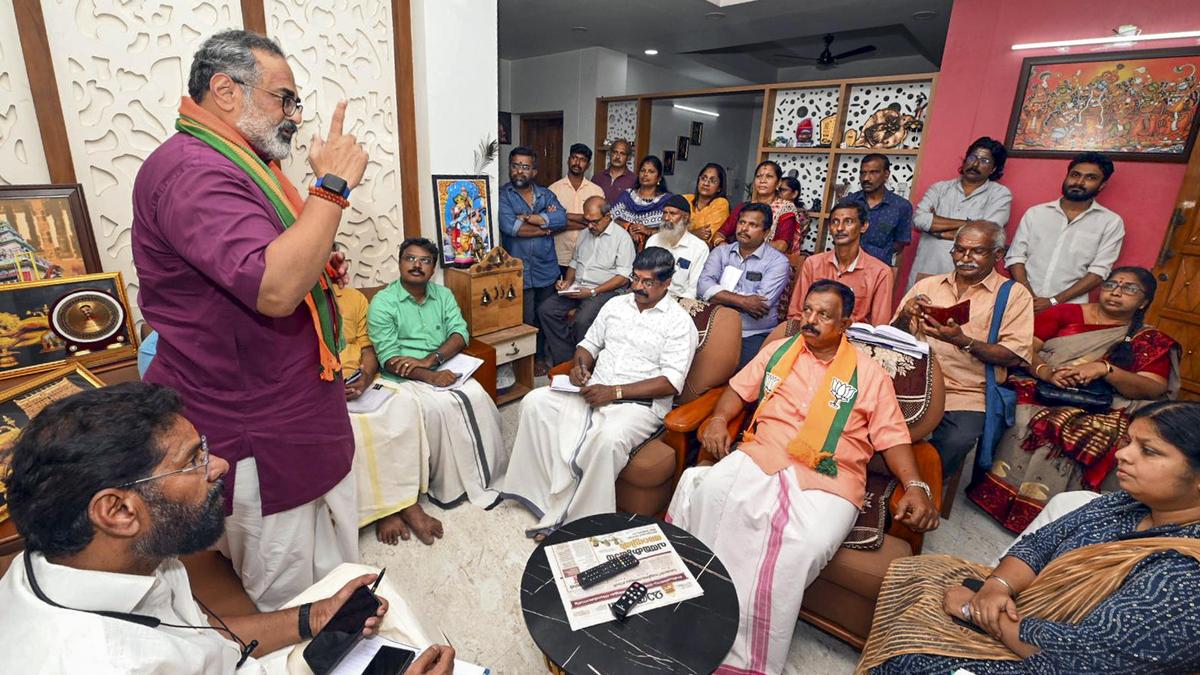

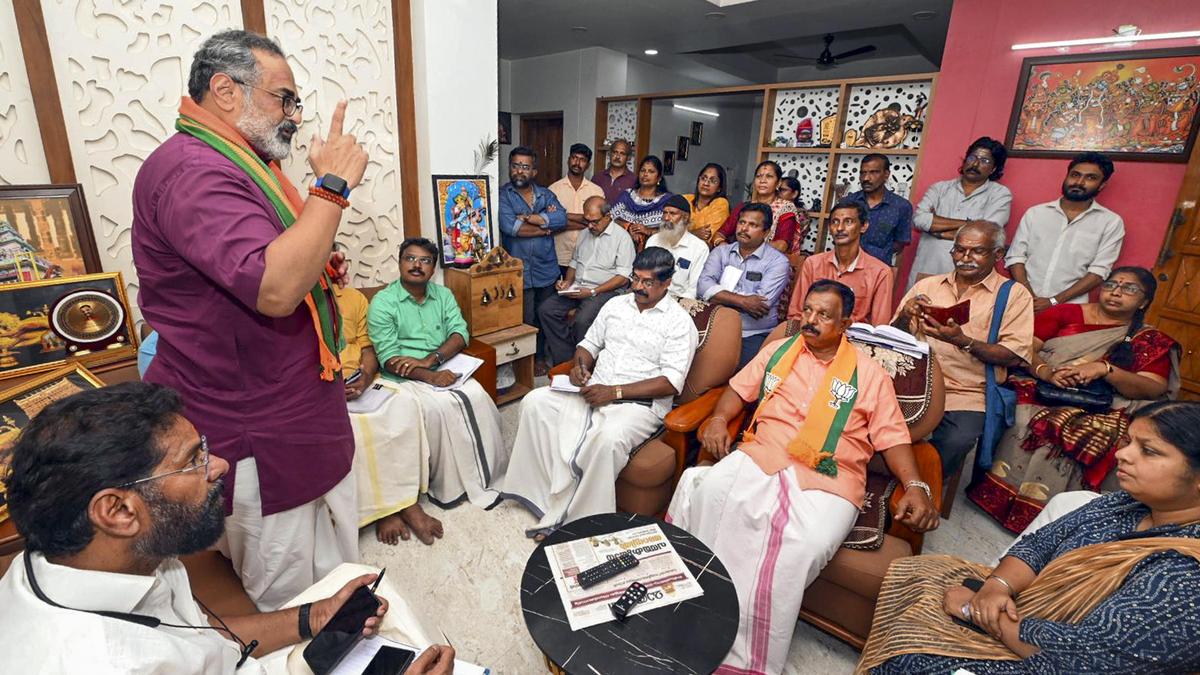
BJP State president Rajeev Chandrasekhar speaks at a meeting as part of the party’s campaign for the Kerala local body elections in Thiruvananthapuram.
| Photo Credit: –
The Bharatiya Janata Party-led National Democratic Alliance (NDA) has mounted an unprecedented campaign in the local body elections, employing a mixed strategy of urban targeting and intensified community outreach with an eye on the Assembly polls next year.
Building on the gains in the Lok Sabha polls and the visibility of Central government schemes, the front aims to capture key corporations such as Thiruvananthapuram and Thrissur, while lifting its tally in municipalities and grama panchayats. Besides, it has set sights on converting the 22 divisions in Kozhikode where it finished runner-up last time into victories in this round.
The electoral performance of the BJP in the three-tier local polls reflects an organic pattern of growth. The party’s breakthrough occurred during the 2015 elections, where it established beachheads in urban segments, setting the stage for its first MLA victory in the 2016 Assembly polls. The 2020 local body elections thus marked a milestone, with the NDA augmenting its ward tally and securing outright majorities in two municipalities and 19 grama panchayats. It achieved considerable representation: 249 members in grama panchayats, 37 in block panchayats, two in district panchayats, 320 in municipalities, and 60 in corporations, capturing 15% of the total vote share.
Despite this trajectory, the BJP lost its lone Assembly seat in the 2021 polls, necessitating a shift to consolidate urban gains, particularly following its victory in the Thrissur Lok Sabha seat in 2024.
Since the NDA assumed power at the Centre in 2014, the BJP has actively challenged the decades-old bipolar political structure in the State, which has traditionally been dominated by the CPI(M)-led Left Democratic Front (LDF) and the Congress-led United Democratic Front (UDF).
Mindful of its Hindu nationalist image, the BJP has been pursuing a cautious outreach to minority communities while accommodating NDA allies who exert distinct caste and community influence. In south Kerala, the BJP has expanded support among Hindus, particularly the Nair community, and is making inroads into the Roman Catholic community. However, its acceptance remains marginal among Latin Catholics, Christian Nadars, and Muslims. The rural fringes of northern Kerala continue to represent a less accessible electoral terrain for the alliance.
BJP leaders say they have successfully resolved internal disputes with their main coalition partner, the Bharath Dharma Jana Sena, a group expected to mobilise Ezhava votes, and other motley groups, enabling them to contest cohesively under the NDA umbrella. The front is now contesting nearly 90% of the seats, signalling its most extensive deployment ever in local body elections.
Strategically, the BJP appears to be navigating a fine line concerning anti-incumbency sentiments against the LDF government. While the recent controversy surrounding the alleged gold theft at Sabarimala is an election plank, the party is opting for relying on quiet moblisation rather than confrontational street protest, wary of triggering the kind of reverse polarisation witnessed in 2019 that helped the Congress.
The party leadership also recognises the delicate political equilibrium with the CPI(M), operating under the calculation that neither benefits from vote transfers to the Congress, which could potentially re-establish the traditional bipolar contest.
BJP State president Rajeev Chandrasekhar, who has announced his candidacy for the Assembly elections from Nemom in Thiruvananthapuram, says Kerala is on the cusp of a change in political style. “The BJP is poised to change the status quo of switching between the LDF and the UDF. We are fundamentally focussing on pro-development and pro-welfare measures and debating education and health sectors,” he says.
He accuses the Congress of propagating controversial narratives and misinformation to distract the electorate, instead of offering a clear political vision. “Both the CPI(M) and the Congress have maintained a tactical understanding to prevent the BJP from winning,” Mr.Chandrasekhar says.
Interestingly, the BJP’s leadership is also tightly controlled from the Centre, promoting newer cadres pursuing a fresh, results-driven template. This top-down model has been designed to achieve an ambitious vote target of 25% and secure representation in every local body. As State general secretary Anoop Antony Joseph puts it, “the party needs to prove winnability with tailored strategies for each civic body.”
Ultimately, this poll will test whether the BJP can successfully transition from being a peripheral player to a formidable third front in Kerala politics.
Published – December 04, 2025 09:28 am IST