



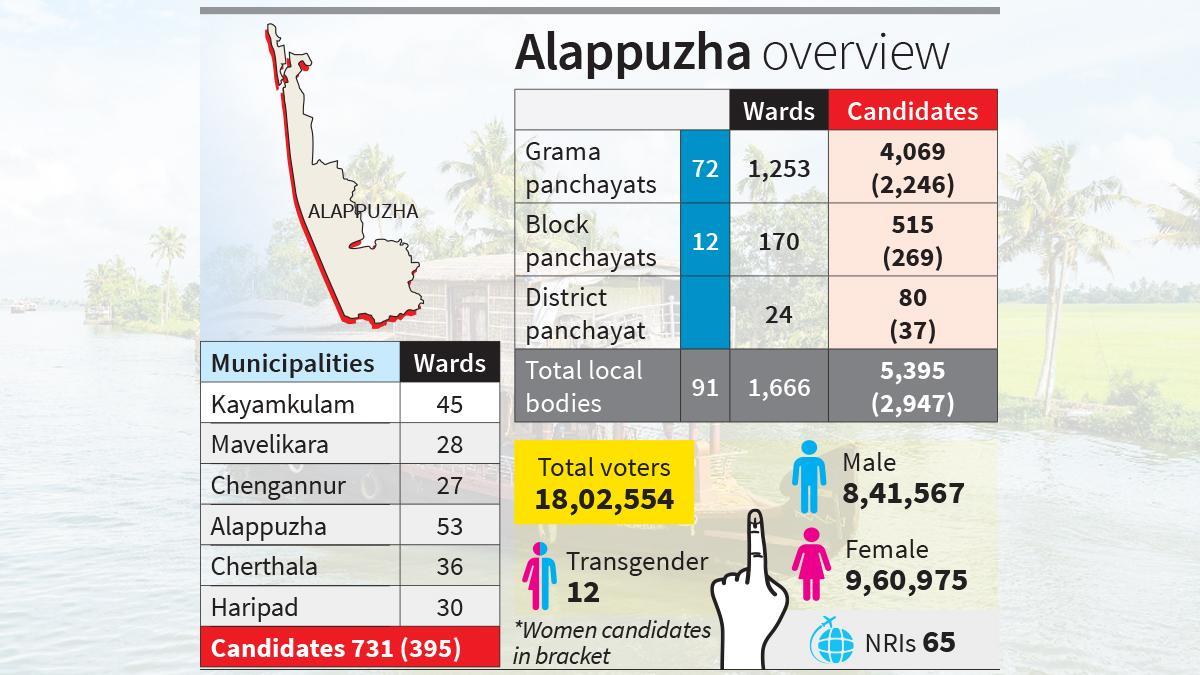

When the State Election Commission announced the local body elections for December, all three major coalitions in Alappuzha welcomed the decision with visible enthusiasm. For months, they had been honing strategies and quietly redrawing their power maps long before the ward delimitation exercise even began. Now, with the whistle blown, the battlefield is live, with 5,219 candidates jostling for 1,666 seats across the district’s three-tier local bodies.
Thanks to delimitation, Alappuzha has 101 more seats than in 2020, including 84 new panchayat wards. This also marks a significant expansion that could disrupt traditional political equations. With tempers already flaring over allegations and counter-allegations regarding the voter rolls, this election has turned into a prestige battle for every major front.
In the last local body polls, the CPI(M)-led Left Democratic Front (LDF) swept the district, securing 53 of the 72 panchayats. The Congress-led United Democratic Front (UDF), which began with 17 panchayats, now holds only 14. The National Democratic Alliance (NDA), led by the BJP, despite winning majorities in three panchayats, was kept out of power as rival coalitions joined hands with Independents to block the saffron front from gaining a foothold. Its only consolation was a notable increase in vote share.
But the BJP-led front is no longer the underdog it once was. After its Lok Sabha candidate secured a striking 28.3% of the votes last year, the party senses an opening. This time, the saffron camp hopes to convert its rising vote share into real seats, bolstered by the Bharath Dharma Jana Sena (BDJS), which holds influence in certain pockets.
The Independents, meanwhile, remain the silent force that can flip the script. They currently rule five panchayats and are once again poised to play kingmaker. In several local bodies, major parties have already fielded Independents as their ‘official’ candidates, underscoring the high stakes involved.
The municipal arena is equally charged. Of the district’s six municipalities, the LDF rules three while the UDF governs two. The exception is Mavelikara, where all three fronts won nine seats each. In a dramatic twist, the UDF clinched power by allying with an Independent and continues to hold control with the support of the Janadhipathya Kerala Congress. The Congress-led coalition also dominates Chengannur and Haripad.
The LDF, however, maintains its edge in Kayamkulam, Cherthala, and Alappuzha. With the number of municipal wards increasing from 215 to 219, the outcome in these newly added wards will be critical in determining the balance of power in these closely contested urban bodies.
At the upper levels, meanwhile, the LDF remains firmly entrenched, commanding 11 of the 12 block panchayats and enjoying long-standing dominance in the district panchayat. The Left currently holds 21 of the 23 divisions and with delimitation, the number has now risen to 24.
But beyond vote share trends, independent power plays, and coalition crosswinds lie the regional issues with the potential to reshape the political ground. One such concern is the growing disenchantment among paddy farmers over delays in procurement and payment, an issue that could resonate across the wider Kuttanad region. Equally significant is the coastal highway project, which has triggered fears of displacement among coastal communities already scarred by the upheaval caused during the recent national highway redevelopment.
Published – December 06, 2025 09:41 am IST