




In Wayanad’s Meppadi panchayat, the political aftershocks of the July 30, 2024 landslides still run deep. The disaster that wiped out the tiny tourist hamlets of Mundakkai and Chooralmala along with 298 lives continues to cast a long shadow, echoing through the current local body polls.
The disaster had torn through three wards of the Meppadi panchayat: Attamala, Mundakkai and Chooralmala. Mundakkai has become a no-go zone after the landslides. The polling booths at GLP School, Mundakkai, and at the Government Vocational Higher Secondary School, Vellarmala, no longer exist.
In the recent delimitation, both wards were merged into a single Mundakkai-Chooralmala ward 11 with 2,241 voters. The combined rolls reveal 406 people missing, a figure that local residents say mirrors the real human cost of the tragedy.
Survivors of the tragedy will return from various parts of Wayanad, where they now live in rented houses, to cast their votes. The trauma of watching their loved ones perish in the landslides continue to shape their attitudes towards political parties.
For C.K. Noorudheen, the outgoing United Democratic Front (UDF) councillor from Chooralmala, meeting the survivors has become too painful. He says he cannot face people who have suffered the greatest tragedy of their lives. UDF’s outgoing panchayat president K. Babu has also stepped back from the fray. In 2020, he represented Mundakkai, a ward swept away by the landslides.
Main contest
In the new Mundakkai-Chooralmala ward, the main contest is between the UDF’s Mansoor K. and the Left Democratic Front’s (LDF) K.K. Sahad, with the Bharatiya Janata Party’s (BJP) Vijayan and Independent candidate Siddique also in the fray.
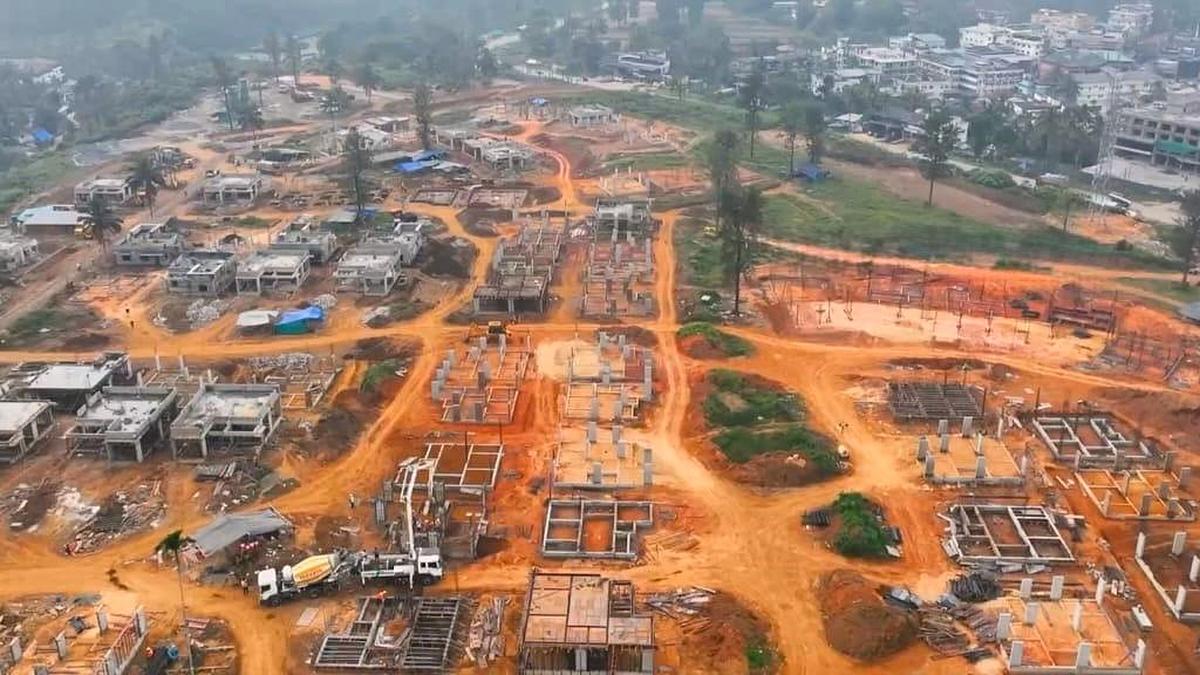
Many survivors living in rented houses are to move to the model township being built at Elston Estate, Kalpetta. Though the government had promised completion of houses by year-end, the deadline now looks improbable.
Controversies, disputes, and protests have trailed the government’s response to the tragedy and its victims at every stage. In reaction, those affected formed a collective called Janasabdam Action Council and launched an agitation demanding comprehensive government support, including housing.
Over 1,000 families directly and indirectly impacted by the disaster have joined Janasabdam. They are demanding that the government waive their existing loans, provide housing for every affected families and offer a sustainable means of livelihood.
“The problems facing the survivors are severe. Having lost everything—their homes, businesses and land, they have no way to repay their existing loans. Our first demand is a waiver of those loans,” says Janasabdam coordinator Nazeer Alakkal.
Political parties are quiet on the issue. Though they accept that the demands are valid, they say it is ultimately the government’s responsibility.
The Janasabdam disagrees with political parties. Yet the group’s dedication to democratic engagement never waltzes. “Our belief in democracy is unshakable. No one in our movement advocates an election boycott; that is never the answer for the problems we face,” says Mr. Nazeer, who was a former Kalpetta block panchayat member.
Distrust in govt.
Political parties responded differently after the disaster. Distrust in the government’s rehabilitation package led the Indian Union Muslim League (IUML) and the Congress to offer houses to survivors, while the Communist Party of India (Marxist) [CPI(M)] and its affiliates contributed directly to the Chief Minister’s disaster relief fund.
The IUML and the Congress both pledged 100 houses each; but controversy surrounds their offers. More than 100 survivors awaiting the IUML houses in Meppadi have declined the government’s Kalpetta township. The Congress’s scheme is yet to take off.
Repeated changes in the government’s commitments have bred mistrust. “People do not believe the government any more. At first, it said 1,500 affected families would get houses. Then it became 1,024, and now only 451. The same happened with the land: the government promised ten cents for a 1,000-sq-ft house, cut it to five cents, and have now settled on seven cents after protests,” Mr. Nazeer points out.
This mistrust is likely to influence people’s perceptions of the local body as well. Broadly, there is a sense that the local administration has fallen short in addressing the needs of the survivors.
A persistent issue is that government relief for survivors has allegedly reached undeserving individuals, while deserving families were overlooked, sometimes with the alleged complicity of political parties.
On govt. aid
“Several survivors like me did not receive the ₹2 lakh under the government’s micro-plan while some undeserving persons got it. With survivors dispersed across Wayanad and beyond, many remain unaware of the aid, allowing others to take advantage,” says M.T. Abdul Majeed, a landslide survivor.
Three months ago, a hit-and-run accident destroyed Mr. Majeed’s autorickshaw. He narrowly survived, but missed insurance by a day. “Now I make a living doing daily labour,” he says.
“As the elections approach, we focus on the candidates themselves, not their parties, because none of them seems any different,” says Mr. Majeed.
He echoes the broader sentiment of the survivors. Political parties and their candidates are well aware of it. They approach voters cautiously, choosing their words carefully and making promises with circumspection. They are aware that the force of nature is far beyond their imagination.
Published – December 01, 2025 09:45 am IST