


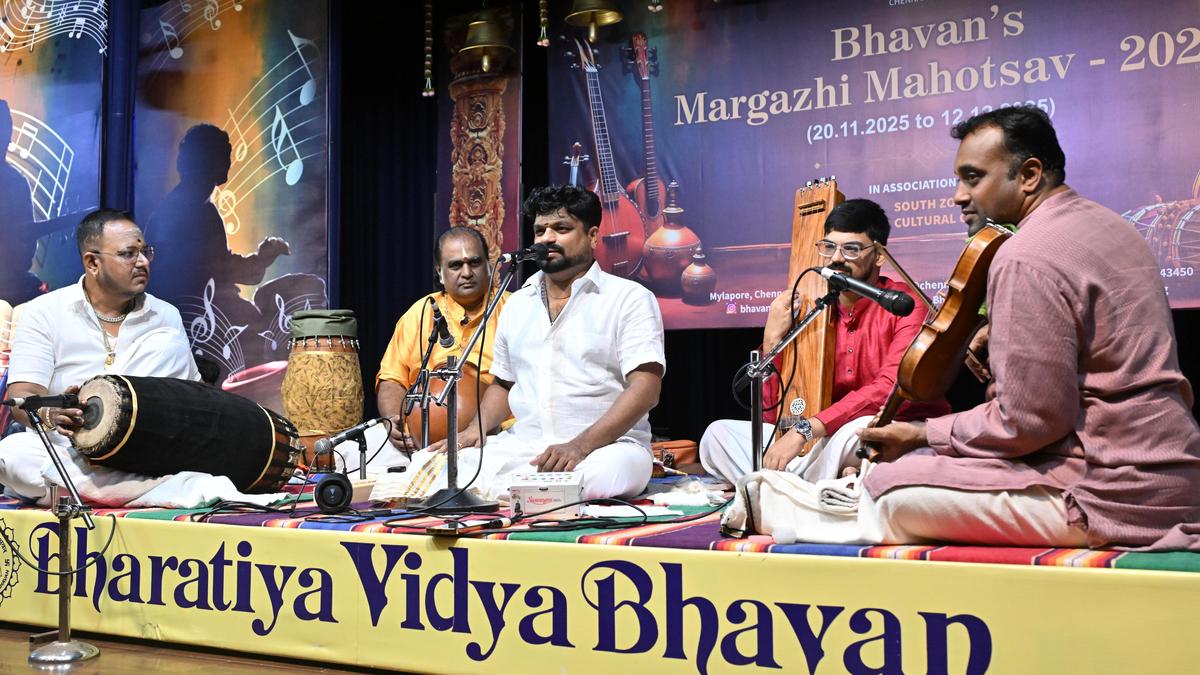

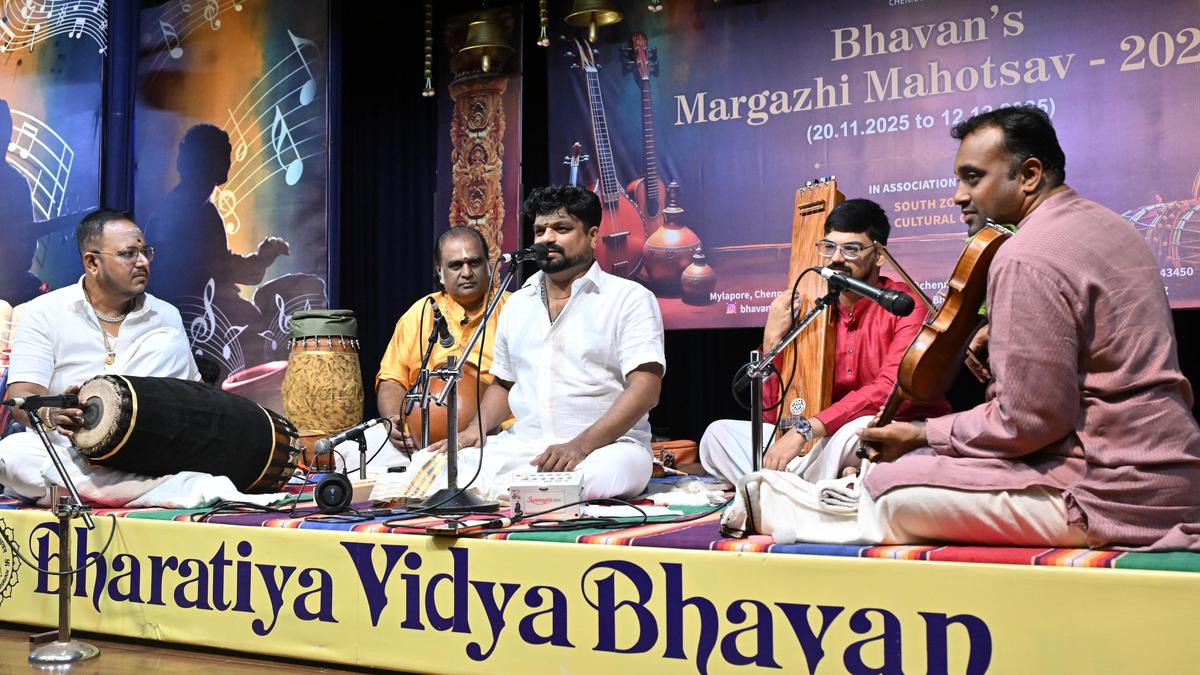
Kunnakudi M. Balamurali Krishna with H.N. Bhaskar (violin), B. Shree Sundarkumar (mridangam) and S. Karthick (ghatam)
| Photo Credit: SRINATH M
Kunnakudi M. Balamurali Krishna’s music is characterised by vibrant energy, a penchant for arithmetical intricacy and matching technical virtuosity. When this flair is tempered by aesthetic sensitivity, as it largely was at his Bharatiya Vidya Bhavan recital, the effect is elevating. A seasoned accompanying ensemble of H.N. Bhaskar (violin), B. Shree Sundarkumar (mridangam) and S. Karthick (ghatam) played a key role in sustaining this balance.
Balamurali Krishna opened with a neat presentation of the Khanda Ata tala varnam ‘Vanajakshi’ by Pallavi Gopala Iyer. Following an Abhogi outline, he delivered a nuanced rendition of Tyagaraja’s ‘Nannu brova niku’, where the composer questions Rama’s inordinate delay in granting him refuge. Judicious use of janta and datu phrases embellished the kalpanaswaras.

Kunnakudi M. Balamurali Krishna.
| Photo Credit:
SRINATH M
The famous Tamil kriti in Varali, ‘Kaa vaa vaa’, which seeks Muruga’s divine presence and protection, was Balamurali Krishna’s next song. The classic, with its pallavi and anupallavi replete with vocatives, invoking the god’s various names, was rendered with apt and animated intonation.
The singer then presented ‘Paridaanamichite’, Patnam Subramania Iyer’s Bilahari composition in Khanda Chapu. Occasional off-key moments in the fast passages of an otherwise well-rounded raga essay suggested that the impulse to push the tempo came at the cost of alignment. Speed was again the driving force in the niraval and swara sections, where the accompanists were in synergy, but the melodic quotient momentarily yielded to rhythmic drive.
‘Sanatana paramapavana’ in Phalamanjari, invoking the grace of the Supreme, was sung in a leisurely tempo that unfurled the beauty of the Tyagaraja kriti in this rare raga. An intriguing chatuswari vakra-sampurna melody derived from Karaharapriya, Phalamanjari has just four notes (sa-ga-ma-dha) in the ascent, and though the descent employs all seven, the order is irregular.
Hemavathi, the main piece, catapulted the concert to a different plane, as both the alapana and the kriti ‘Sri kanthimatim’ provided an immersive experience. The raga was unveiled with unhurried, well-spaced phrases that revealed its contours in its true colours, and a sustained mandhra sthayi exploration was particularly compelling. It was like a celebration of ‘Dikshitar 250’, as Balamurali Krishna showcased the kriti’s architectural strength and meditative depth with a sublime rendition where tranquility ruled. This was followed by the kalpanaswaras at the pallavi opening, which embraced measured arithmetical articulation. The tani avartanam was an expansive percussion dialogue between Shree Sundarkumar and Karthick, defined by tonal clarity, absorbing patterns and variety.
A soulful rendition of Papanasam Sivan’s ‘Muruga muruga ena nee sol’ in Hamsanandi rounded off the concert, which underlined the value of musical restraint.
Published – December 08, 2025 04:16 pm IST