



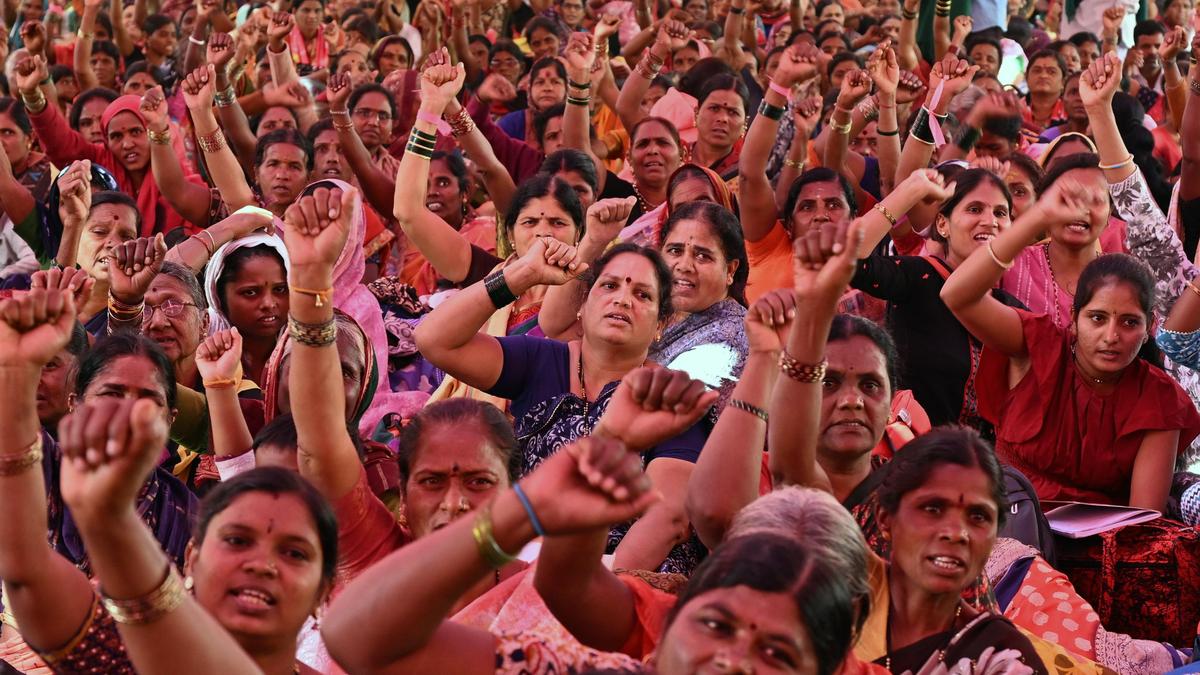

Women’s organisations from across Karnataka at a protest at Freedom park, demanding a liquor ban, on Tuesday.
| Photo Credit: K. MURALI KUMAR
“Every day starts with the fear that one of the men in my house will come home drunk and beat us again,” said Lakshmamma, a daily-wage worker from Gunjahalli in Raichur, clutching a photo of her 18-year-old grandson, now addicted to alcohol.
For the 62-year-old, liquor is not an abstract policy issue; it is the reason she lost her husband, saw her son drift into addiction, and now watches her grandson slip down the same path. “How many children will we lose? Alcohol has eaten our families alive. The government must protect families like ours and ban liquor.”
Ms. Lakshmamma, like many others, had travelled overnight to Bengaluru to stand shoulder-to-shoulder with thousands of women at Freedom Park. Women’s organisations from across Karnataka came together on Tuesday for a joint State-wide protest demanding a ban on liquor and stricter action against illegal sales.
The protest, insistent and deeply personal, is the latest chapter in a more than 10-year-old movement demanding that the State confront what they say is Karnataka’s most silent social crisis — alcoholism.
The anguish filling Freedom Park is not new. The Madya Nisheda Andolana, a State-wide coalition of over 30 organisations, has been demanding prohibition for many years. They last held major demonstrations in 2016, 2018, 2019, 2023, and again this year, with smaller protests continuing at the taluk and district levels throughout between. Yet, women say nothing has changed.
Ms. Lakshmamma’s story reflects what many others echoed. Her husband died seven years ago from alcohol-related complications. She raised two daughters and a son alone, working long hours on farms. But addiction clawed back into her house through the next generation.
Mehbooba Firdos, another protester from Sindhanur said that out of her four sons, only one stayed sober. “The others beat me when they are drunk. No neighbour interferes. Who can we go to?”
Another woman described the loss she had endured. “My daughter-in-law left because my son beat her whenever he drank. He kept drinking even after she left, and one day his body gave up. We didn’t even have money to cremate him properly. Now my grandson has dropped out of school to work. How do we go on like this?”
Women spoke of being widowed young, of children pushed into labour to compensate for lost wages, of households slipping into debt and poverty.
“Whether it is licensed outlets or grocery shops and homes selling illicit liquor, the flow has become easier, especially for young boys,” said Geeta J. from Konkal village in Yadgir district.
Two demands
The protesters on Tuesday placed two demands before the State government — restore gram sabha’s power over liquor licensing and set up village-level women’s vigilance committees.
In States like Haryana, Maharashtra, and Rajasthan, gram sabhas have the final say in whether a liquor shop can open in their jurisdiction. Licences are issued only if a minimum number of women, often 20% of the sabha, approve the proposal. Karnataka had a similar provision until 2016, when the government removed it. The protesters want this restored, along with a stricter clause allowing even 10% of gram sabha members to veto permission, as followed in some States.
They are also seeking quasi-judicial powers for women’s committees in every panchayat to identify and shut down illegal liquor outlets operating out of houses, grocery shops, stalls or sheds. The Karnataka Panchayat Raj Act already allows the formation of additional committees for social justice, with protesters arguing that these powers can be extended to curb illicit liquor sales.
CM promises action
Chief Minister Siddaramaiah met the protesters, heard their demands, and accepted their petition. He promised the group that their memorandum would be looked into by the government.
Published – November 25, 2025 09:00 pm IST