



In the early hours of January 8, 2005, at around 2 a.m., darkness engulfed the narrow stretch branching off from the Grand Northern Trunk (GNT) Road, also known as the Kolkata–Chennai National Highway. The villagers of Thanakulam near Periyapalayam, about 60 kilometres from Chennai, were fast asleep, unaware of the danger approaching.
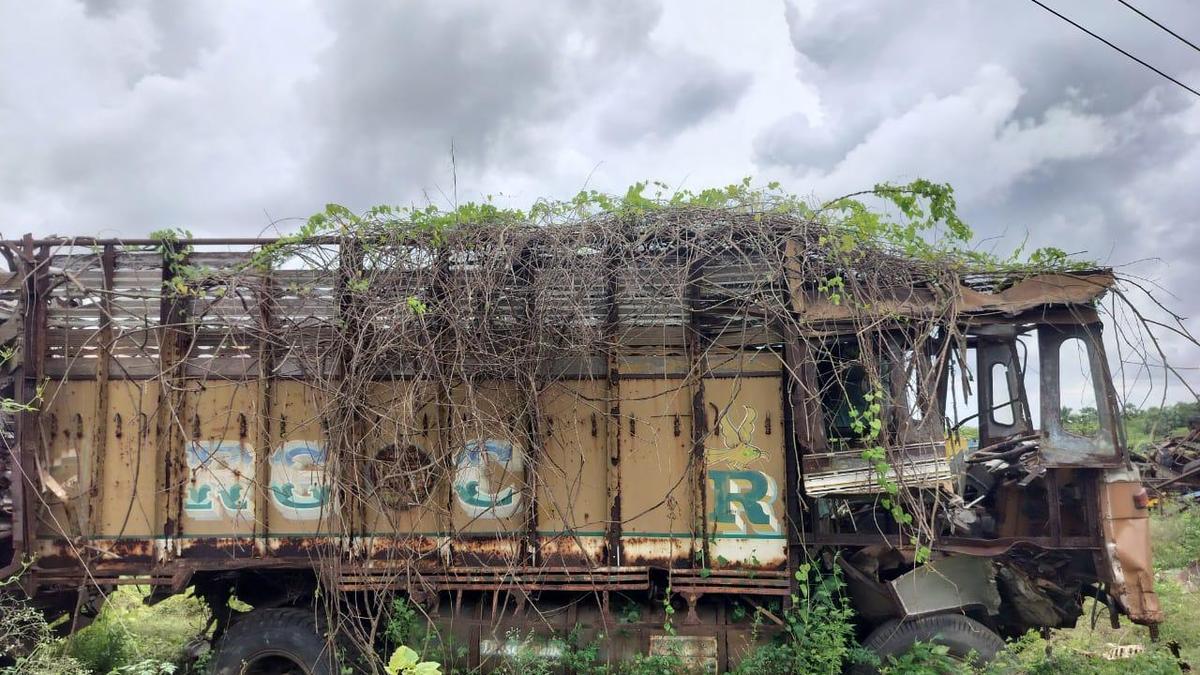
A fully-covered goods carrier — HR 38 J 5249 — rolled quietly along the deserted road and halted about half a kilometre from the village. Six to eight men climbed down silently from the lorry and moved toward the house at the village entrance — the residence of K. Sudarsanam, at that point of time, a sitting AIADMK MLA and former Minister.
At exactly 2.15 a.m., with the swing of an axe, the stillness was shattered. The armed gang smashed the wooden front door, storming inside. Their leader stood guard outside, gripping a gun.
The gang quickly climbed the staircase to the first floor. They bolted the room of Sudarsanam’s elder son, Vijayakumar, who was sleeping inside. They then broke open the door to the room in which his second son, K. S. Sathish Kumar was asleep. They shattered the glass of a window, and through that gap, the intruders rained blows on Sathish Kumar with blunt iron rods, leaving him bleeding.
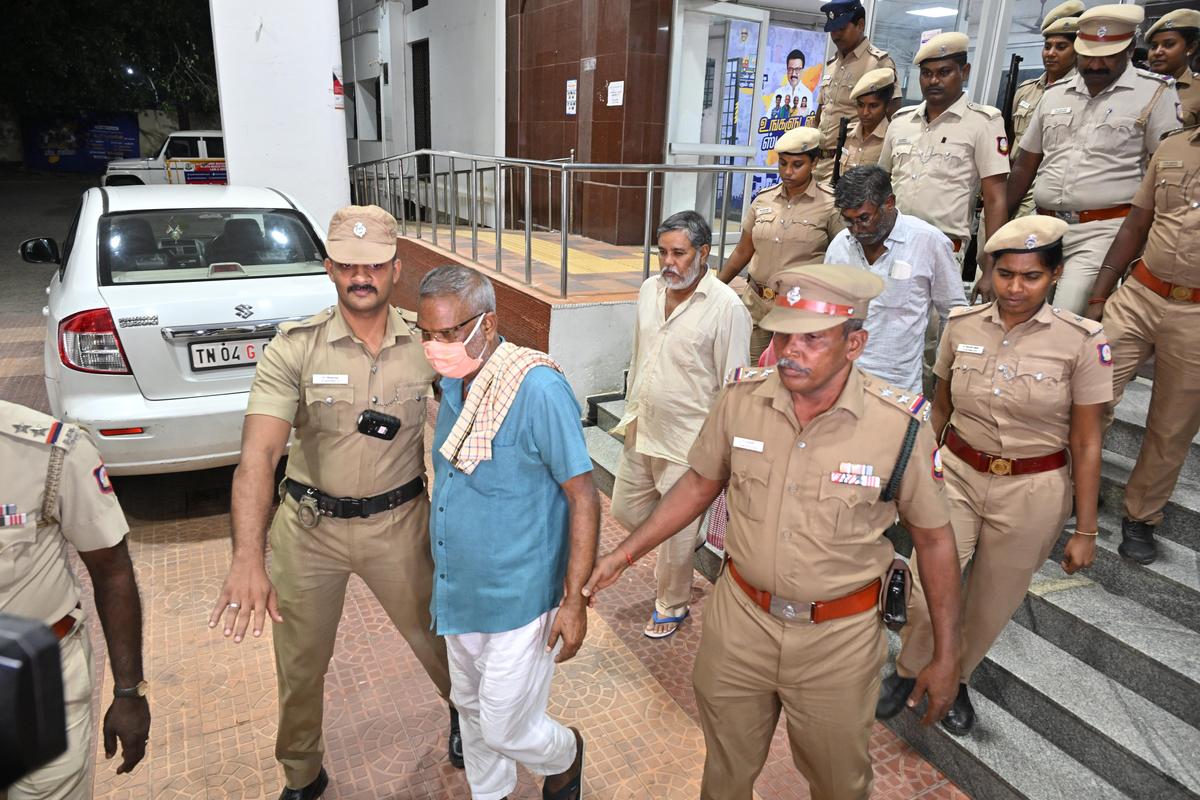
Members of Bawaria gang are being escorted by the police to a Sessions Court in Singaravelar Maligai.
| Photo Credit:
M. Srinath
When his wife, Geetha, rushed forward, one of the men twisted her left arm until she cried out in pain. Their eight-year-old daughter clung to the attackers’ legs, begging them not to hurt her father. But the gang ignored her pleas, continued assaulting Sathish Kumar and Geetha, and ripped jewellery off Geetha’s body at knifepoint.
Woken the commotion, Sudarsanam who was sleeping with his wife in a room on the ground floor — stepped out carrying a sickle. The moment the assailants saw the weapon, they fired a .12-bore round into the right side of his chest. He collapsed and died instantly.
The gang then entered his bedroom, the pooja room and the room next to the kitchen. They tore open almirahs, overturned beds and looted nearly sixty sovereigns of gold jewellery.Three women — Jayamal, Sudarsanam’s wife; Thatchayani, his mother-in-law; and Neela, the household maid — were unharmed but absolutely terrified.
Recalling the incident, Sathish Kumar said: “Hearing the sound of my room door being hit multiple times, I looked through the window and saw six or seven people trying to break it. I held the door tightly from behind but couldn’t stop them. They broke the window next to the door and attacked me with an iron rod through the opening. A blow to my left shoulder forced me aside. They then entered the room. I fainted. After 10–15 days of treatment, I was told that my father had been shot dead.”
Hearing the family’s screams, villagers gathered outside the compound wall and hurled stones at the dacoits. The gang fired a round toward them, dispersing the crowd, and escaped into the darkness, with valuables looted from the house, boarding their lorry parked half a kilometre away.
The then Tiruvallur Superintendent of Police V. Vardharaju rushed to the scene, cordoned off the area and summoned his team. “The public had gathered in large numbers by them. The crime scene was calamitous, with bloodstains everywhere. Our job was to protect the integrity of the scene. A pair of chappals used by the accused and an empty bullet shell were recovered,” he said.
The dacoity and murder shook the entire State. Special teams were formed under the then Inspector-General of Police (North), S. R. Jangid. Deputy Superintendents of Police V. Jayakumar (Thirukoilur), M. Sudhakar (Madhavaram), C. Vijay Kumar (Tiruvallur), and Ara. Arul Arasu (Hosur) joined the investigation. Mr. Vardharaju said as soon as they began investigation, they started noticing a similar pattern in several other highway dacoities in the State. Working with then Cuddalore SP Davidson Devasirvatham, they mapped the crimes.
Decade of dacoity
For nearly 10 years, a string of dacoities involving murders and grievous assaults — all with similar a modus operandi — had been reported across Tamil Nadu. Between 1995 and 2005, 24 such incidents occurred along the National Highway from the Tiruvallur–Andhra border to the Krishnagiri–Karnataka border, resulting in 13 deaths and 63 serious injuries. Chance fingerprints were lifted at many scenes but there were no matches in police records. Similar offences in Andhra Pradesh and Karnataka also remained unsolved.
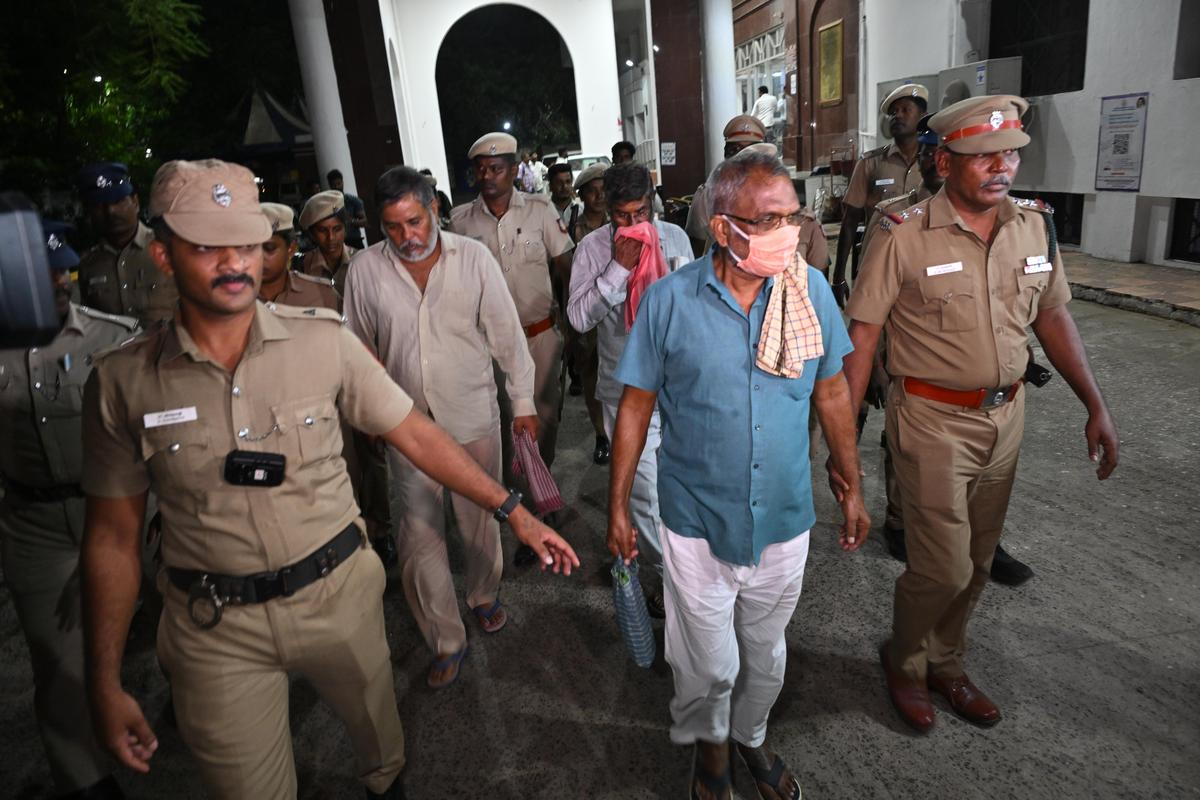
The three gang members coming out of the Sessions Court after the judgment.
| Photo Credit:
M. Srinath
“The gang used only to speak only in Hindi during the crimes. Words like ‘Chabi doh’ (give the key) and ‘Chup raho’ (keep quiet) were used. It was clear that this bunch were from north India,” said Thillai Natarajan, former investigation officer in the Periyapalayam case.
The gang first struck Tamil Nadu on June 7, 1995, at the house of M. Mohan Kumar in Walajapet, then part of Vellore district. They killed him, seriously injured his wife and two children, and stole jewellery and cash worth over ₹50,000. The case was closed as undetectable three years later. The following year, they struck again in the same town in another house.
After a five-year gap, the gang resurfaced in 2001, committing a major dacoity in Avinashi, followed by three more robberies in Dharmapuri and Salem districts.
Their crimes surged in 2002, with eight dacoities reported in Salem, Avinashi, Kangeyam, Gummidipoondi, Athur, Kariamangalam, Burgur and Sriperumbudur. The most sensational was in Salem on September 12, 2002, in which they killed Congress functionary Thalamuthu Natarajan and his watchman Gopal and injured six others. A sub-inspector reportedly saw the gang walking away but failed to act. They walked two kilometres, boarded a lorry and vanished.
In 2003, they struck four locations — Sholavaram, Walajapet and Natrampalli — committing murders at three of them. In 2004, they targeted Thiruverkadu, Vellavedu, Sriperumbudur and Thiruvalam. In Thiruverkadu, they shot house owner Gajendran dead, killed his watchman and injured two others. In Sriperumbudur, they slammed a 14-year-old girl against a wall.
The breakthrough
Mr. Jangid said that based on the modus operandi, investigators suspected North Indian criminal gangs but could not identify any one gang in particular. Teams visited Karnataka, Andhra Pradesh, Maharashtra and Madhya Pradesh, ruling out criminal tribes in those regions. They then focused on Rajasthan, Uttar Pradesh, Haryana, Delhi and Punjab, as their investigation had shown similarities with the Bawaria gang’s modus operandi.
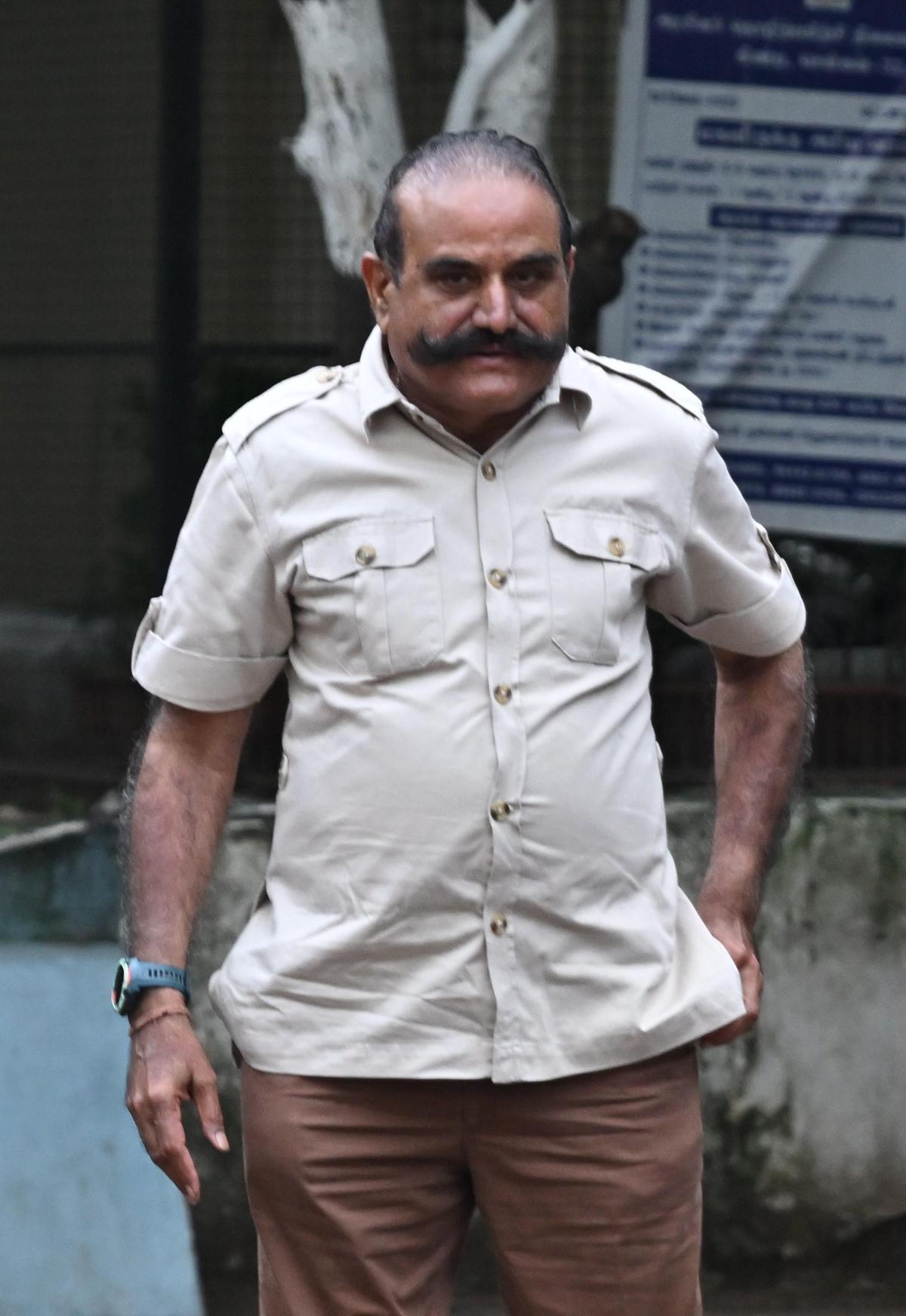
Former Director General of Police S.R. Jangid, who as IG (North) led the special teams that cracked the case
| Photo Credit:
M. Srinath
“Initially, it was virtually a wild goose chase. Every lead was pursued. Fingerprint experts travelled with the teams carrying the chance prints lifted from scenes. Police records in these States were checked,” Mr. Jangid said. A major challenge was that police forces in UP, Haryana, Punjab and Rajasthan did not regularly preserve fingerprints or maintain detailed records of hardened criminals.
The breakthrough came on February 1, 2005, when Inspector of Police (Fingerprints) Dhanancheliyan, who was part of the Uttar Pradesh team, found that four chance prints matched a thumb impression recorded in 1996 in the “register of transit prisoners” at Agra Central Jail. The print belonged to Laxman alias Ashok, a Bawaria criminal from Chandanpura village in Bharatpur district, Rajasthan. He was linked to six dacoities in Tamil Nadu and Andhra Pradesh.
Tamil Nadu police teams camped in the region for days, arresting the criminals. They seized a sheet from a schoolgirl’s notebook containing phone numbers of gang members. Call records and a confession from an accused in Rajasthan confirmed the involvement of the Bawaria gang from Haryana and Rajasthan.
Who were the Bawarias
The Bawarias were among the most violent criminal groups, operating mainly at night along highways. Their lorries had secret chambers for hiding weapons and iron rods. They parked near roadside eateries and walked up to four or five kilometres to targeted homes, smashing doors with stones or steel rods and unleashing brutal, unprovoked violence.
13 persons were eventually arrested, including Oma alias Omprakash Bawaria, 55, of Ghargot village in Faridabad district, the gang leader; his brother Jagadish; Ashok alias Laxman; Rakesh alias Kuttu; Anguri; Jaildar Singh; and three women. Two gang members were killed in an encounter near Meerut.
Courts later convicted several of them, including Oma and Ashok, in four cases — for the Walajapet doctor’s murder and for the murder of MLA Sudarsanam in Periyapalayam. In 2006, Oma and Laxman initially received the death penalty in the Walajapet case while others were given life imprisonment. The High Court later commuted the death sentences. Oma died in Vellore Central Prison, and three others continue to serve life terms.
The Sudarsanam Case
In the Sudarsanam murder case, 32 persons were named in the charge sheet filed by Periyapalayam Police on September 18, 2006. Of them, 22 remained absconding. Two — Oma and Boora — died during trial, and one was treated as a juvenile. Seven were tried, but the case was later split after three women jumped bail. The trial ultimately proceeded against Jagadish, Rakesh alias Guddu, Ashok alias Laxman, and Jaildar Singh alias Lali Master, a schoolteacher.
Additional Public Prosecutor D. Maharajan said the prosecution examined 66 witnesses and produced 52 exhibits and material objects, including two country-made guns and two lorries used by the accused.
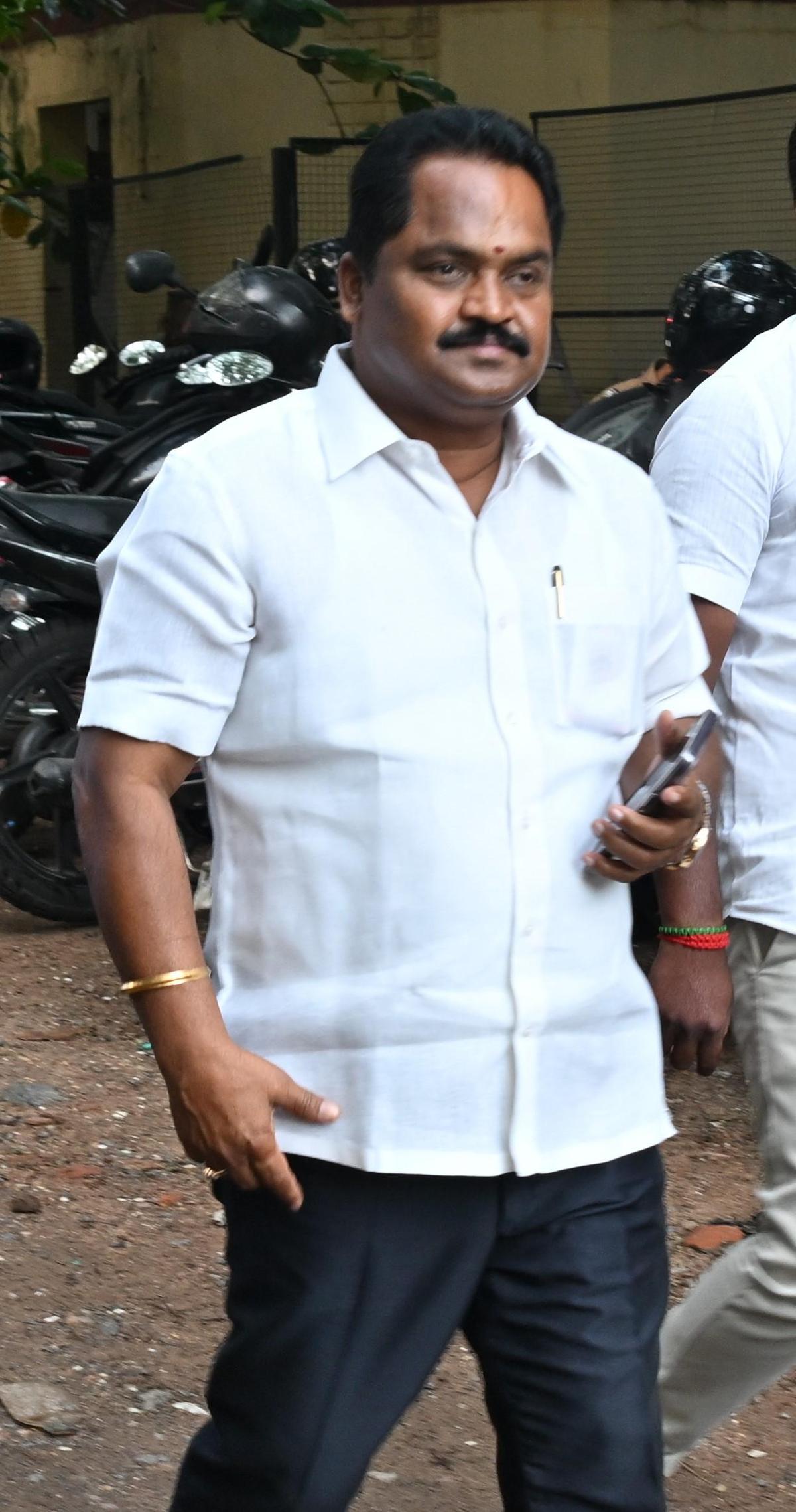
K.S. Sathish Kumar, son of the deceased MLA Sudarsanam
| Photo Credit:
M. Srinath
The four men were brought to the XV Additional Sessions Court at Singaravelar Maligai under tight security on Monday, November 24, Judge L. Abraham Lincoln held that the eight-year-old child, who had held the attackers’ legs and pleaded with them not to harm her father, had clearly seen their faces and credibly identified them.
He noted that the fingerprint expert’s evidence strongly corroborated the eyewitnesses and supported the prosecution’s version. “The prosecution has produced unassailable evidence against the accused, and the defence has not raised any serious doubt regarding the credibility of the witnesses,” he said.
However, the court found that the prosecution had “miserably failed” to prove the involvement of Jaildar Singh or link him to the gang through admissible evidence. He was acquitted.
The remaining three were sentenced to four to five life terms under Sections 397 (robbery or dacoity with attempt to cause death or grievous hurt), 396 (dacoity with murder), and for illegal possession of arms and ammunition. They will remain in prison for the rest of their natural life.
The grave dacoities committed by the Bawaria gang, which once terrorised the State, came to an end a few years ago, but justice, even if limited, has been served. However, several gang members remain absconding and continue to evade trial in pending cases.