



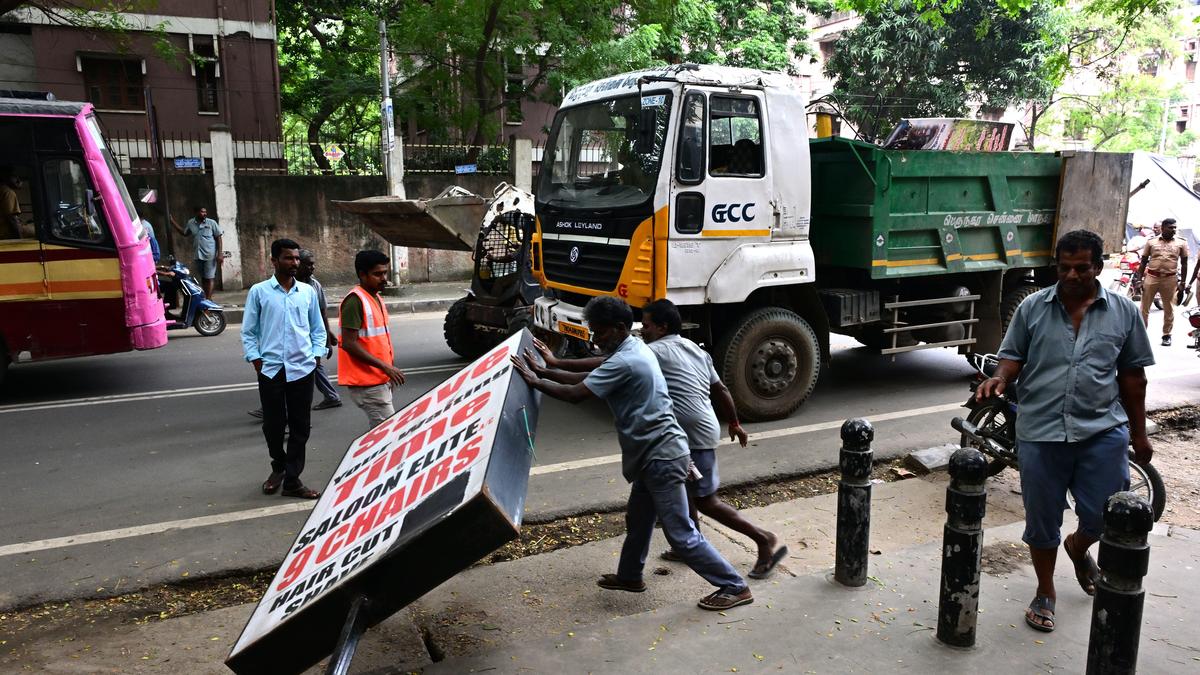


Greater Chennai Corporation workers removing encroachment at Kamarajar Salai in Chennai. Representational image. File
| Photo Credit: B. Velankanni Raj
The Madras High Court has called for a plan to relocate the public toilets, electrical junction boxes and Amma canteens constructed on pavements and cycle tracks of all major roads at K.K. Nagar and Ashok Nagar in Chennai thereby considerably shrinking the width of the driveways.
The First Division Bench of Chief Justice Manindra Mohan Shrivastava and Justice G. Arul Murugan said, the Greater Chennai Corporation (GCC) had not seriously disputed the allegation of large scale encroachments levelled by public interest litigation petitioner V.B.R. Menon, an advocate.
Hence, the Bench directed GCC to submit within three weeks an appropriate relocation plan so that the toilets and community kitchens were continued for the benefit of the public and at the same time, the pavements and roads were also kept open to their full width and length for traffic movement.
The judges directed Tamil Nadu Generation and Distribution Corporation (TANGEDCO) to ensure that electrical junction boxes and transformers were also relocated. Stating that they must be relocated to an appropriate place, the court said, the electrical equipment could not be installed on pavements and footpaths.
“Since, for transmission and distribution of electricity to individual customers, existence of transformers is also necessary, the authorities shall act with utmost seriousness to ensure that one public purpose does not destroy the other. Three weeks’ time is granted to the GCC and TANGEDCO to submit a time-bound relocation scheme,” the Bench ordered.
On the PIL petitioner’s complaint that several private individuals too had encroached upon the pavements in the two localities by setting up bunk shops, small stalls and other such commercial hubs, the court directed the GCC to verify the complaint and remove all encroachments immediately.
In his affidavit, Mr. Menon, a resident of K.K. Nagar, said, his locality as well as the adjacent Ashok Nagar were developed in the 1960s with very wide roads, parks and schools. Then, these two localities had only Tamil Nadu Housing Board flats and plots and the population was very less.
Subsequently, saplings were planted on a large scale on both sides of the major roads and still there was enough space for two-way vehicular traffic under the canopies created by the trees. However, over the years, the housing board tenements were converted into multi-storey residential buildings leading to a surge in the population, he lamented.
Many commercial establishments had also sprung up on Anna Main Road, Kamarajar Salai and Rajamannar Salai in K.K. Nagar making the area highly congested, the petitioner said and accused the local politicians of being complicit in allowing such large constructions.
Stating that he had been raising the issue with the corporation officials and other authorities since 2016, he said, a decision was taken in 2017 to enforce one-way traffic in some of the major roads. However, the decision remains only on paper for the last seven years and motor vehicles continue to ply freely on both sides even on roads that were meant only for one-way traffic, he said.
The petitioner stated that parking of private cabs and auto rickshaws on main roads and allowing street vendors in no-vending zones were also causes of concern.
Published – November 24, 2025 04:12 pm IST