


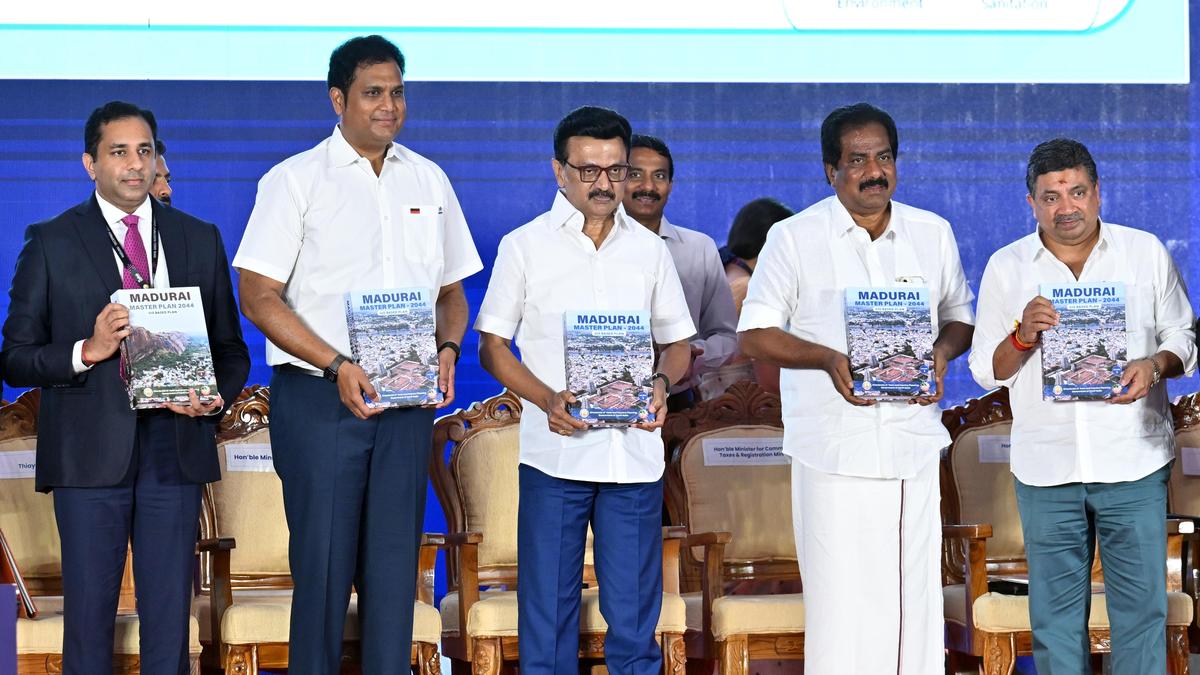

Chief Minister M.K. Stalin releasing the Madurai Master Plan 2044 in Madurai on Sunday.
| Photo Credit: R. ASHOK
The Madurai Master Plan – 2044 released by Chief Minister M.K. Stalin during TN Rising conclave here on Sunday promised a comprehensive 20-year framework intended to guide the region’s long-term development up to 2044.
The Master Plan’s core vision, which is to transform Madurai into a culturally rooted, climatically resilient, globally competitive, and economically vibrant city by 2044, encompassed a 1,254.93 sq. km planning area, covering Madurai corporation, two municipalities, five town panchayats, and 316 revenue villages.
The document established ‘Pudhu Madurai’ as a role model for sustainable urban development in India.
The master plan outlined a transformative shift in Madurai’s development trajectory, moving from a traditional, core-centric growth model to a diversified, corridor-based, and cluster-based planning system.
“The central strategy is to reinforce the urban structure through improved mobility to facilitate the decentralisation of business and logistics functions towards peripheral growth corridors,” the document noted.
The key proposals included development of new road corridors, widening and upgrading of existing roads, establishment of new bus terminals and railway facilities, creation of Mass Rapid Transit System (MRTS) corridors and expansion of the airport to enhance regional and local connectivity.
By adopting a heritage-inclusive approach to ensure Madurai’s identities are preserved, the master plan prioritised retaining the historic core and revitalisation of traditional neighbourhoods.
It foresaw the integration of tangible and intangible assets – vernacular architecture, ritual routes and historic streetscapes – into modern urban development as the best way to preserve its cultural richness.
Moving towards creating climate-friendly developments, the restoration of waterbodies to strengthen natural systems and position the city as climatically resilient, was set a key priority of the master plan.
To drive inclusive and diversified economic development, the plan identified eight strategic clusters designed to build a strong, competitive, and future-ready economic base.
Strategic clusters encompassed IT/ITES innovation, agro-processing, textile and apparel, rubber and auto components, multi-sectoral, Micro, Small and Medium Enterprises (MSME), commercial – retail and arts and crafts.
When each of the clusters develop their capacity to strengthen the respective sectors and complement the other clusters, they will collectively build a strong, competitive, and future-ready economic base.
Finally, by addressing housing needs with a multi-pronged approach that included affordable rental housing near proposed economic clusters, specialised housing like women’s hostels, studio apartment, student housings, night shelters near key transit location and rehabilitation of untenable slums, it sought to transform the city into an inclusive urban region that provides equitable living conditions for all segments of the population.
Published – December 07, 2025 07:51 pm IST