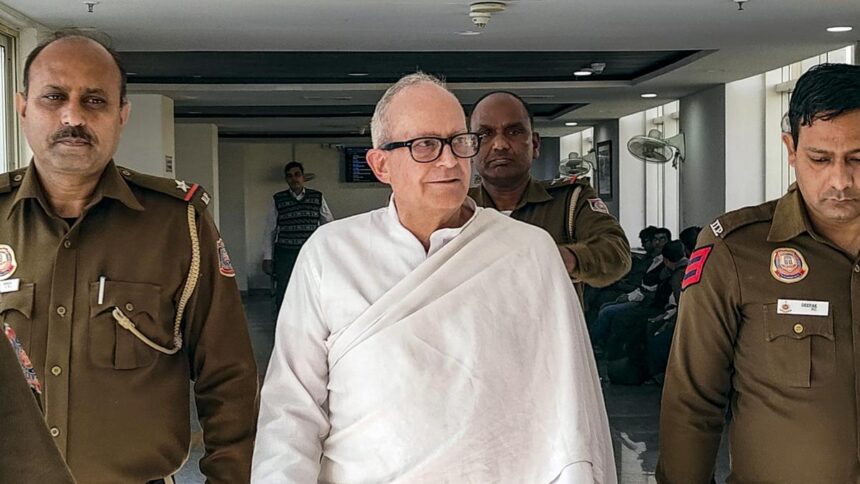





Prabha Chandra, senior professor of Psychiatry at NIMHANS, describes pregnancy and postpartum as a phase of profound neurobiological change.
| Photo Credit: Getty Images/iStockphoto
“It takes a village to raise a baby,” goes the old saying. But in today’s hyper-connected world, it can also take a village — both real and virtual — to stress out a mother.
This irony set the tone for a session on maternal health at Manotsava, the mental health festival that began in Bengaluru on Saturday.
The discussion, titled ‘Maternal Health Unfiltered: Strain, Stories and Studies’ examined how the traditional “village” of kin and community that once supported mothers has fragmented into modern, often digital, spaces that can both nurture and pressure them.
Moderated by Jahanvi Nilekani of the Aastrika Foundation, the panel featured Prabha Chandra, senior professor of Psychiatry at NIMHANS, psychologist and podcaster Bakul Dua of Mommy Mixed Tapes, and therapist Poornima Mahindru of Green Oak.
Village to nuclear home
Dr. Chandra, who has spent over two decades studying perinatal mental health, described pregnancy and postpartum as a phase of profound neurobiological change — a period she likened to “matrescence”, or “the adolescence of motherhood”.
“It’s a time when a woman’s brain changes more than at any other point in her life,” she said.
“Areas linked to empathy and caregiving become more active, but these same changes make her more vulnerable to anxiety, guilt and fatigue.”
She noted that traditional family and neighbourhood networks once offered a protective cushion for new mothers. “Today, those support systems have shrunk,” she said.
“Sleep deprivation, lack of planning, and an over-focus on the baby rather than the mother’s well-being are major risk factors for distress.” She further said, “Motherhood should bring neither shame nor a trophy. It should bring care.
Pressures of modern mother
Dr. Mahindru said that cultural expectations and rituals continue to shape, and sometimes strain, women’s early experiences of motherhood.
“Even in the most modern families, postpartum seclusion and food taboos persist,” she said. “What may once have been protective now often leads to isolation.”
She said that the pressure to bear children remains deeply gendered. “Women are still expected to prove their worth through motherhood,” she said. “Once the baby arrives, the mother’s physical and emotional recovery becomes invisible.”
“For generations, women have been told to simply ‘cope’ or ‘adjust’. True maternal care should focus on recovery, rest and respect,” she said.
Solidarity, surveillance
Dr. Dua explored how online platforms have become the new “villages” for many mothers. “WhatsApp groups, parenting forums and Instagram communities are lifelines — especially for those away from family,” she said.
“But this solidarity comes with surveillance. Every feed is full of picture-perfect mothers who are ‘doing it all.’ It becomes an endless cycle of comparison and guilt.”
“Motherhood today is a performance,” she said. “We curate milestones and internalise unrealistic standards of care. The result is a generation of women burning out while trying to be ‘good mothers’.”
She stressed that maternal mental health cannot be discussed in isolation. “We have to talk about fathers, childcare, policy and social support,” she said.
The panel also examined the paradox of agency among modern women. “Many confident professionals surrender control during childbirth out of fear or guilt. Motherhood is one of the most celebrated roles, but also one of the most regulated,” the panelists added.
Published – November 08, 2025 11:25 pm IST