





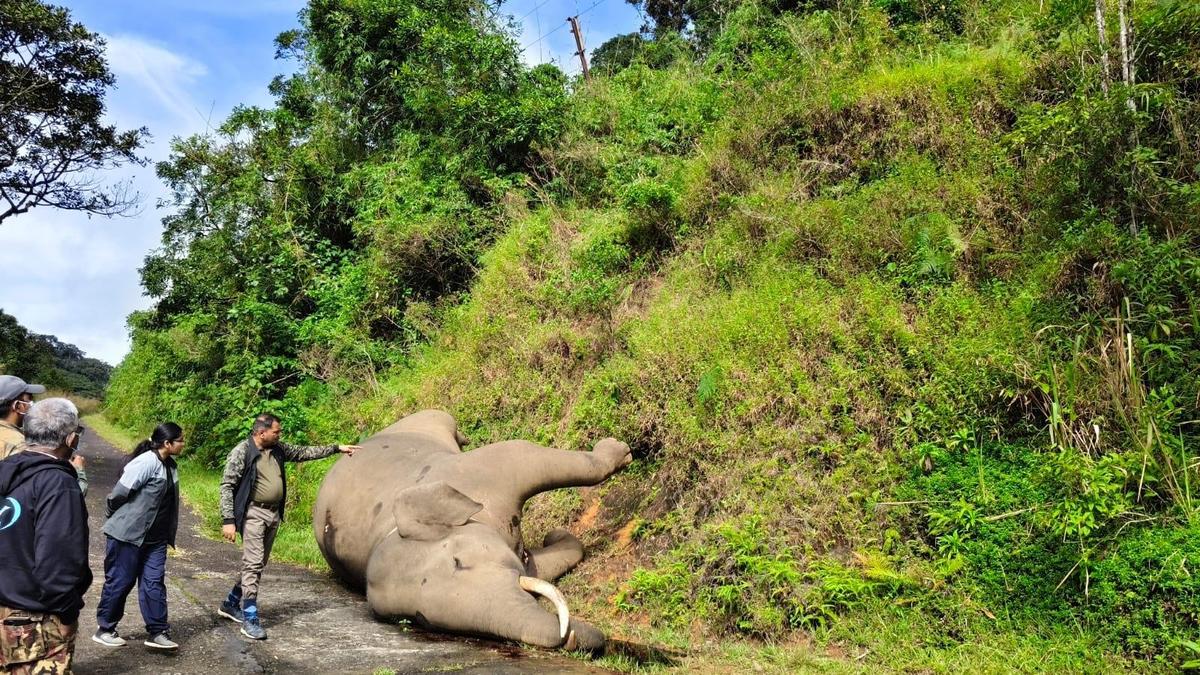
Forest Department officials inspecting the carcass of elephant Radhakrishnan at Upper Githaiyar area of Kalakkad Mundanthurai Tiger Reserve as the tusker suffered fatal fall on Tuesday.
| Photo Credit: SPECIAL ARRANGEMENT
The death of translocated tusker ‘Radhakrishnan’, which was found dead in the Upper Gothaiyar area of Kalakkad – Mundanthurai Tiger Reserve on last Tuesday, was due to multiple compound skull fractures and extensive haemorrhage resulting from a fall from height, leading to sudden collapse, the post-mortem report has concluded.
After ‘Radhakrishnan’ attacked a few houses and the humans while searching for food in Ayyankolli area in The Nilgiris, it was caught and rehabilitated in the Varakaliyar camp before being released in the Upper Gothaiyar area of KMTR on October 26 last. The 30-year-old animal was healthy, foraging well and actively moved around Upper Gothaiyar dam with the radio-collar fitted on the elephant. And, the forest personnel monitoring its movement received the signals from the radio-collar till 3.30 p.m. on November 16.
When the signals stopped, the search for the elephant started that eventually led to the detection of the dead ‘Radhakrishnan’ around 9 a.m. on November 18 suggesting that the animal might have breathed his last on last Sunday itself.
The post-mortem subsequently done on Thursday by Professor of Veterinary College and Research Institute, Ramaiyanpatti, Muthukrishnan and Assistant Professor of Pathology Kumar has found that the elephant had fatal fall from a height.
The post-mortem report said the carcass was found on a tar-topped slope below a 20-feet steep roadside cut, positioned head-down. Above the cut was an eight-meter gentle slope with a large rock at its upper-end and a medium-sized movable stone near the edge. Footmark impressions indicate that the animal first slipped with its right forelimb on the large rock, then inadvertently stepped on the movable stone with the left forelimb.
While attempting to regain balance, both legs knuckled at the edge causing the elephant to slip off the 20-feet drop and fall approximately 15 feet onto its right side on the hard tar surface. Absence of struggle or paddling marks at the site suggests an instantaneous death.
Even though the condition of the bloated carcass was good with well-built muscles and sub-cutaneous fat depositions, the fall had caused multiple and compound fractures in the skull to cause profuse bleeding from the trunk and mouth.
“The paranasal sinuses were filled with extensive hemorrhage and blood clots. Extensive subcutaneous hemorrhage on the right side of the body was found. There was no evidence of electrocution. Hence, the cause of the death was due to multiple compound skull fractures, severe trauma and extensive hemorrhage resulting from a fall from height, leading to sudden collapse,” the report concludes.
Published – November 20, 2025 06:35 pm IST