



The flute holds a revered place in Indian culture largely because of its association with Lord Krishna, who is also known as Venugopala. “The flute is the oldest musical instrument in the world,“ says senior flautist Prapancham S. Balachandran, who holds a Ph.D in the ‘Structural evolution of the flute’. “Flutes dating back to thousands of years have been found in Slovenia, Germany, France and other places. These were crafted from the bones of animals and birds,” shares Balachandran, a disciple of the legendary N. Ramani for 35 years.
“Flutes can be classified into four types — the end-blown flutes such as the Ney (from Iran), Omubanda (from Uganda), and Koauau (from New Zealand); Pan pipes, which are named after the Greek god Pan, has a number of pipes of varying length fixed together; whistle flutes, like the recorders, mentioned by Shakespeare and Milton, have a whistle fixed in the blowing hole and nose flutes, such as the Kalaleng of the Philippines. Then there are side-blown flutes, used in China, India and Europe.
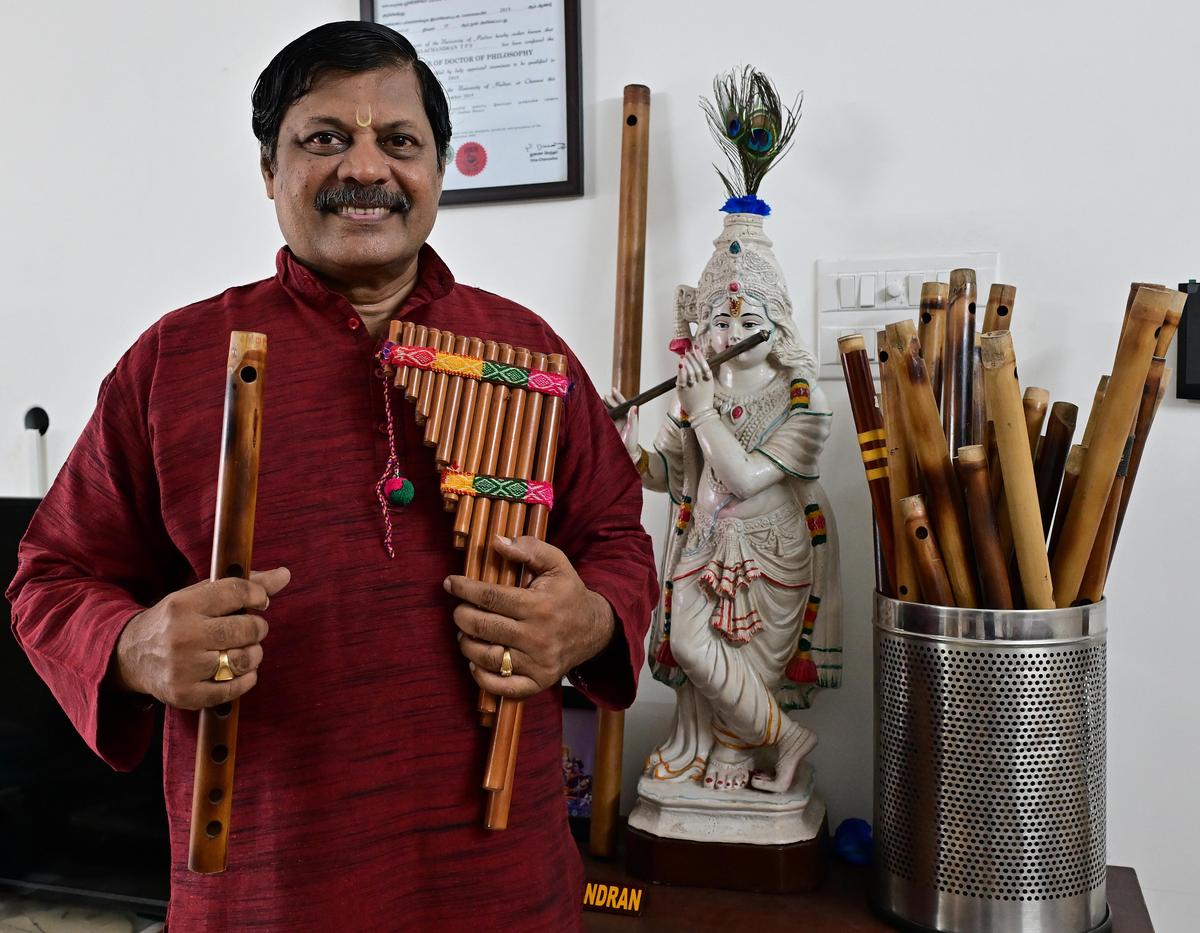
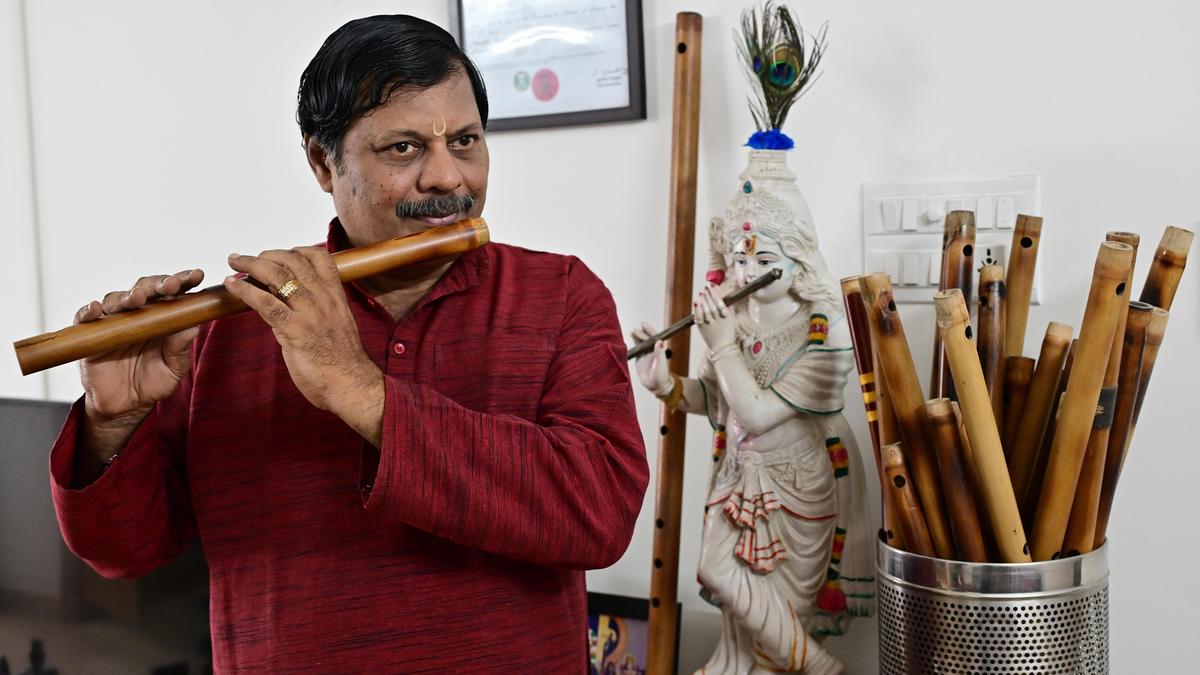
Senior flautist Prapancham Balachandran explains the different types of flutes and their evolution.
| Photo Credit:
VELANKANNI RAJ B
In India, in the Vedic period, bamboo flutes were called Murali, wooden ones were called Tunava and those made with the stalk of reeds were called Nadi. Flutes were played when Vedic hymns were chanted. Flutes were also called vamsi (vamsa-bamboo in Sanskrit).
What are the references to the flute in ancient Tamil literature? “Tholkappiyam says it is called pullankuzhal, because it is made of grass (pul means grass and bamboo is a grass). A verse in the Sangam work Ainkurunooru says that when air entered the holes made in bamboos by bees, the Ambal pann could be heard. Silappadikaram has lots of references to flutes,” says Balachandran.

Prapancham Balachandran mentions that the ancient text Silappadikaram has many references about flute.
| Photo Credit:
VELANKANNI RAJ B
What were the Ambal, Kondrai and Mullai flutes that Tamil literature talks about? “Dr. T.A. Dhanapandian has given detailed explanations about these in his book Pullankuzhal oru Ayvu. Adiyarkku Nallar, commentator for Silappadikaram, says that Ambal refers to both a pann and an instrument. The method of making a Kondrai flute is given in Kalithogai. The fruits of the Kondrai tree (Cassia fistula) are a little more than a foot in length. When the fruit dried up, one end was cut, the seeds were removed, holes were made, and the fruit was used as a flute. The method for making a flute out of the stalk of the Ambal (water lily) is not given in any text. While Adiyarkkunallar says that Kondrai was not a pann, Panchamarabu says it was a pann. Flutes used to be made with holes bored for specific panns, with as many holes as the swaras in the pann. Mullai Pann (Mohanam), Kondrai pann (Suddhasaveri) and Ambal pann (Suddha Dhanyasi) have five swaras. So flutes made for these panns had five holes. It is difficult to play gamakas in such flutes. In Suddha Dhanyasi if you do not play sadharana gandharam, the raga’s beauty is lost. So right from the Sangam period, South Indian flutes have been made for Harikamboji (suddha mela of ancient Tamil music). In orchestras (Amantirikai), the flute supplied the adhara sruti, and the yazh, tannumai and kudamuzha were tuned according to the sruti of the flute. There is a sculpture of an Amantirikai in the Darasuram temple,”, says Balachandran.

Flutes used to be made with holes bored for specific panns, with as many holes as the swaras in the pann, explains Balachandran.
| Photo Credit:
VELANKANNI RAJ B
When Balachandran was programme executive in the drama section of All India Radio, Chennai, he produced a drama on Anaya Nayanar. Sekkizhar says that Anaya Nayanar played the Sankarabharanam raga on the flute. So Balachandran played the Panchakshara mantra (Namasivaya) as a virutham in Sankarabharanam in this radio play.

Senior flautist Prapancham Balachandran is seen playing the clay flute.
| Photo Credit:
VELANKANNI RAJ B
Are the materials for making flutes specified in Tamil literature? “Panchamarabu says that bamboo is uthamam (best); bronze is madhyamam and karunkali, senkali and sandal are adhamam (not desirable). Bamboos growing in flat terrain, not affected by winds, not very young or old, and without cracks or twists were used. Measurements given in Panchamarabu conform to those of four kattai flutes of today,” says Bhageerathy, Balachandran’s PhD guide. She adds that he made a flute following the instructions given in Panchamarabu.
Balachandran describes the process of making flutes. The cut bamboos must be sun dried, until they turn yellow. They are coated on the inside and outside with pungai oil (made from the seeds of pongamia pinnata), to keep insects at bay, and then are dried in the shade. Panchamarabu says they must be dried in the shade for at least a year. Perumpanatrupadai says that a burning piece of wood was used to make holes in the bamboo. But these days, heated iron rods are used for the same. Then the swarasthanas are checked to get a perfect sound.
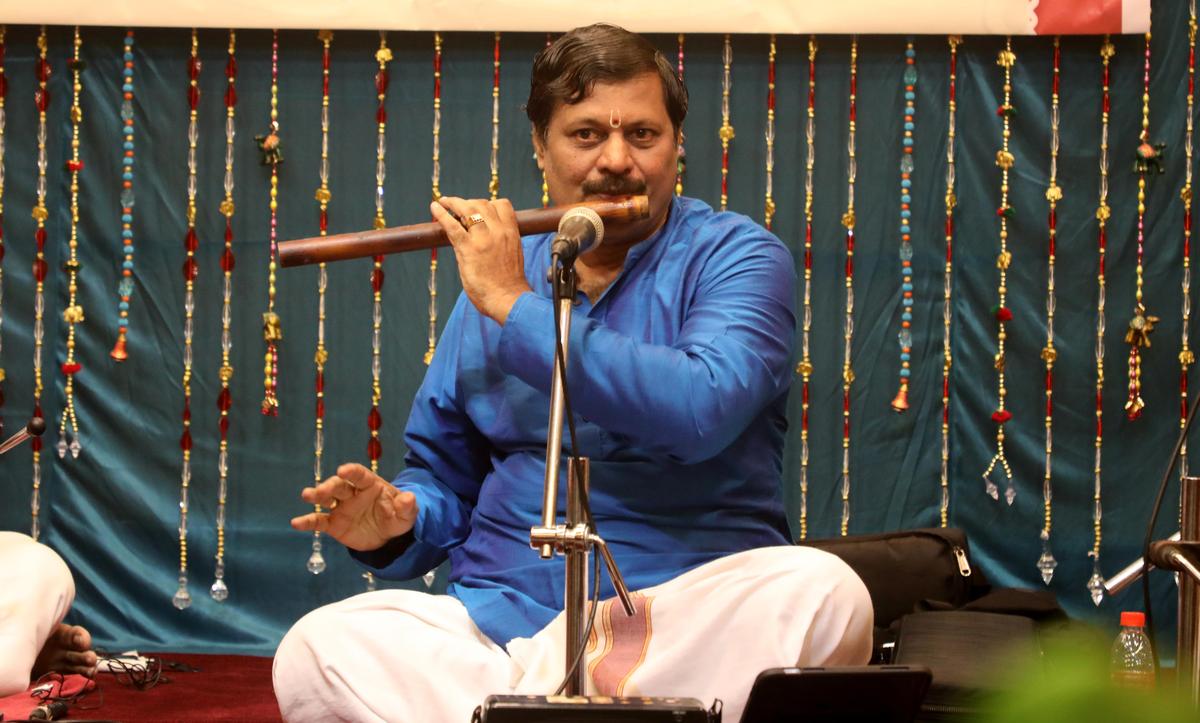
Prapancham Balachandran, during one of his concerts in Chennai in 2023.
| Photo Credit:
Akhila Easwaran
What are the differences between the North Indian bansuri and the South Indian flute? “The bansuri is longer. So there must be a considerable gap between the nodes in the bamboos used to make them. The gap between the thaana swaras is greater in the bansuri. Legendary flautist Pannalal Ghosh invented the seventh hole (madhyam hole) in the bansuri.”
In South India, there was a renaissance in flute playing in the 19th century, when Sarabha Sastri began to play the instrument. He is said to have played five kattai sruti flutes, as did later vidwans like Palladam Sanjeeva Rao, Thiruppamburam Swaminatha Pillai and T.R. Mahalingam (Mali). “These flutes were loud, and the music produced was often referred to as sweet shrillness,” says Balachandran. Mali tried heavier flutes. “It is tough to play tara sthayi swaras on such heavy flutes, because a lot of air has to be blown.” The next change came with N. Ramani. “With Ramani sir’s guidance, flute-maker Sankaralingam. made two and a half kattai flutes with a length of approximately 49 cms and a circumference of 8.38 cms. Thus Ramani sir began the trend of flutes with a lower sruti.”
Are there any rules for preservation of flutes? “They must be kept in a cloth bag, which must be placed in a wooden box. Panchamarabu says that we should tie a cloth on a long rod and clean the inside of the flute. These days neem oil and pungai oil are used. Once a month, the instrument must be washed and aired.”
Published – November 05, 2025 04:31 pm IST