



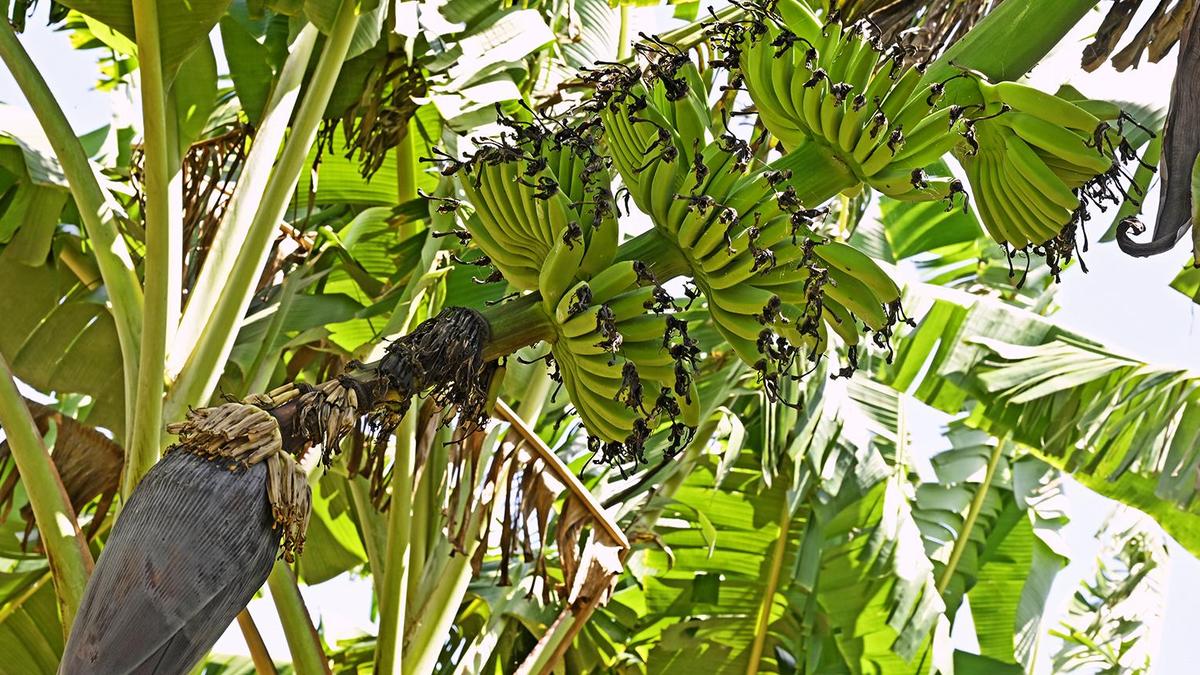

With farmers now receiving a one-time subsidy of ₹60,000 for cultivating Rasabale, the crop has been taken up in about 80 acres in Nanjangud. File.
| Photo Credit: K BHAGYA PRAKASH
The cultivation area of the GI-tagged Nanjangud Banana (Rasabale), known for its distinctive taste and grown exclusively in and around Nanjangud, has been gradually expanding due to concerted efforts by scientists and horticulture officials.
With farmers now receiving a one-time subsidy of ₹60,000 for cultivating Rasabale, the crop has been taken up in about 80 acres in Nanjangud. Though some farmers outside the region also grow the variety, it cannot be marketed as Nanjangud Rasabale owing to geographical indication (GI) restrictions.
A key reason, according to scientists, for the decline in Rasabale cultivation in earlier years was the outbreak of Panama wilt disease, which discouraged farmers from continuing with the crop. To restore confidence, scientists and horticulture officials are working in mission mode to introduce disease-control measures and provide healthy planting material.
The Department of Horticulture, the University of Horticultural Sciences (UHS), Bagalkot, and the JSS Krishi Vigyan Kendra, Suttur, with support from the National Centre for Banana, Tiruchi, have joined hands to protect and revive this heritage crop. The College of Horticulture, Yelwal (Mysuru), under UHS, is also contributing to the ongoing initiatives. Officials have set a target of expanding the cultivable area by at least 50 acres every year.
Other GI-tagged crops, including Mysuru Mallige (jasmine) and Mysuru Veeledele (betel leaf), are also being promoted alongside Rasabale under a budget scheme aimed at boosting production and enhancing value addition. Jasmine is currently cultivated in about 5 hectares, while veeledele covers nearly 100 hectares in Mysuru taluk.
Scientists from UHS have also developed post-harvest and value-added products from Rasabale to improve its market potential. These products were showcased at the GI Mahotsav 3.0, held on the CSIR-CFTRI campus in Mysuru, where Rasabale and its products drew considerable curiosity from visitors. Senior UHS scientists and horticulture officials briefed visitors on the crop and the revival efforts underway, including those for jasmine and betel leaf.
Expressing confidence in further expanding Rasabale cultivation, Joint Director of Horticulture Manjunath Angadi said the crop area is gradually increasing and urged farmers to utilise the subsidy and technical support being provided.
Girigowda Manjunath, Associate Professor, College of Horticulture, UHS, Mysuru said, “The biggest setback for Rasabale was Panama wilt disease, which discouraged farmers and led to a sharp decline in cultivation. We are now addressing these challenges with effective solutions and helping farmers regain confidence. Our efforts are yielding positive results.”
Published – December 07, 2025 04:52 pm IST