




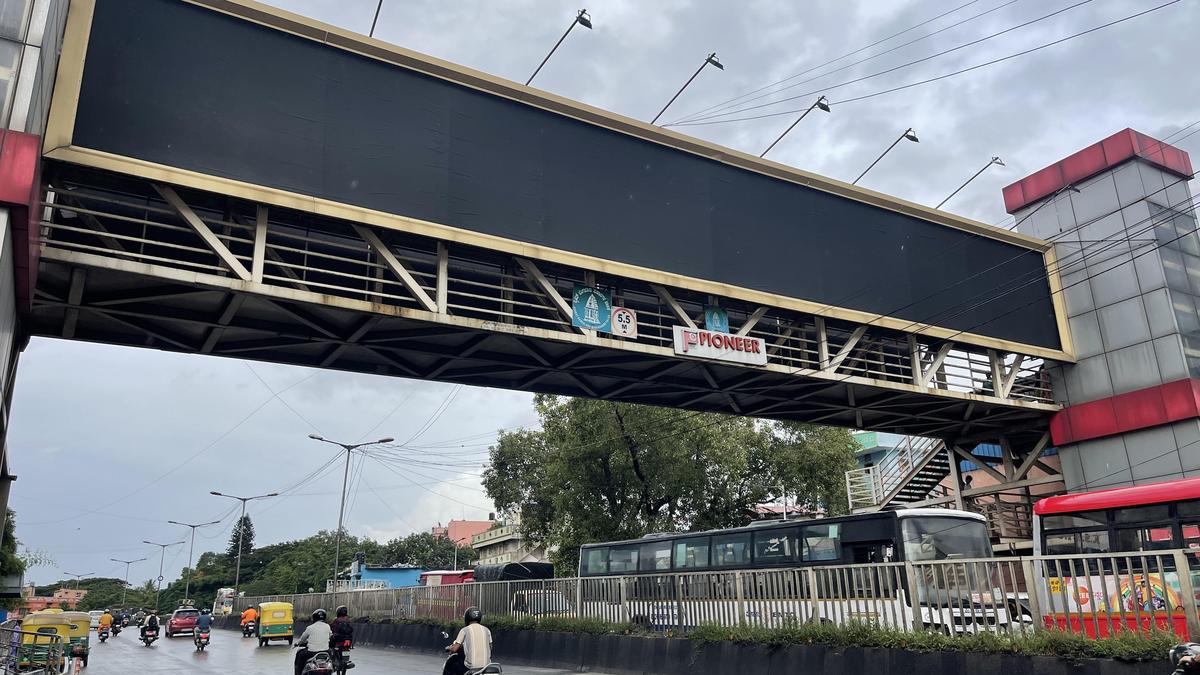


Although the pre-bid meeting was attended by over 50 companies, only two firms expressed interest in participating.
| Photo Credit: File photo
After a seven-year ban, the erstwhile Bruhat Bengaluru Mahanagara Palike (BBMP) drafted new advertisement bylaws with high hopes of generating ₹500 crore in revenue. However, the new bylaws have failed to impress advertising firms.
The advertisement tenders floated by the BBMP in the last week of July were cancelled by the Greater Bengaluru Authority (GBA) following a lack of interest from bidders, a well-placed source in the civic body told The Hindu. Although the pre-bid meeting was attended by over 50 companies, only two firms expressed interest in participating.
The BBMP had divided the tenders into eight packages, meaning each firm would hold advertising rights in one specific zone of the civic body.
“Although two companies showed interest, neither of them completed the tender process. We couldn’t proceed with the bidding,” the source said. However, officials had anticipated the firms’ disinterest.
Modelled on Delhi’s advertising laws, the Karnataka government’s advertisement bylaws required the winning bidder to pay an upfront fee equal to five times the bid amount. This particular clause was flagged by the firms during the pre-bid meeting. The rule, considered a “costly affair”, discouraged smaller companies from participating even before the process began.
Setback for tunnel roads
This is a setback for the State government’s big-ticket Tunnel Road project as well. B-SMILE, which has received a sanction from the Housing and Urban Development Corporation (HUDCO), had promised to transfer advertisement revenue, along with premium Floor Area Ratio (FAR) revenue, towards loan interest payments. Now, with firms showing disinterest, the onus is on the GBA to come up with rules that attract and encourage advertising companies, especially with the loan sanction at stake.
Advertisers’ concerns
An advertising company owner noted that civic body tenders have traditionally attracted wide participation from local firms, but this one’s “unnecessarily high costs” kept them away.
“There were also technical flaws, such as limited time to obtain the No Objection Certificate (NOC) from the advertising department and the absence of clear instructions on how to apply for fresh advertising rights,” he said, adding that the new bylaws required firms to obtain fresh rights. According to GBA sources, only 10 firms applied for these new advertising rights.
Additionally, obtaining an NOC from the advertising department required the submission of historical documents to verify the company’s track record, something most local firms lacked. Similar concerns were raised before the civic body.
Adding new rules
The source told The Hindu that the civic body has now gone back to the drawing board to frame new rules.
“All the requisitions from companies have been taken into account and the civic body is revisiting the laws to identify gaps. Changes can be expected wherever absolutely necessary,” the source said, adding that the revisions aim to address flaws in the existing bylaws.
Meanwhile, local firms are closely watching developments and hope the GBA will address the high-cost concerns and make room for smaller players.
The GBA is yet to decide who will float the new tenders, the newly formed corporations or the GBA.
Published – November 01, 2025 07:21 pm IST