



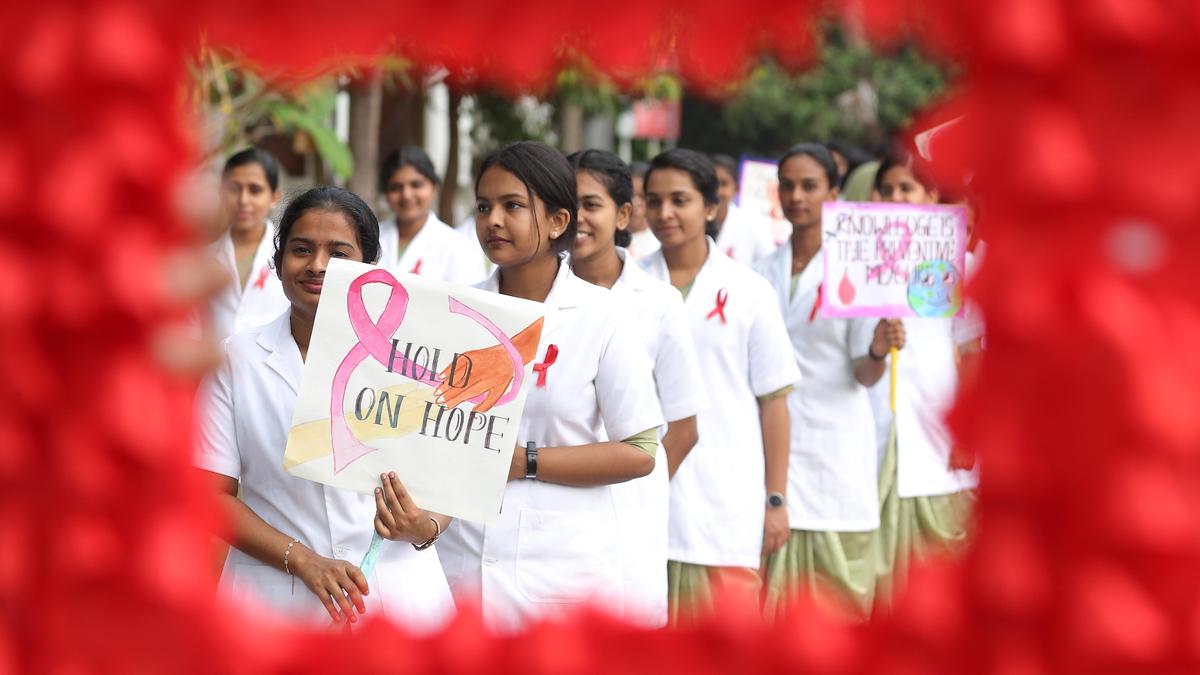

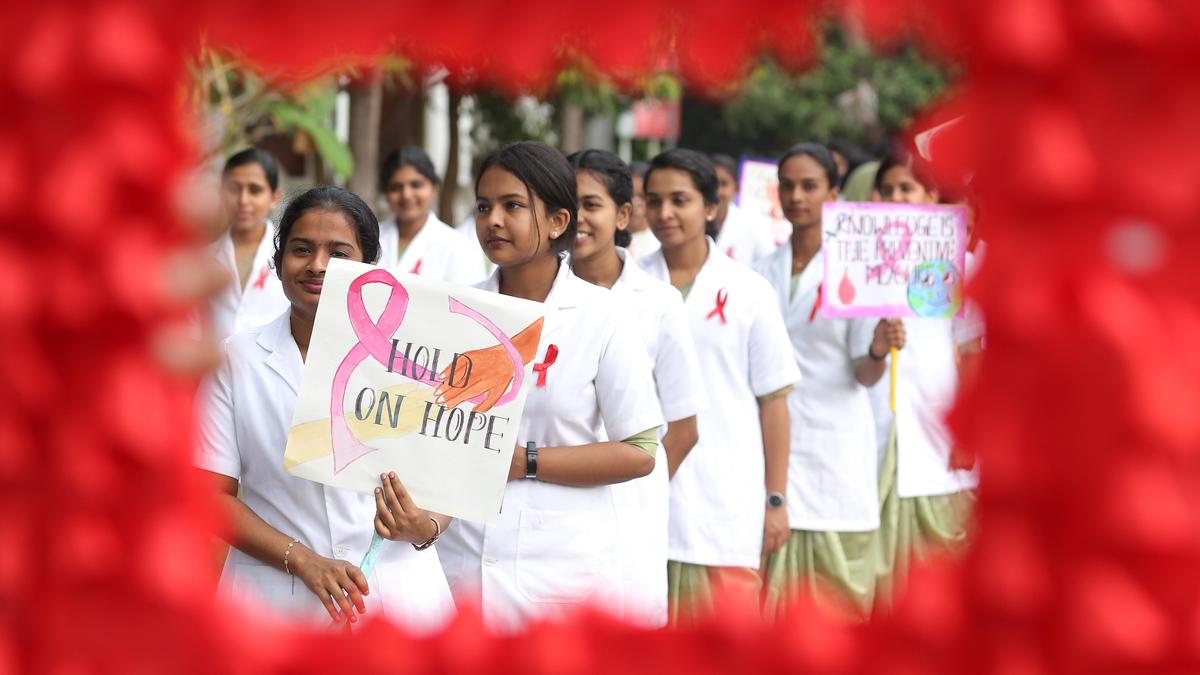
An awareness rally organised by the Kerala State AIDS Control Society, District AIDS Control Unit, District Medical Office (Health), and Chavara Cultural Centre in Kochi on Monday, marking the World AIDS Day observance.
| Photo Credit: R.K. Nithin
Kerala has one of the lowest HIV prevalence rates in the country at 0.07% as against the national prevalence rate of 0.20%.
However, the State’s concerns regarding HIV stems from the fact that new HIV infections have been going up steadily in the State amongst the 15-24 year age group in the past three years.
When read together with the fact that 62.6% of the individuals who contracted HIV in the past three years in Kerala had got the infection through unsafe heterosexual sex involving multiple partners, the emerging picture is indeed concerning.
1,213 infections in 2024
Going by the data available with the Kerala State AIDS Control Society, the State reported 1,213 new HIV infections in 2024. The State has a total of 23,608 people living with HIV.
In the three years between 2022 and 2025 (October), Kerala detected 4,477 new HIV cases. While the majority are men (3,393), there are 1,065 women (of whom 90 are pregnant women) and 19 transgenders.
“New infections during this three-year period have more or less been steady. However, what is alarming is the steady increase in new HIV infections in the 15-24 year age group in Kerala. In 2022, new infections in the 15-24 year age group was 9%, which increased to 12% in 2023 and 14.2% in 2024,” a senior official pointed out.
In 2025, between April and October, the proportion of new HIV infections among the 15-24 year age group has already touched 15.4%, indicating that HIV prevention activities and messaging will have to be intensified in this vulnerable age group.
KSACS’ data shows that amongst those who contracted HIV between 2022 April and 2025 October, 62.6% of the individuals got infected through the heterosexual route, involving multiple partners.
During the same period, while 24.6% of individuals contracted the infection through homosexual or bisexual route, 8.1 % who contracted the infection were injecting drug users, who indulged in needle sharing. Mother-to-child transmission accounted for 0.9% of the cases. In the case of 3.7% infections, the reasons are unknown or non-specific and in 0.1 %, there could be more than one reason.
Going by the trend in new infections, the KSACS reckons that Ernakulam, Thiruvananthapuram, Thrissur and Kozhikode are the priority districts for HIV prevention programmes for the State, in that order.
Kerala remains a low-prevalence, high-performance State in HIV control and leads in viral load suppression and service coverage. But it has its task cut out . The State will have to accelerate its HIV prevention activities amongst the youth, as well as mobile populations and specifically address the gaps in awareness and behavioural aspects.
Published – December 01, 2025 09:29 pm IST