


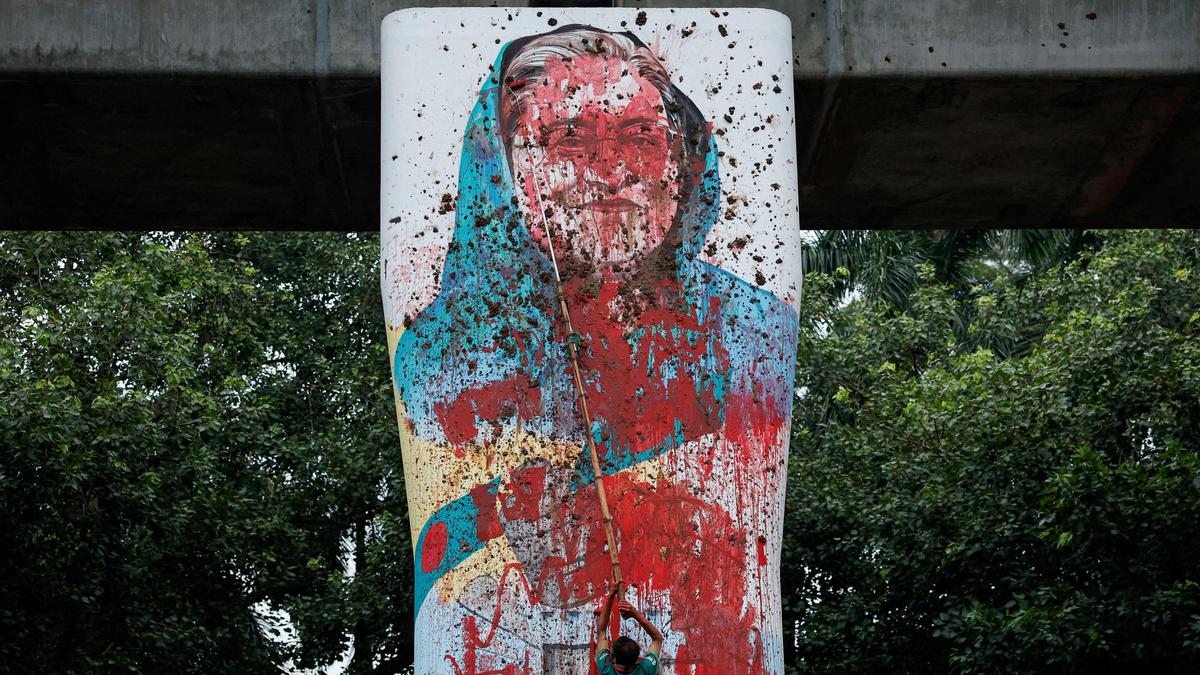

As Bangladesh’s National Security Advisor Khalilur Rahman arrived in New Delhi on Tuesday (November 18, 2025), and Dhaka prepares a ‘note verbale’, the Indian government is considering its response to Bangladesh’s demand for the extradition of its former Prime Minister Sheikh Hasina.
During his visit to Delhi, Mr. Rahman is expected to meet with NSA Ajit Doval and attend the Colombo Security Conclave, which includes India, Sri Lanka, Maldives, Mauritius, and Bangladesh.

Officials and experts are clear that Ms. Hasina — who has lived in New Delhi since last August — is and will remain an “honoured guest”. However, they also point out that according to the India-Bangladesh mutual extradition treaty signed in 2013, there are many steps yet to be followed by the administration of Chief Executive Muhammad Yunus before the government needs to proceed. In addition, a big question looms over the legitimacy of Bangladesh’s International Crimes Tribunal, which was set up in 2009 by Ms. Hasina herself to prosecute those accused of war crimes during the 1971 Bangladesh liberation war.

‘No formal extradition request yet’
In its statement reacting to the death sentence that the ICT handed down to Ms. Hasina on Monday, after her conviction for ordering the killing of anti-government protestors between June and August 2024, the Ministry of External Affairs said that it would “engage constructively with all stakeholders”, indicating it will not be rushed into a definitive “yes or no” response.

“Let us be clear that so far India has not received a single formal extradition request,” said Veena Sikri, who served as India’s High Commissioner to Bangladesh from 2003 to 2006. “A press statement is not a formal request – the process for an extradition is very complex and legal,” Ms. Sikri added. As a “first step”, she said, a formal request would have to include the ICT’s Monday order along with all the evidence provided, explaining the legitimacy of the court itself and the trial process details as well.
Once a request is received, officials said, the government will have to assess it against its obligations under the 2013 agreement signed by then-Home Minister Sushil Kumar Shinde during a visit to Dhaka. That agreement was meant to smoothen the path for the extradition of criminals and terrorists wanted in India, including ULFA leader Anup Chetia, who was transferred to India in 2015.

Treaty exceptions
The 2013 agreement came as Ms. Hasina faced international criticism for setting up the ICT to try the killers of her father Sheikh Mujib ur Rahman, and others who colluded with Pakistan during the liberation war, expanding the mandate of Bangladesh’s International Crimes (Tribunals) Act, 1973. The ICT’s death sentences — especially against 66-year old Opposition BNP leader and six-time MP Salahuddin Qader Chowdhury, and 73-year old Jamaat e Islami chief Motiur Rahman Nizami, among the six accused hanged between 2013 and 2016 — led to accusations that the Hasina government was targeting political opponents through the court. India’s support had helped Ms. Hasina at the time.
However, the 2013 treaty itself makes many exceptions the government could use to defend its grant of refuge to Ms. Hasina. Article 6 of the extradition treaty refers to the “The Political Offence Exception”, that allows the parties to refuse an extradition if it is for an “offence of a political character” (Article 6(1)). However, Article 6(2) also says that if the offence is for murder, incitement to murder, and a number of other charges, then these cannot be considered “political”. As a result, the article leaves room for interpretation, officials said.
Article 8 of the extradition treaty sets out more than six other grounds for the refusal of an extradition request and says that if the accused “satisfies” the requested state (in this case, India) that the charges are “unjust or oppressive” or “not made in good faith in the interests of justice”, the extradition may be denied.
Full trial possible
Another option would be to honour the extradition request and to initiate a process based on the Bangladeshi request. This would involve a full extradition trial, where Ms. Hasina would be able to respond to the charges against her, something she has been unable to do in Bangladesh.
Finally, New Delhi could choose not to accept the validity of the ICT. Under the extradition treaty, the warrant must be issued by a “judge, magistrate or other competent authority”.
Experts, including former diplomats, pointed to the irony of the ICT set up by Ms. Hasina, which was decried as “illegal and unconstitutional” by the Opposition parties, now being used to convict and sentence her in turn. The appointment of Tajul Islam as the ICT’s chief prosecutor is particularly ironic, given that he was earlier the chief defence lawyer for the Jamaat-e-Islami. The appointment of U.K. human rights lawyer Toby Cadman as advisor to the prosecutor, given that he had challenged the validity of the ICT’s verdicts a decade ago, also represents a “conflict of interest”, experts said.
The experts also pointed out that while India has no refugee policy per se, it has a long tradition of providing shelter to those requesting it, regardless of the foreign policy implications. Examples range from the Dalai Lama, who fled to India in 1959 and his Tibetan followers who have followed due to the Chinese takeover, to Sri Lankan Tamils in the 1980s, Afghans fleeing the Taliban in 1996, and the Rohingya from Myanmar in the 2010s.
Published – November 18, 2025 09:26 pm IST