



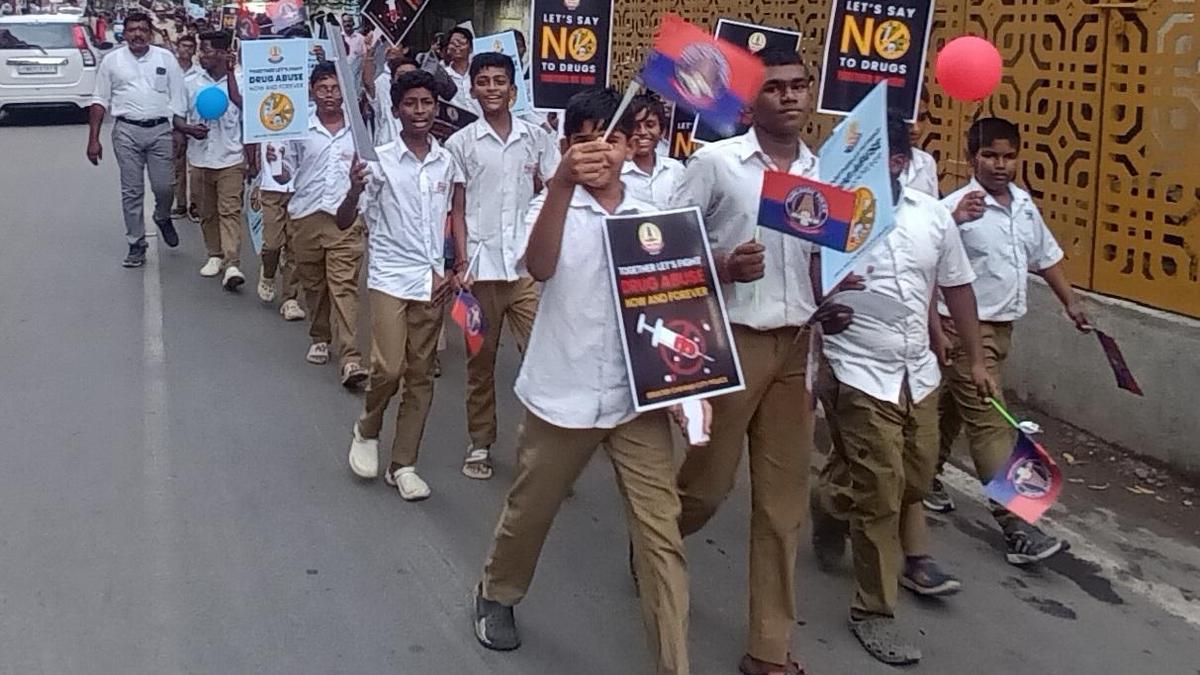

Police officials and school students hold an anti drug awareness rally in Chennai.
| Photo Credit: RAGU R
It is one year since the Tamil Nadu government mandated that educational institutions establish ‘anti-drug clubs’ and form ‘volunteer teams’ to create awareness, prevent drug abuse and promote a drug-free lifestyle.
As a result of this, over the last one year in Chennai, schools and colleges have come up with innovative campaign ideas to combat the scourge of drugs.
According to the office of the regional joint director, Directorate of Collegiate Education, each of the 64 arts and science and B.Ed colleges in Chennai under its jurisdiction has not only formed a club but taken proactive measure to ensure there is maximum reach both inside and outside the classroom.

Some of the institutions have more than one club, established in keeping with the strength of the college. “We get reports from colleges every month and we have a meeting in the Collectorate as well to discuss the activities under Drug Free Tamil Nadu. Due to regular follow-ups, these clubs are active,” says K. Sudarkodi, regional joint director, Directorate of Collegiate Education.
Colleges run competitions and activities. The Government gets them to have an essay writing programme and a marathon to create more awareness about the issue.
Asking certain institutions to take up a survey in the neighbourhood with student volunteers to understand the prevalence of narcotics use has been another step in a data-based approach to tackling this issue.

Along with other law enforcement departments such as Greater Chennai City Police and the Excise Department, Chennai is fighting a smart and relentless war to eradicate drugs, say experts.
Anti-trafficking clubs
Involving the youth as allies in this war is a major step.
P.M. Nair, retired Director General of Police, NDRF, who has been working with educational institutions to set up Anti Human Trafficking Clubs, says investing in youth through such clubs is a good practice as they listen, take it forward and will become ambassadors of the initiative.
“We are creating a new generation of people who are aware of national security,” says the retired IPS officer and an expert working against human trafficking.

He suggests that the State Government undertake both a qualitative and quantitative study to understand the impact of such clubs in fighting narcotics.
As an extension of the anti-drug clubs in educational institutions, Nair says anti-human trafficking clubs should also be brought into its fold. As per United Nations convention against transnational organised crime, there are three types of organised trafficking — arms, drugs and humans. “Drug menace is a known problem while human trafficking is not as much of a known problem, but both are serious issues affecting youth. We should empower boys and girls on both issues,” he says.
The Mizoram model of involving the community to fight drugs is also worth emulating. Here we can involve Panchayats who will spread it at the grassroots level.
Published – December 01, 2025 01:57 pm IST