


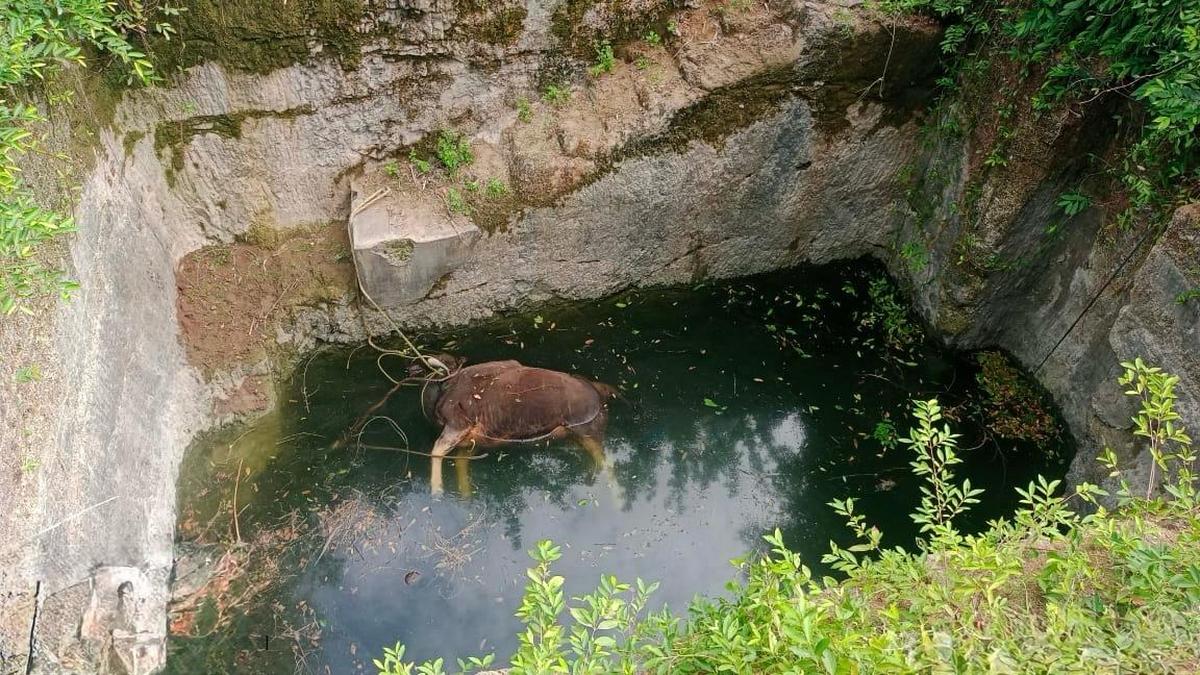

A carcass of gaur floating in a well in Thuvarankurichi forest range limits.
| Photo Credit: Special Arrangement
In late September, an adult gaur died after falling into an open well in the reserve forest in Thuvarankurichi range in Tiruchi district. The incident came to light next morning after a man found the carcass of the female bovine floating in the well.
The carcass was taken out with great difficult from the well which had water up to a depth of 30 feet. A couple of days ago, a three-year-old spotted male deer fell and died in an open well at Pannapatti in Manapparai forest range. Another spotted deer was found dead in a well at Thadhamalaipatti in the same forest range in early September.
A gaur fell into a well recently in Thuvarankurichi forest range limits. However, the team managed to safely rescue the animal. These are the latest incidents to be reported although similar instances have occurred in the past in Thuvarankurichi and Manapparai forest ranges which have several reserve forests under its respective limits.
These cases have brought under spotlight the challenges posed to the Forest Department officials with regard to open wells in the vicinity of reserve forests in Thuvarankurichi and Manapparai ranges. “Absence of a parapet or even temporary fence around such open wells has led to wild animals falling into them while moving in search of food and water at night,” say field-level Forest Department officials.
The Thuvarankurichi forest range alone accounts for 11 reserve forests where there is a sizeable number of gaurs besides spotted deer, monkeys, and birds. Forest officials say that there were over 250 open wells belonging to private individuals in the 5km-8km radius of reserve forests.
The two recent instances in Thuvarankurichi forest range were reported about one kilometre away from the Velamalai and the Periyamalai reserve forest. The Manapparai forest range has 26 reserve forests with several open wells in its vicinity. The depth of these open wells are about 45 to 50 feet with most of them not having steps inside.
The duration of the rescue operation depends on the animal, its size and the depth of the well. “It takes a whole day to rescue a trapped gaur from an open well as the operation requires a lot of planning and removal of water,” say the officials. “The operation has to be carried out meticulously with assistance from the locals and fire fighters along with necessary paraphernalia to lift the trapped live animal”.
Open wells also pose a hazard to humans at night. A 35-year-old man, while driving a tractor for ploughing, fell into an open well along with the vehicle near the Kannuthu reserve forest and died.
Field-level officials say they have been sensitising the local people on the need to erect a parapet or put up temporary fence around open wells. The officials have conveyed this message to the panchayat heads and to the rural development officials concerned emphasising the need to put up protective measures around open wells to safeguard wild animals and humans from falling into them.
Published – November 03, 2025 09:40 pm IST