




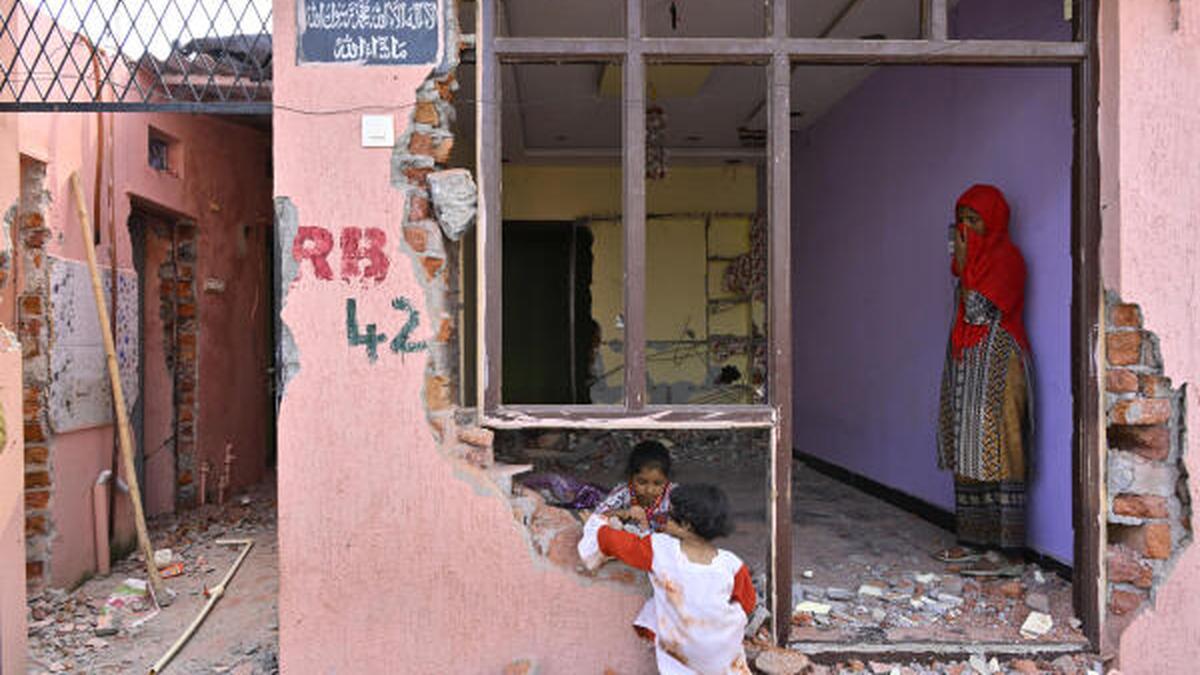

In the ten-storey apartment block in Pilligudiselu, Saidabad, Hyderabad, at least seven children spill into the corridors, running, playing, and lingering in the open spaces. Among them is 13-year-old Afreen (name changed), along with other children. Anyone who pauses to speak with them hears their shyly expressed aspirations: a doctor, a soldier, a police officer. But little do they know that these dreams are slowly slipping out of reach.
Their lives changed on October 1, 2024, when their homes, among 160 structures in Shankarnagar Colony, Old Malakpet, along the Musi River, were demolished under the Musi River Development Project. Following the demolition, most families from Shankarnagar were relocated to government-built two-bedroom, hall and kitchen (2BHK) units in Saidabad, about three kilometres from their former neighbourhood. The government promised them ₹25,000 shifting assistance and ₹2 lakh financial aid. A few families, however, said they had also been allocated 2BHKs to locations nearly 20 kilometres away.
The fruitless search for schools
As families moved into new houses, many of those this reporter spoke to said their economic activity had been sharply disrupted. The immediate and long-term consequences of this instability are most visible among children, who not only witnessed the demolition of their homes but are struggling to adjust to unfamiliar surroundings and rebuild a sense of stability. The majority of the families relocated to Saidabad belong to the Muslim community, primarily the lower-middle class. Some families enrolled their children in government residential schools, hoping to maintain continuity in their education. Others continued sending their children to their old schools.
But for many, especially girls and boys from households where the breadwinner is absent due to addiction, death, or ill health, even these limited arrangements are now beginning to fall apart.
Before the demolition, Afreen, a Class 4 student, attended a nearby private school along with her sisters in Class 3 and UKG. The school fees, ranging between ₹300 and ₹500 per child per month, were manageable, and the school was within walking distance. Their mother, both the breadwinner and the homemaker, earned ₹5,000–₹6,000 a month working as a cook, setting aside nearly ₹1,500 of it for her daughters’ education.
“Though it was hard, I kept working because I wanted my children to study. But now I can’t afford it any more, as I haven’t been able to find work here, and I can’t go back to my old workplace because of the distance,” she said.
“We have been allotted a house in Pratap Singaram, 20 kms away, just a couple of days ago. I am hesitant to move there. Going that far would mean being completely cut off from my family,” she said adding she was living with her in-laws and hasn’t received monetary compensation.
Meanwhile, at least two boys in their early teens have begun wage work in the absence of their fathers, as their mothers have been unable to find work after relocating. “I wanted my son to go to school, but I can’t afford a private one,” said a mother. “I am willing to put him in a nearby trust school, as he wants to study.”
M W Ansari, founder member and head of Kurmaguda Academy for Relief and Education (KARE) Trust School in the locality, says his school saw an immediate rise in admission requests in the middle of the academic year after families moved into the 2BHK units. “Ours is a trust-run school with small classrooms, meant to serve underprivileged children. We couldn’t accommodate the new students, but we didn’t have the heart to say no, though ultimately, we had to,” he said.
Accoridng to him, the families are not keen to enrol their children in a nearby government school. “There are multiple concerns, like addiction and bullying.” For those who have been newly relocated, there should ideally be a separate school or arrangement for them, he added.
Children look after toddlers, take up work
Similar patterns are visible in other demolition-affected communities in Mumbai and Chennai too.
More than 600 families from Jai Bhim Nagar in Powai were displaced during the Brihanmumbai Municipal Corporation’s (BMC) demolition drive in June last year. Most of the displaced families belong to the Scheduled Caste. The BMC’s anti-encroachment operation uprooted residents from a settlement that had taken shape in the early 2000s, during a period when Maharashtra’s Mumbai real estate sector was rapidly expanding.
Huma Namal of Sabki Library, a student-run organisation in Mumbai set up to support the community, says it was estimated roughly 20% of the around 250 children in the settlement, were either out of school or had their regular schooling severely disrupted. The library, which had been set up on the footpath, was also demolished this year.
Among those who dropped out of school is a 17-year-old girl. She has since enrolled in open schooling. Her days now begin as a domestic help from 9 a.m. to 5 p.m., followed by tuition classes from 6 p.m. to 9 p.m.
Many other girls and her male cousins faced similar disruptions. She told this reporter over phone that, before the demolition, families relied heavily on their community network: mothers would leave their kindergarten-age children with relatives living nearby, and the settlement had open spaces where children played safely. Expenses were minimal apart from the electricity bill, and her mother’s income, supplemented by ration support, was just enough to manage.
Everything changed after the demolition. While some families continued living on the footpath beside the cleared site, others were pushed out again when the footpath on the opposite side was cleared this August. “So we had to look for a house to rent, and the rents here range between ₹10,000 and ₹15,000. Now that we have managed to find a place, I have also started going to work along with my brother, who left regular schooling and joined a vocational training course after Class 10, and my mother,” she added.
Her aunt, who joined the call, says she goes to work during the day, leaving her small child in the care of her two elder daughters, who were in Classes 9 and 7. The family continues to live beside the footpath, where, she says, the toddler often ends up wandering dangerously close to the road. As a result, schooling for the two older girls has been disrupted.
Activist calls for child plan before evictions
Across urban resettlement sites in India, demolitions and relocations disrupt schooling, fracture community support systems, and deepen vulnerabilities, says Vanessa Peter of Information and Resource Centre for the Deprived Urban Communities (IRCDUC). According to her, since the early 2000s, more than 43,000 resettlement tenements have been constructed in Kannagi Nagar and Ezhil Nagar, and in Perumbakkam in Chennai. Families at the brunt of this predominantly belong to the SC and BC communities.
A survey by IRCDUC in Ezhil Nagar identified 112 children who had discontinued their education after relocation. Of these, only 47 have been re-enrolled in school by IRCDUC. Ms. Peter says bringing the remaining children back into the education system has been extremely difficult.
“From ground experience, forcible eviction destroys a child’s environment, documents, community support, access to school, safety, income stability, and mental well-being, all of which make re-admission extremely challenging. Inter-community hostility and bullying also push children out of school, as newly relocated children often struggle to find acceptance or a sense of belonging in their new surroundings,” she said.
One of the fundamental issues that needs attention is the absence of any proper assessment before eviction. State governments and even the Centre often treat the basic enumeration exercise as a substitute for a Social Impact Assessment (SIA), says she. But enumeration records only rudimentary family details. It does not capture a child’s schooling status, class level, learning needs, vulnerabilities, health issues, or even the distance they travel to school. As a result, the specific educational requirements of children are never mapped or planned for before families are relocated, leaving them to bear the brunt of the disruption. There is also no clear legal mandate requiring an SIA before an eviction is carried out.
These children, she says, face some of the most immediate and long-lasting consequences of forced resettlement, as education, the very tool that could enable mobility and lift families out of poverty, is denied to them. Their families, meanwhile, are struggling with severe economic instability and are focused simply on securing their next source of income. She adds that the system must have a proper child-care and support plan in place during such evictions, because even within the same community, children’s mental and physical health needs vary greatly. Many of them, having witnessed their homes being torn down, continue to carry the emotional and psychological effects long after the demolition.
(This is written by Bhaskar Basava, an independent journalist based in Hyderabad, covering politics, human rights, and environmental issues, primarily from Andhra Pradesh and Telangana. He is now expanding his work to include education across all States.)
(Sign up for THEdge, The Hindu’s weekly education newsletter.)