





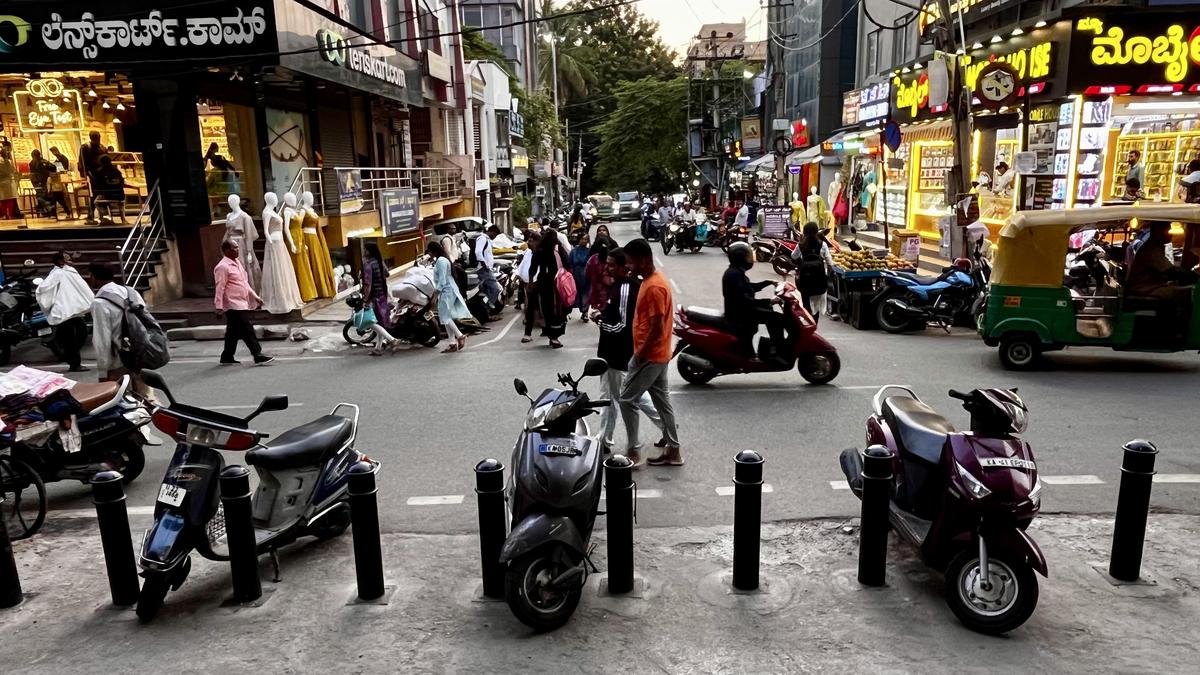

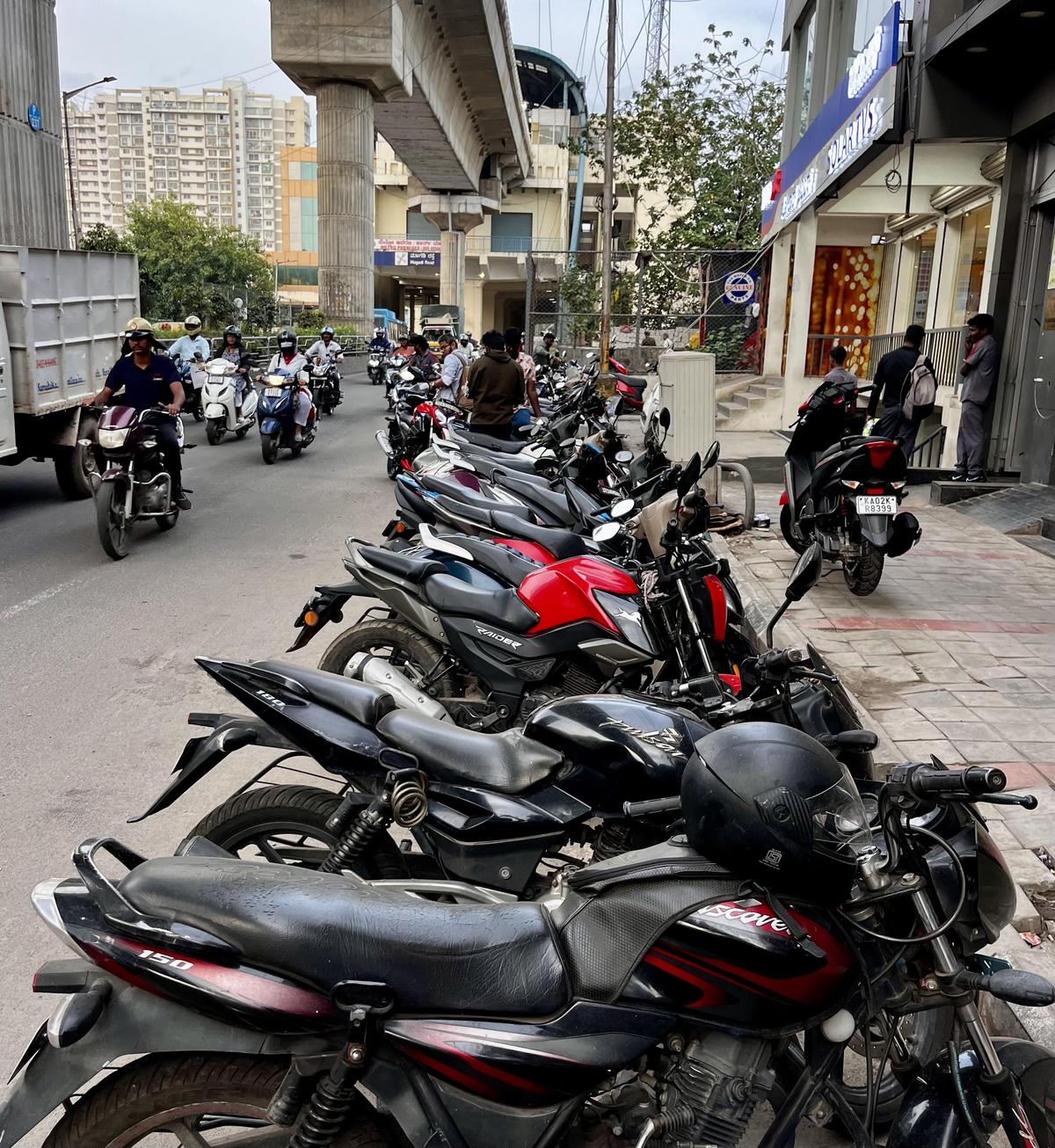
Unauthorised two-wheeler parking near a metro station in Bengaluru.
| Photo Credit:
SUDHAKARA JAIN
Parking woes around Namma Metro stations are intensifying, with limited or non-existent designated parking at many stations forcing commuters to leave their vehicles on surrounding roads, often in what were quiet residential neighbourhoods.
As Bengaluru’s Metro network expands and ridership grows at average 10 lakh every day, the struggle for space has become a daily ordeal for both residents and commuters.
Only 66 stations
Across the 96-km network, the Bangalore Metro Rail Corporation Ltd. (BMRCL) has designated parking at only 66 of the 83 stations, accommodating about 12,000 two-wheelers and 2,300 cars.
A visit by The Hindu reporters to several high footfall stations across the Purple, Green, and Yellow Lines found that parking facilities fall drastically short of demand. Commuters are found routinely parking on nearby bylanes, in front of houses, parks, and even across private gates, creating friction with residents and adding to congestion.
On R.V. Road, the major interchange between the Green Line and the newly inaugurated Yellow Line, the shortage is acute. The station sits amid a residential pocket, and commuters park all along the lanes.
Somashekhar N.R., a resident of Jayanagar 5th Block, said, “I am a senior citizen. Every morning and evening, I go for a walk in the Rose Garden near R.V. Road Metro station. But right in front of the park gate, two-wheelers and cars are parked. It is difficult to even enter.”
Suma R. from Jayanagar said that despite putting up ‘No Parking’ signs outside her house, people continue to leave their vehicles across her gate. “Now, I have placed big stones so that nobody can park. Parking issue has worsened after the Yellow Line opened,” she said.
At the Attiguppe Metro Station on the Purple Line, the approach road from RPC Layout is perpetually packed with two-wheelers. Commuters, many of them office-goers, park from early morning until late night along the road and adjoining lanes. The presence of a private school next to the station adds to the chaos during morning and afternoon hours, as the vehicles of parents jostle with commuters for space.
Full parking
At the Jalahalli Metro Station on the Green Line, even the dedicated parking available fails to meet demand. By 9.30 a.m., parking lots at Jalahalli, Peenya Industry, and Peenya stations are full.
Sandeep Kumar, a regular commuter on the Green Line, said he spends several minutes each day searching for a spot. “Once Jalahalli’s lot is full, cars spill over onto the service road of Tumakuru Road, which worsens congestion,” he said.
The Purple Line’s Challaghatta and Kengeri Metro stations have become major entry points for people travelling to Bengaluru from Ramanagara, Bidadi, Channapatna and other towns along the Bengaluru-Mysuru access-controlled highway.
Challaghatta, the first station for commuters entering the city from Mysuru Road, has parking space only for a small number of vehicles. Hundreds end up parking in residential pockets. “I park at the Kengeri Bus Terminal Metro station, and sometimes in residential areas,” said Santhosh N. from Bidadi, who travels daily to Bengaluru for work.
Ironically, the Kengeri Metro Station itself has no dedicated parking, leaving commuters dependent on the Kengeri Bus Terminal station nearby, a facility that is stretched far beyond its designed capacity.
At Indiranagar, a busy station on the Purple Line which was the stretch first opened in the network, the small parking facility fills up before 9 a.m. Commuters then park along 9th A Main Road and 10th A Main Road, both residential streets.
Commuters from Jeevan Bima Nagar, Malleshpalya, HAL 2nd Stage, Domlur, and Koramangala often leave their vehicles used for last mile connectivity on residential lanes. Abhinav Sarma, a resident of Koramangala, who uses Indiranagar station to commute to Brookefield, said lack of space forces him to park in the parallel lane.
High land costs
The BMRCL officials cited high land acquisition costs as a major reason for this issue. “Space constraints, particularly in central neighbourhoods, make it difficult to create large parking lots,” an official said.
He said newer corridors such as the Yellow Line have been designed with a greater focus on two-wheeler parking due to limited land availability. At the same time, the BMRCL is working on constructing multi-level parking structures at major stations like K.R. Pura and Majestic, he added.
Published – December 13, 2025 10:29 pm IST