



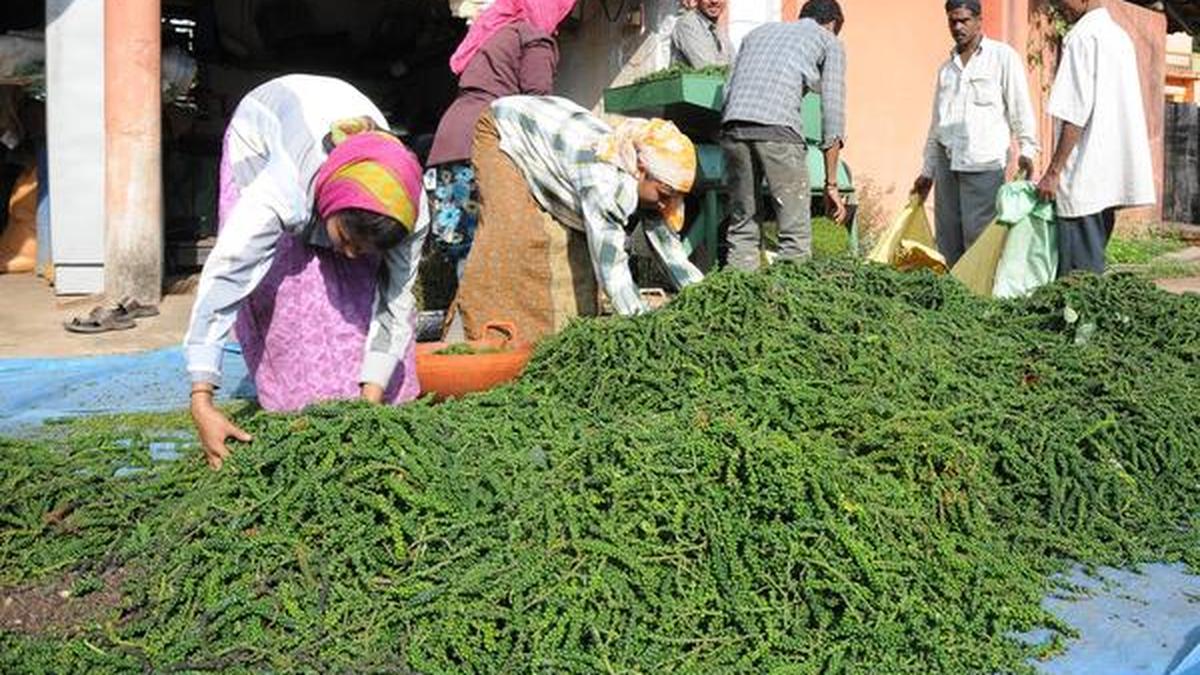

Karnataka, the largest pepper producing State in India, has witnessed a sharp yield decline at 44.3% during crop year 2024-25. A similar, or even bigger, output reduction is expected during this year’s pepper harvest scheduled to commence in February 2026, as per pepper growers in the State who spoke with The Hindu.
The State’s pepper production is estimated to decline to 47,891 tonnes this year from 86,000 tonnes last year, according to the Spices Board. Karnataka has 2,11,497 hectares of land under pepper production, mostly grown in coffee heartlands as intercrop.
India grows pepper in 3,09,363 hectares of land. The country’s pepper production has shown substantial volatility rising from 61,000 tonnes in 2019-20 to a peak of 1.26 lakh tonnes in 2024. As many as 85,000 tonnes were produced in 2025, and 74,000 tonnes are expected in 2026, as per International Pepper Community (IPC), an inter-governmental organisation for global pepper cultivation.
Kerala, the second largest pepper producer, is also expected to witness an output decline at 28.7%, according to the Spices Board.
Rain impact
The main reason for drastic pepper output decline in Karnataka is persistent rain between May and mid-November, which made pepper vines vulnerable to various diseases, such as foot rot, quick wilt, anthracnose (pollu roga), leaf rot or blight, and also to complete destruction of vines in several cases.
Bose Mandanna, of Subramanya Estate at Suntikoppa in Kodagu, who grows coffee and pepper, said, “Due to a long spell of rain, lack of sun light and low temperature, fruiting spikes didn’t set well resulting in small berries. Overall, we are disappointed and are expecting a poor crop this year.”
Apart from these, Mr. Mandanna, also a Coffee Board member said, incessant rains did not allow farmers to carry out normal practices like application of fertiliser and fungicide.
According to Salman Baseer, the newly-elected Chairperson at Karnataka Planters’ Association (KPA), the decline in output is also because of the loss of vines due to water-logging. Pepper vines are delicate, and they are vulnerable to various diseases in wet weather.
Not spread out
Weather patterns have drastically changed. For instance, many plantations have received 60% to 65% of the year’s rain in three weeks of July itself, he said.
“The rains are not spread out, a huge downpour for weeks led to water stagnation. Three to four hours of continuous water logging and cold weather can destroy roots and kill the vines. Many farmers lost their vines entirely,’’ Mr. Baseer elaborated.
The KPA Chairperson also noted that many new airborne diseases are coming from Kerala towards South Kodagu, and now hitting plantations in Sakleshpur area. Extensive ginger farming is also spreading a lot of aerial diseases, such antroconas and pytophera, to pepper vines, Mr. Baseer added.
Aravind Rao, immediate past Chairperson, KPA, observed that excessive rainfall during flowering has affected the overall crop quality and vines died due to quick spread of fungal wilt, this year, almost like last year.
Silver lining
The only silver lining for pepper farmers is the increase in pepper prices. Last year it was hovering between ₹600 and ₹650 per kg, and this year ₹650 to ₹700 per kg. “However, prices are not increasing in accordance with the fall in production. This is because of heavy imports from Sri Lanka and other locations under reduced duty rate,” added Mr. Rao.
Sahadev Balakrishna, Chairman, UPASI Coffee Committee, stated, “Income loss for farmers from pepper could be 20% to 30%. However, we will know the exact impact after a few weeks.”
According to Shirish Vijayendra, former Chairperson of KPA and a coffee and pepper farmer in Chikkamagaluru, “Usually, monsoon comes with a few days of break and sunshine. It was different this year and last year. It rained without a break. A lot of diseases like phytophthora, panicle drop and quick wilt have affected the crop. The size of the panicle (flower and fruit) is small this year.”
Published – November 26, 2025 05:25 pm IST