


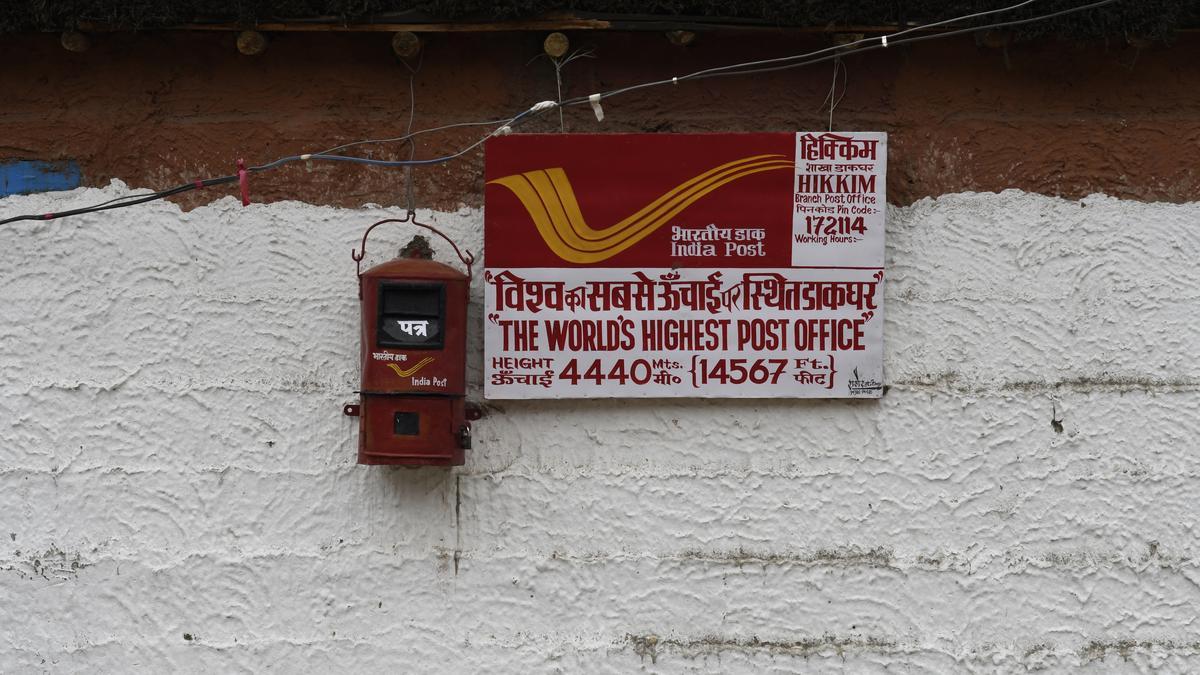

Image for the purpose of representation only.
| Photo Credit: File
The Department of Posts this week released a draft amendment to the Post Office Act, 2023, aimed at introducing an interoperable, standardised and user-centric addressing system called the Digital Hub for Reference and Unique Virtual Address, or DHRUVA. The framework has been under consultation for a few months, with one key element, DIGIPIN, rolled out in March.
DHRUVA, a senior official involved in its implementation said, will be able to replace textual addresses with email or UPI address-like labels such as “name@entity,” which would act as a proxy for a physical address. The government hopes to build this system as part of its digital public infrastructure initiatives and will allow private firms to participate.
The department is hoping to draw interest from e-commerce and gig platforms, where users need to provide addresses across multiple services. On these platforms, individuals would be able to provide a label instead of an address and authorise firms to receive the geographic coordinates and full text of their address instantly, instead of filling out address forms repeatedly.
The draft amendment would allow the postal department to set up a Section 8 not-for-profit entity under government supervision. The body would play a role similar to the National Payments Corporation of India, which is an association of banks administering the UPI payments system.
Consent-based
Users would be able to authorise firms to view their address for a specified period if they wish, after which a given label will require re-authorisation. There is no compulsion in the draft amendment for private players to join, the official said, and the department hopes the system will be compelling enough for firms and users to sign up. Labels will be provided by address service providers, and the consent architecture will be managed by address information agents, or AIAs.
The DIGIPIN system is the foundational layer for this service, the official said. DIGIPIN is a ten-character alphanumeric expression of latitude longitude coordinates. The technology was developed to provide more precise locations in rural areas or in cases where the textual expression of a physical address does not offer adequate information. DIGIPIN was open-sourced by the department, and each DIGIPIN corresponds to a roughly 14 square metre patch of land, with a mathematical function deterministically generating a unique code. This translates to around 228 billion DIGIPINs for Indian territory.
Published – December 04, 2025 08:06 pm IST