


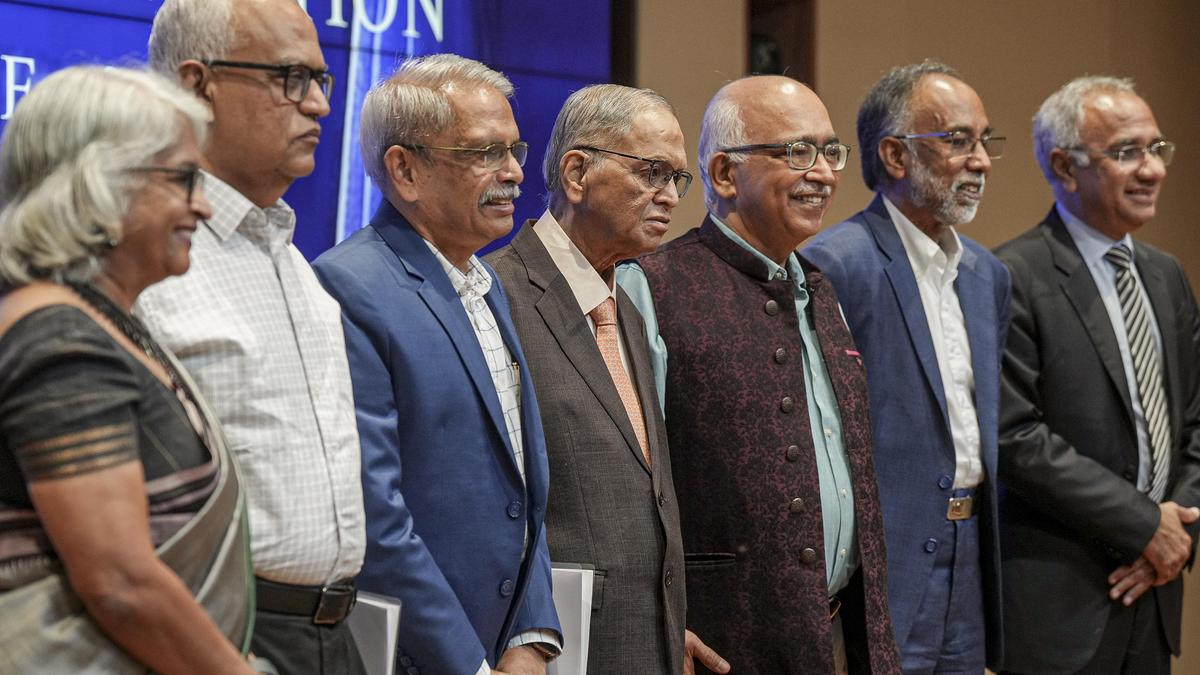

A scholar of Prakrit and Kannada poetics, and a Bengaluru-based scientist are among six winners of the Infosys Prize 2025.
On November 12, the Infosys Science Foundation (ISF) announced the winners of the Infosys Prize 2025 in six categories —Economics, Engineering and Computer Science, Humanities and Social Sciences, Life Sciences, Mathematical Sciences, and Physical Sciences.
The Infosys Prize honours the accomplishments of individuals whose research and scholarship significantly impact India.
The prize for each category comprises a gold medal, a citation, and a prize purse of $100,000 (or, its equivalent in rupees).
“I extend my heartfelt congratulations to the winners of the Infosys Prize 2025, whose achievements reflect the vital connection between research, science, and society, inspiring the next generation of innovators. The Infosys Prize continues to embody our belief that research and science are cornerstones of human progress. It reflects the Foundation’s enduring commitment to nurturing a culture that drives innovation and broadens understanding across disciplines,” said K. Dinesh, President – Board of Trustees, IFS.
The winners of the Infosys Prize 2025 in the six categories are:
Economics
Nikhil Agarwal: Paul A. Samuelson Professor of Economics at Massachusetts Institute of Technology, he has won the Prize for his pioneering contributions to market design, including the development and implementation of pathbreaking methodology for empirical studies of allocation mechanisms, including school choice, medical residency, and kidney exchanges.
Engineering and Computer Science
Sushant Sachdeva: Associate Professor (CSC) of Mathematical and Computational Sciences at the University of Toronto, he has been awarded for his deep insights into mathematical optimization and the resolution of longstanding open questions in algorithmic theory that has established new standards on achievable performance in computational problems affecting information flows across societal lifelines, including the internet, transportation, and communication networks.
Humanities and Social Sciences
Andrew Ollett: Associate Professor in the Department of South Asian Languages and Civilizations at the University of Chicago, he is regarded the world’s foremost scholar of the Prakrit languages in this generation. His book, Language of the Snakes, is a magisterial analysis of the cultural roles of Prakrit in tandem with Sanskrit and the Indian vernaculars over the last two thousand years. Mr. Ollett’s linguistic mastery and knowledge is breathtaking, ranging from detailed contributions to the study of Sanskrit, Prakrit, Kannada, Tamil, Old Javanese, and Chinese, in addition to his knowledge of the modern European languages and his training in Greek and Latin.
Life Sciences
Anjana Badrinarayanan: Associate Professor at the National Centre for Biological Sciences, Bengaluru, the award is in recognition of for her pioneering contributions to understanding mechanisms of genome maintenance and repair. Through innovative live-cell imaging combined with genetic and cell biological approaches, her work has revealed fundamental principles of how DNA damage is repaired, demonstrated mutagenesis in non-dividing cells, and identified novel pathways of mitochondrial DNA damage responses, illuminating principles central to life and evolution.
Mathematical Sciences
Sabyasachi Mukherjee: Associate Professor at the School of Mathematics at Tata Institute of Fundamental Research, Mumbai, he has won the prize for his powerful and original work that links two distinct areas of mathematics — the dynamics of Kleinian group actions and the iteration of holomorphic and anti-holomorphic maps in complex dynamics. His results have reshaped our understanding of conformal dynamics, an area of study that has important implications across physics, fluid dynamics, and even data science.
Physical Sciences
Karthish Manthiram: Professor of Chemical Engineering at the California Institute of Technology (Caltech), he is awarded for his pioneering work on sustainable electrochemical routes to essential chemicals. His breakthroughs in lithium-mediated ammonia synthesis and oxygen-atom transfer catalysis have transformed our understanding of electrified chemical manufacturing, demonstrating how renewable electricity can drive selective, efficient synthesis of chemicals that are fundamental to agriculture and industry.
Published – November 12, 2025 03:11 pm IST