



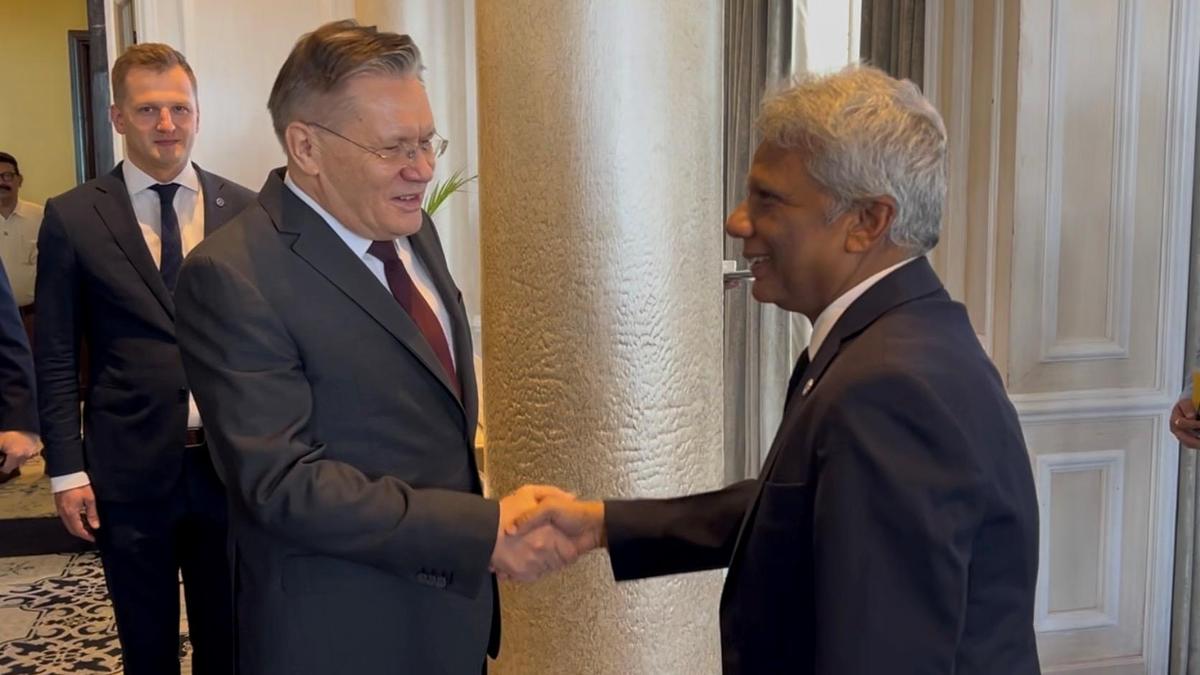


Ajit Kumar Mohanty, Chairman, Department of Atomic Energy, receiving Alexey Likachev, Director General of Rosatom State Corporation, at the joint meeting between the top-brass of the Indian and the Russian nuclear power agencies held in Mumbai on Monday.
| Photo Credit: SPECIAL ARRANGEMENT
Even as the first 2 X 1,000 MWe reactors of Kudankulam Nuclear Power Project (KKNPP) are generating power, pre-commissioning activities have started in the third reactor with similar capacity.
This message was shared during a meeting in Mumbai on Monday between Alexey Likhachev, Director General of the Rosatom State Corporation, and Ajit Kumar Mohanty, Chairman, Department of Atomic Energy (DAE). The main agenda of the talks was development of bilateral cooperation in the field of nuclear energy between the two countries.
During the meeting, Rosatom and the DAE reviewed the progress of the KKNPP. While the first 2 x 1,000 MWe reactors were connected to the national power grid in 2013 and 2016 respectively, four more reactors with similar capacity are under construction.
At Unit 3, pre-commissioning activities are under way with preparations for testing of safety systems on an open reactor. Meanwhile, construction and installation works and equipment deliveries continue at Unit 4, and Units 5 and 6 are actively under construction.
The discussion also covered expansion of partnership, including development of projects for both large and small-scale nuclear power plants and cooperation in nuclear fuel cycle. Attention was given to opportunities for localising equipment production in India.
Addressing the meeting, Mr. Likhachev lauded the mutually beneficial Indian-Russian partnership in the field of nuclear energy, sources in the DAE said.
“The KKNPP laid the foundation for our cooperation and opened the way for new joint initiatives and technology exchange. We have built an effective interaction system and a reliable supply chain, which now serves as the basis for further development of new projects… Today, India has set itself an ambitious goal of increasing its nuclear generation capacity to 100 GW and Rosatom is ready to contribute by offering efficient technologies,” Mr. Likhachev said.
Also under consideration were new areas of cooperation, including construction of small modular reactors (SMRs) of Russian design in India. In April 2024, Rosatom presented its Indian partners with information on its floating nuclear power solutions.
Rosatom’s fuel company TVEL supplies India with advanced nuclear fuel TVC-2M, which offers new capabilities to the KKNPP, allowing the station to operate under an 18-month fuel cycle.
“The KKNPP has laid the groundwork and defined the multifaceted nature of Russian-Indian cooperation in the peaceful use of nuclear energy. One of the key areas remains the serial construction of high-capacity nuclear power units of Russian design in India, based on the VVER-1,200 technology. Relevant organisations are currently developing technical specifications for a new nuclear power plant in India, featuring VVER-1,200 reactor units,” the sources said.
Published – November 11, 2025 07:53 pm IST