


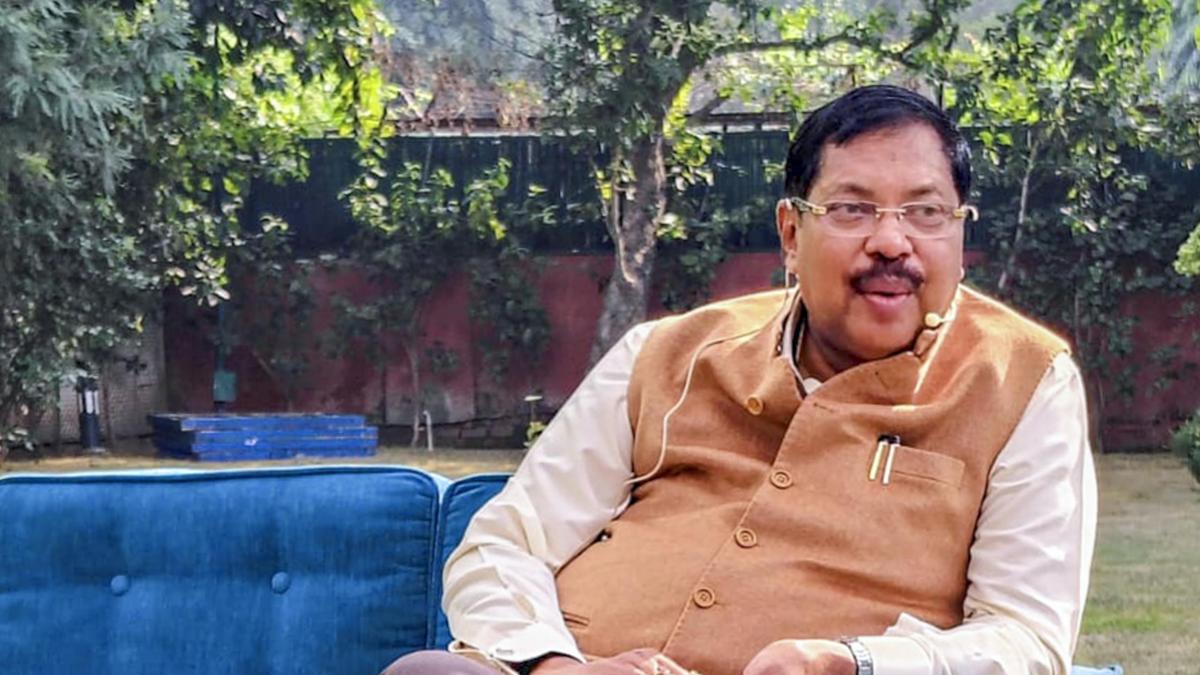


Outgoing Chief Justice of India (CJI) B R Gavai during an interaction with journalists at his official residence on his last day in office, in New Delhi, on November 23, 2025.
| Photo Credit: PTI
Chief Justice of India B.R. Gavai on Sunday (November 23, 2025) said the 2025 Presidential Reference opinion against tying Governors to timelines was not intended to shift the burden back on States to run pillar-to-post to get their recalcitrant Governors to pass pending Bills on time.
“If the Constitution does not provide for a timeline, we [judiciary] cannot read something that is not there. It is for the Parliament to do that,” CJI Gavai, who is retiring on November 23, said in a media interaction.

He explained that an opinion given in a Presidential Reference did not overrule a judgment but only clarified the law.
“In a Presidential Reference, we cannot overrule a judgment, but we can lay down the law, and while laying down the law, we can observe that the law laid down in a particular manner [in a judgment] is not correct,” the CJI said.
The Presidential Reference was triggered by a judgment in the Tamil Nadu Governor case on April 8, which broke the silence in the Constitution and held that Bills must be cleared by Governors and President in three months or they would be ‘deemed’ to have got assent.

On November 20, a five-judge Bench led by Chief Justice Gavai, in its advisory opinion, contradicted the April 8 judgment and concluded that Governors and the President cannot be forced to follow a timeline. They need to act only within a “reasonable period”. The Bench, however, did not specify the term “reasonable period” in its opinion.
“We have only relaxed the timeline. At the same time, we have balanced it by saying the Governor cannot sit on a Bill endlessly. We have also provided for a limited judicial review based on the facts and circumstances of each case. You cannot have a straitjacket formula that in every Bill, if assent is not granted, it would be deemed to have been passed. In a routine Bill, one month is sufficient for a Governor to clear it. However, in Bills concerning Internal or external emergency, a Governor may not be able to take a call in a month. He may take three or four months,” the Chief Justice said.
To a question if Justice B.V. Nagarathna’s dissent to a Supreme Court proposal to elevate Justice Vipul Manubhai Pancholi had any merit, the Chief Justice said that “if it had, the four other judges on the Collegium would not have agreed to the proposal”.
CJI Gavai said he did not believe in the age-old adage that there should be “friction” between the judiciary and the government. “I do not believe friction is necessary, especially when we have to depend on the Purse for infrastructural development… I do not think continuous friction is necessary,” he said.
The Chief Justice said the popular notion is that a judge is independent only if he decides against the government. “The decision of a judge is not based on whether the litigant is the government or a private person. You decide as per the papers before you. The government may succeed, or the government may lose in a given case. That is not the correct approach,” he said.
When asked if he had come under pressure from the government at any time, he replied, “No. I know when asked this question everyone in my position would say ‘no’. But in my case, it is really a ‘no’!”
The CJI replied to a question about the large number of transfers of High Court judges during his six-month tenure, saying they were largely made in the interest of administration of justice, but there were also complaints against some judges. “In such cases, transfers were recommended after due verification of the allegations,” he said.
Asked why he decided to forgive the lawyer who threw an object at him in court instead of taking punitive action, Chief Justice Gavai said, “Maybe it is the way I was brought up. The decision [to let the lawyer go] was taken on the spur of the moment.”
Published – November 23, 2025 09:40 pm IST