




Telangana will pursue a multi-pronged approach to achieve near-zero emissions by 2047 and emerge as a clean energy powerhouse.
Renewable and low-carbon systems will be at the core as it eyes global leadership in sustainable and inclusive growth, powered by clean energy, sustainable industries, climate-smart agriculture, sustainable forests and green urban systems, as per the Telangana Rising 2047 Vision document that is set for launch next week.
Near-zero emissions are to be achieved on the back of large-scale deployment of renewables, retrofitting of existing coal-based capacity with advanced SOₓ and NOₓ emission control systems, fully integrated with storage, smart grids and green hydrogen, providing 24×7 clean, reliable and affordable rates for all citizens, the government said.
The State will formulate robust policies for renewable energy development, grid modernisation and market reforms to ensure affordable, reliable power. Clean and Green Energy Policy 2.0 will facilitate renewable integration, storage, open access, time-of-day pricing and PPP-driven distribution reforms. A State Net Zero Power Council will be set up to coordinate innovation and progress; and industries can directly procure renewables via power exchanges or group captive models.
Estimating power demand to rise from 100 TWh in 2026 to 780 TWh 2047, with peak demand soaring from 19 GW to 139 GW, the government said 90% of capacity by 2047 will be renewables and storage systems. Cleaner and efficient thermal will account for balance 10%.
More than 60% of energy generated by 2047 will be battery and pumped-hydro storage, supported by smart grids and green hydrogen integration. A total of 765 kV green transmission corridors will connect solar and wind generating areas, along with being enabled by IoT and AI-based grid control.
No ICE vehicle sales after 2039
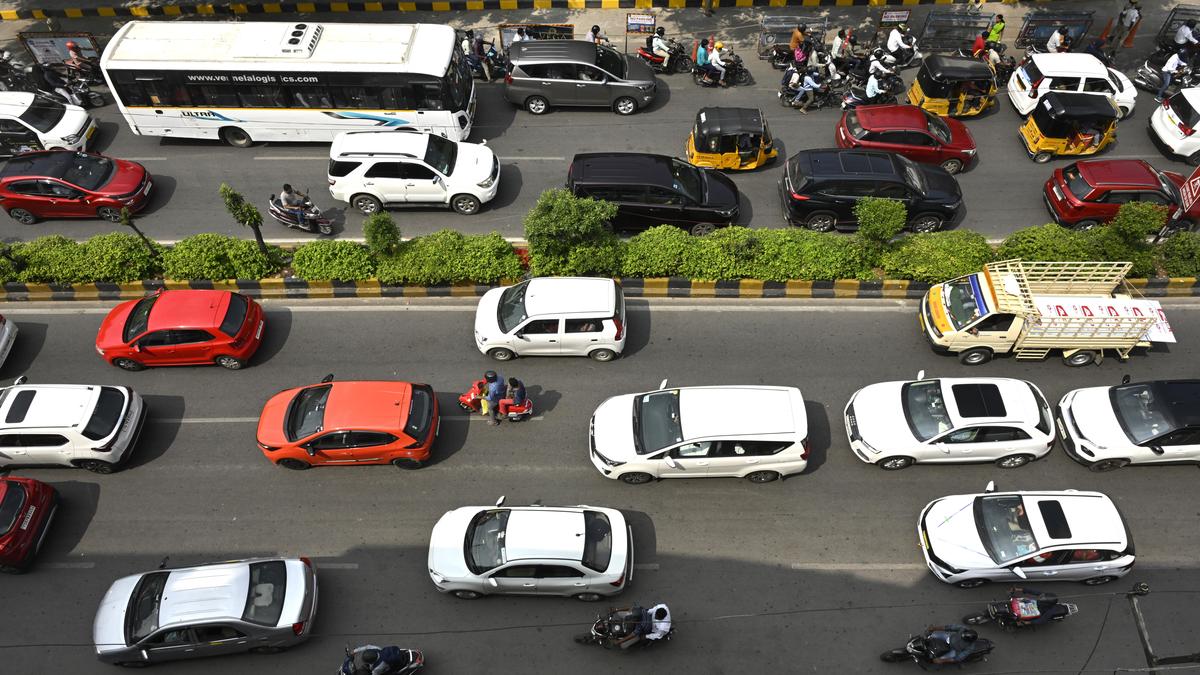
On integrated smart mobility, the government said that a seamless, smart and sustainable transport network is to be developed. Almost 80% of existing and all new urban routes will have aspects of non-motorised transport, ensuring a people-first, low-carbon mobility network State-wide.
Elaborating on the pathways to 100% clean mobility, it said Hyderabad will have the largest electric bus fleet by 2030. By 2047, all passenger transport, from metro, MMTS and buses will be ZEV and 80% of private 2W/3W/4W will be ZEV. Internal combustion engine (ICE) vehicles will not be sold after 2039.
Setting up 6,000 public charging stations by 2030 and establishing fast-charging corridors every 20 km by 2047 besides hydrogen refuelling stations connecting highways and industrial routes form part of the proposals. Telangana Mobility Valley (TMV) will be promoted as a global centre for manufacturing as well as research and development related to EV and energy storage, battery recycling, and hydrogen and fuel-cells.
The State is keen on developing metro rail networks in all cities with populations exceeding 5 lakh and deploy AI-based traffic management and integrated real-time multimodal transport platforms. It will promote walking and cycling infrastructure, implement transit-oriented development (TOD); green tax and vehicle scrappage policy for high EMF (high-emission fossil) vehicle retirements, besides developing elevated corridor to initially operate high-capacity buses, with provisions to convert it into a rail-based transit track as passenger demand grows.
The government also plans to have renewable energy corridors and strategies such as Mahbubnagar — Wanaparthy, Jogulamba-Gadwal, and Nagarkurnool, Narayanpet for solar projects; floating solar in major lakes across the State; rooftop solar-powered metro and e-mobility for Greater Hyderabad, Warangal, and Karimnagar; and harnessing wind power in Narayanpet, Vikarabad and Sangareddy.
For the capital required to drive clean energy growth, the government plans to tap green bonds and blended-finance instrument, while optimising carbon credit trading system and engaging with national and global markets to generate recurring climate finance.
By 2047, Telangana want to be a full net zero State, combining zero-emission technologies, a circular economy and nature-based removals to become a green industrial State, as per the document.
Published – December 01, 2025 09:48 pm IST