



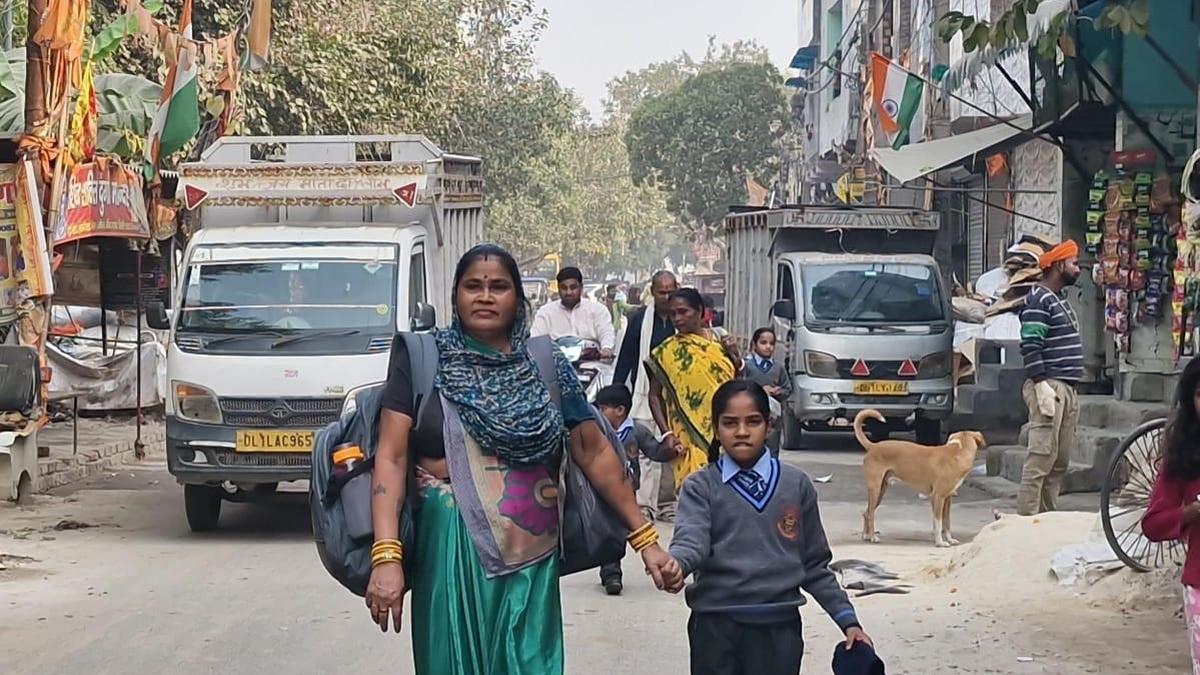

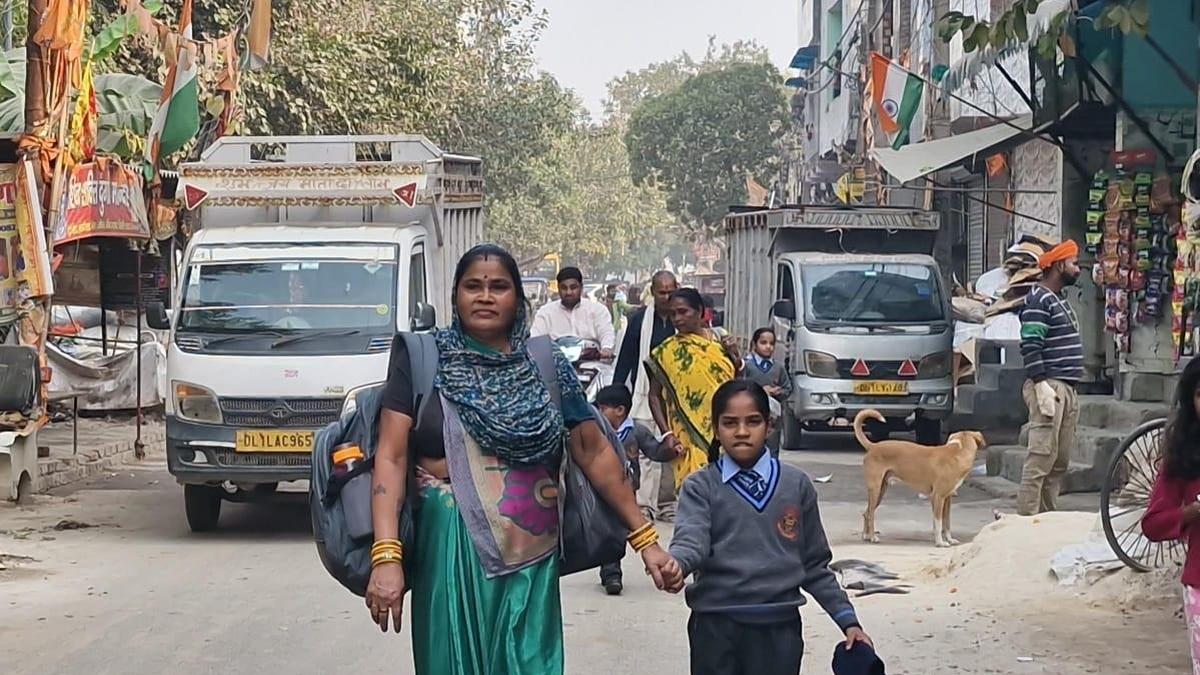
Harbai, who complained about clearing layers of black ash, walking back home with her child.
| Photo Credit: Special arrangement
Harbai, a 56-year-old resident of Metro Vihar JJ Colony in north-west Delhi’s Bawana, says she often clears layers of black ash from the terrace of her four-storey residence. “A few years ago, we couldn’t figure out where all this dust was coming from. But now we know there is a plant nearby that burns garbage, which emits this black ash,” she recalls.
Her neighbour, 59-year-old Somvati, says she struggles with breathlessness every morning. “It feels like some residue always sits in my throat. People with asthma or other lung problems suffer even more,” she says.
Less than 2 km away stands the 24 MW waste-to-energy (WTE) plant, run through a public-private partnership between the Municipal Corporation of Delhi (MCD) and Re-Sustainability. Residents of nearby villages, Holambi Khurd, Sonath, Holambi Kalan and Naya Bans, report similar health concerns. On the day of The Hindu’s visit, the air quality index (AQI) in the Bawana Industrial Area was slightly higher than that of New Delhi.
Even during GRAP III restrictions, which curb industrial activity, these plants continue operating because they are classified as “essential services”.
Delhi’s four WTE plants in Bawana, Tekhand, Okhla, and Ghazipur operate round the clock and together process around 7,500 tonnes of the 11,300 tonnes of mixed waste generated daily. The remaining waste piles up in landfills. Government rules mandate regular health facilities and medical camps for residents within a 5-km radius of such plants. But villagers say these are rare. “There are so many industries here now. We are told everything is safe, but we live with the impact,” said Lekh Ram, 49, from Holambi Khurd.
Segregation gaps
At the Bawana facility, a senior employee said around 85 garbage trucks arrive daily and often make multiple rounds, and over 200 workers handle the waste.
“All the waste is unsegregated. Machines sort it in several rounds, but they can only do so much, given the condition in which we receive it,” he said.
He insisted that the plant follows all prescribed norms, provides safety gear to workers, and undergoes DPCC inspections every three months.
A Jindal Group representative, which operates the Okhla and Tekhand plants, said fly ash and bottom ash are stored in sealed silos or sent to approved landfills, while plants use flue-gas systems to trap acidic pollutants.
Plastics like PVC are separated before burning to prevent the release of toxic fumes.
Parth Kumar of the Centre for Science and Environment said proper source segregation is essential as toxins remain in combustible material when waste arrives mixed.
“These plants are inside the city where people live. When residents raise concerns, GRAP-like norms should be prepared,” Mr. Kumar said, adding that clear information must be provided on which pollutants are being tracked and their emission levels for “greater transparency”.
Published – November 24, 2025 01:41 am IST