



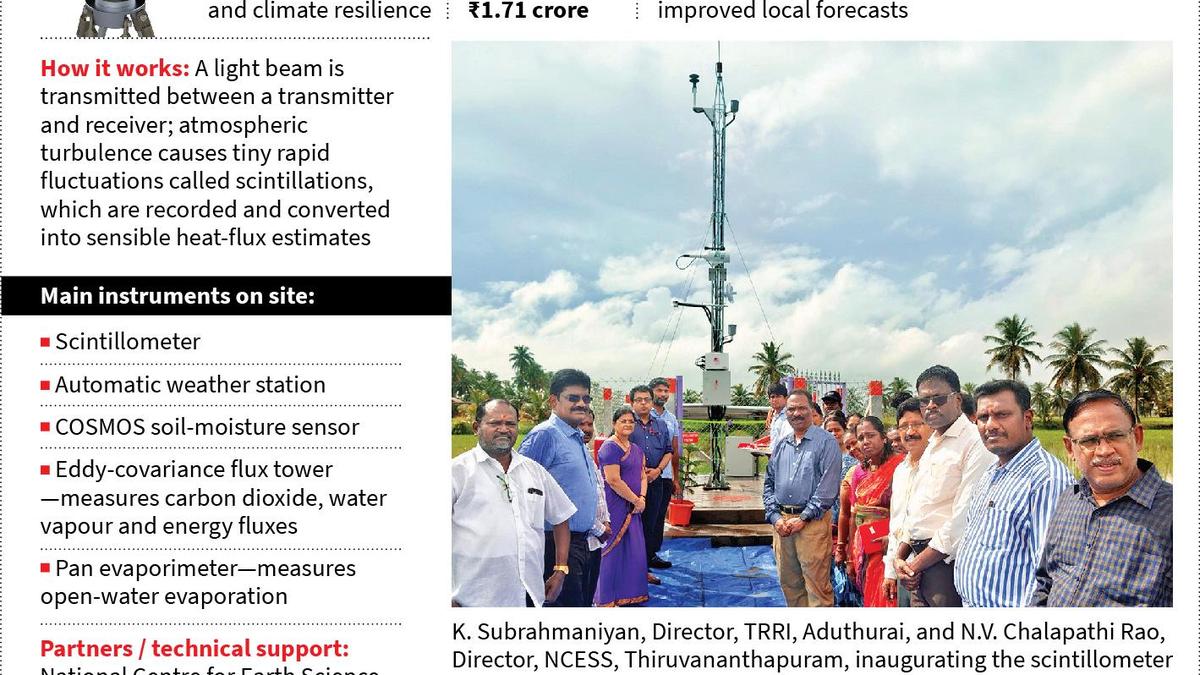

A scintillometer — an optical instrument that measures heat and moisture exchange between the land surface and the atmosphere — was installed at the Tamil Nadu Rice Research Institute (TRRI), Aduthurai, in mid-October.
It joins an existing suite of sensors at the TRRI Critical Zone Observatory (CZO), making the site one of the few in India with such comprehensive land–atmosphere monitoring.
The CZO at TRRI, established under Tamil Nadu Agricultural University (TNAU) with support from the National Centre for Earth Science Studies (NCESS), became fully operational in 2022. It is one of three such observatories in India and the only one in Tamil Nadu. The site already records weather parameters, soil moisture and direct air–surface fluxes; the scintillometer now provides direct estimates of sensible heat flux, a key variable for understanding the surface energy balance.
“The observatory will generate long-term datasets on meteorological, canopy and hydrological parameters for the Cauvery delta,” said K. Subrahmaniyan, Director, TRRI. Continuous, local measurements, he noted, are crucial for managing water and crops in this climate-sensitive agricultural region.
The scintillometer operates by transmitting a light beam between two fixed points. Minute, rapid fluctuations in the beam caused by turbulent air — known as scintillations — are analysed to estimate heat transfer from the land to the atmosphere. When integrated with data from the Automatic Weather Station, COSMOS soil-moisture sensor, pan evaporimeter and eddy-covariance tower, these observations improve estimates of evapotranspiration, soil moisture and local microclimate, directly supporting irrigation planning and local forecasts.
TRRI scientists say the combined dataset will help refine remote-sensing products and translate measurements into actionable advisories for farmers. S. Elamathi, nodal officer for the Gramin Krishi Mausam Sewa (GKMS) scheme, said the installation would strengthen climate-resilient decision-making in the Cauvery delta.
Beyond immediate extension benefits, the observatory is expected to support research on carbon and water cycles, microclimate-driven pest and disease dynamics, and climate-smart cropping systems. TRRI also plans to use the site as a training and capacity-building platform, offering students hands-on exposure to experimental design, high-frequency environmental data processing, and linking field measurements with policy and practice.
Published – November 08, 2025 08:48 pm IST