





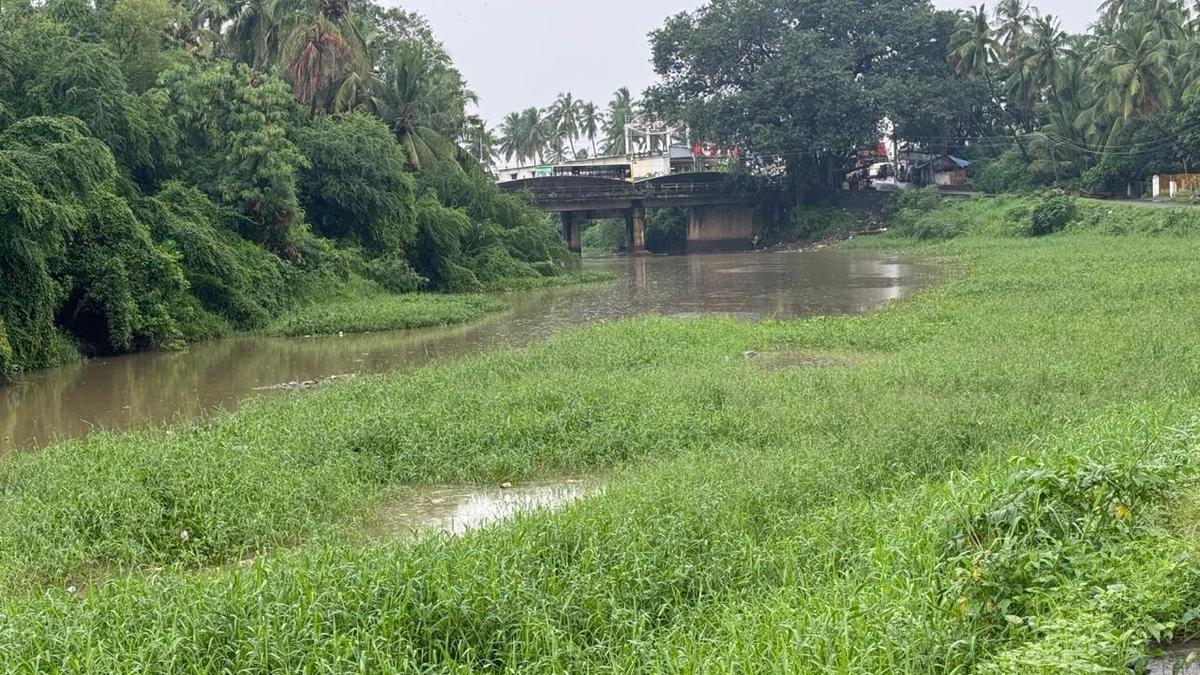
The Pazhayar river choked by invasive aquatic weeds at Nagercoil in Kanniyakumari district.
| Photo Credit: SPECIAL ARRANGEMENT
Rampant discharge of sewage and untreated water into Pazhayar river at several places in Nagercoil, including Ozhuginesary, has raised serious concerns among residents about the river’s future and measures being taken to curb the pollution.
According to a 2024 report, ‘Exploring the situational dynamics of the Pazhayar river,’ the river is a part of Kodhayar river basin, which covers an area of 1,646.964 sq km. The basin lies entirely within Tamil Nadu and almost within Kanniyakumari except for a small portion in Radhapuram taluk of Tirunelveli district.
As per the report, domestic pollution, agriculture pollution and waste water from rubber processising units are major sources of pollution. “The alarming level of pollutants and sewage waste that are discharged into the river by Nagercoil Corporation impacted the water quality,” the report says.
The visible confluence of sewage discharge into the Pazhayar river on Arattu road in Ozhuginesary has become a major concern among residents. The river stretch here is choked with water hyacinths and other invasive aquatic weeds, due to eutrophication, a condition that persists across several parts of the river within city limits, including areas near Suchindram and Swamithoppu.
Murugesan, a resident of Vadasery said, “The bathing ghats along the Aratu road, once regularly used by residents, are now abandoned. Some ghats are even covered by bushes and weeds.”
He added that the continuous discharge of sewage into the river near Ozhuginesary bridge had been happening for years and awaited a permanent solution.
N. Udhayarajan, director, Uvakai foundation, highlighted the lack of a proper sewage treatment plant (STP) for Nagercoil Corporation as the major reason for growing pollution in the Pazhayar river. The underground drainage system (UGDS) was yet to be completed in many parts of the Corporation limits, and even if it was completely implemented, managing the UGDS in Nagercoil would be complicated due to its terrain.
“In case of Pazhayar river, once the river enters the city, there is hardly any gradient, which reduces the possibility of flushing out pollutants,” he added.
He further noted that while the river was perennial, and flood helped flush the pollutants to some extent, both the public and the authorities must take proactive measures to protect it for future generations. With growing population and rapid urbanisation, the absence of proper drainage and sewage systems had resulted in indiscriminate discharge of untreated water into the river. Additionally, pollution coupled with the unchecked growth of invasive weeds had led to eutrophication, causing severe ecological impact.
Chenabagasekara Pillai, member, Scientific Advisory Committee, Tamil Nadu Agricultural University, Coimbatore, echoed similar concerns that rapid urbanisation without adequate infrastructure had pushed the Pazhayar river into a critical state. “As everyone says, civilization began on the banks of the river, the agricultural heritage of Nanjil Nadu region began with the Pazhayar river. But today, sewage enters the river at many points, and concrete action from government authorities is still awaited.”
The district once had around 4,000 irrigation tanks and now had only around 2,000, reflecting the failure of both government authorities and residents to protect the water resources, he added..
Responding to the concern, an official from the Water Resources Department said the Nagercoil Corporation was cutting off sewage inlets leading into the river. Once the process was completed, further action would be taken to prevent additional pollution.
Nagercoil Corporation Mayor R. Mahesh also said the Corporation had begun sealing sewage outlets into the Pazhayar and would soon cover all remaining areas within its limits.
Published – November 23, 2025 08:07 pm IST