



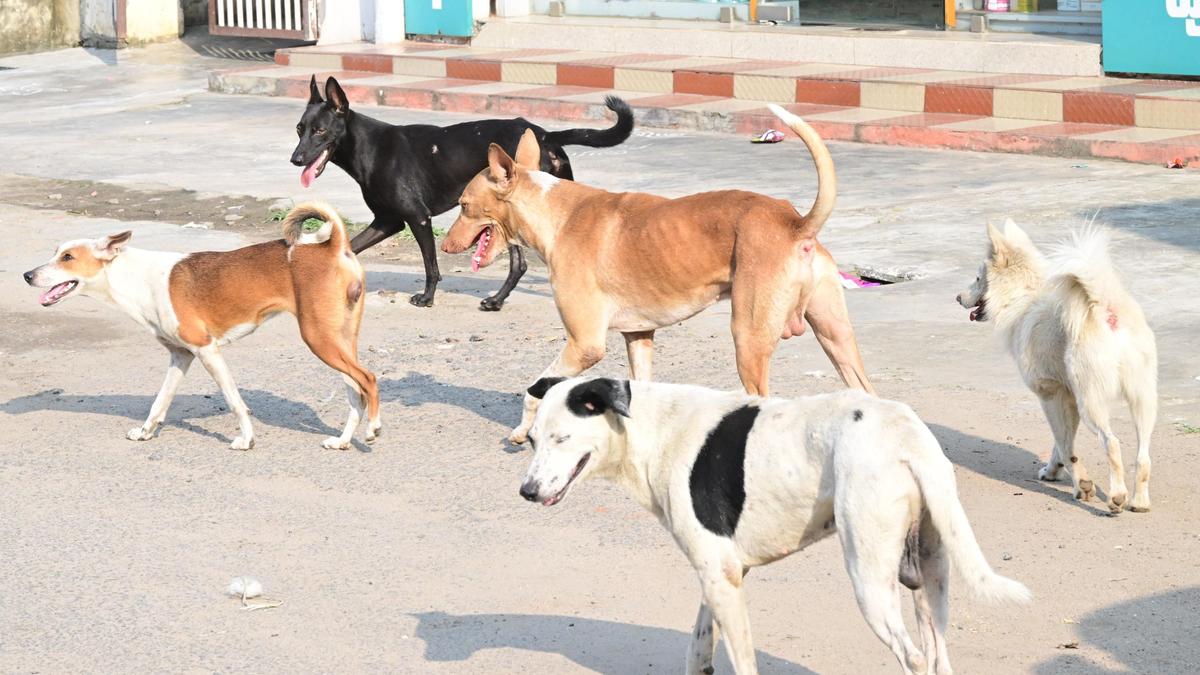

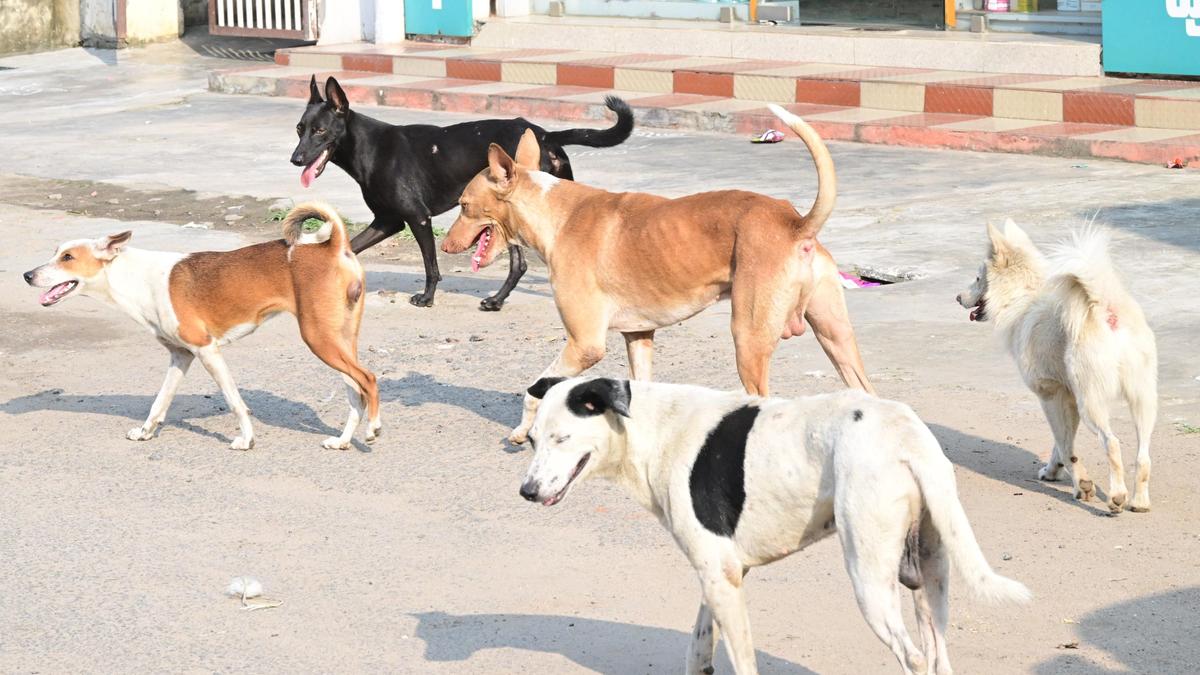
Man-animal conflict: Stray dogs roam the streets of Vijayawada as activists warn that simply removing them from public spaces will not solve the problem
| Photo Credit: G.N. Rao
Expressing concern over the increasing number of dog attacks across the country, the Supreme Court on November 7 directed States and Union Territories to remove stray dogs from public places and shift them to “designated shelters” after sterilisation and vaccination.
However, the order has sparked backlash from animal welfare advocates, who argue that it undermines long-term and humane approaches such as the Animal Birth Control (ABC) and vaccination programmes. Implementing the directive has also proven challenging in Vijayawada, which lacks adequate shelter facilities for dogs.
“Relocating street dogs to shelters is never the solution,” said Pisupati Ravi Keerthi, founder of the Vijayawada-based Sanghamitra Animal Foundation, who has rescued over 12,000 animals in the past seven years. Criticising the Supreme Court’s order, he argued that it fails to address the root cause. “When dogs chase cars or attack children, people blame the animals instead of questioning the corporation. Why doesn’t it allocate sufficient funds for neutering drives?” he asked.
In the ₹1,454.58 crore budget for 2025–26, the Vijayawada Municipal Corporation (VMC) set aside ₹5.5 crore to control the animal menace — more than double last year’s ₹2 crore allocation — but still considered insufficient.
“At the Ajith Singh Nagar shelter, maintenance is poor. Dogs easily pick up ticks and infections in such conditions. There have been several instances where dogs had to be re-sutured soon after sterilisation,” said Mr. Ravi Keerthi.
He also alleged that the sterilisation drives are conducted in a disorganised manner. “There is no ward-level planning. Moreover, the corporation fails to release dogs back into their original localities after surgery, leading to aggressiveness and territorial fights,” he pointed out.
The Animal Welfare Board of India’s Revised ABC Module, issued in February 2025, stresses that dog population management and rabies prevention depend on the effective implementation of the ABC Rules, 2023. The module warns that creating a territorial vacuum — when a few dogs are removed while others escape — can lead to more conflicts and bite incidents.
According to VMC data, Vijayawada has about 40,000 street dogs and 320 kennels. Of these, around 14,000 dogs have been neutered and vaccinated. “The limited number of kennels, where dogs are kept under observation for a week post-surgery, has slowed down the ABC programme,” said B. Somasekhar Reddy, Veterinary Assistant Surgeon, VMC. “We plan to build more kennels, but this requires additional funding, which will be taken up in the next council meeting,” he added.
In compliance with the Supreme Court’s order, the VMC has decided to issue notices to educational institutions, railway and bus stations, hospitals, and other public establishments, advising them to install boundary fencing and appoint a nodal officer to ensure no stray dogs enter their premises.
The corporation has also identified 59 designated feeding zones across the city’s three circles to minimise human-animal conflict. “We are urging citizens to feed dogs away from residential areas, and sanitation officials have been instructed to monitor the process,” Mr. Somasekhar Reddy said.
Calling for a balanced approach, Mr. Ravi Keerthi emphasised the need for public awareness. “People must learn the dos and don’ts when dealing with street dogs. They are part of our community, and it is our collective duty to ensure that the dogs in our locality are vaccinated and sterilised,” he said.
Published – November 12, 2025 06:39 pm IST