



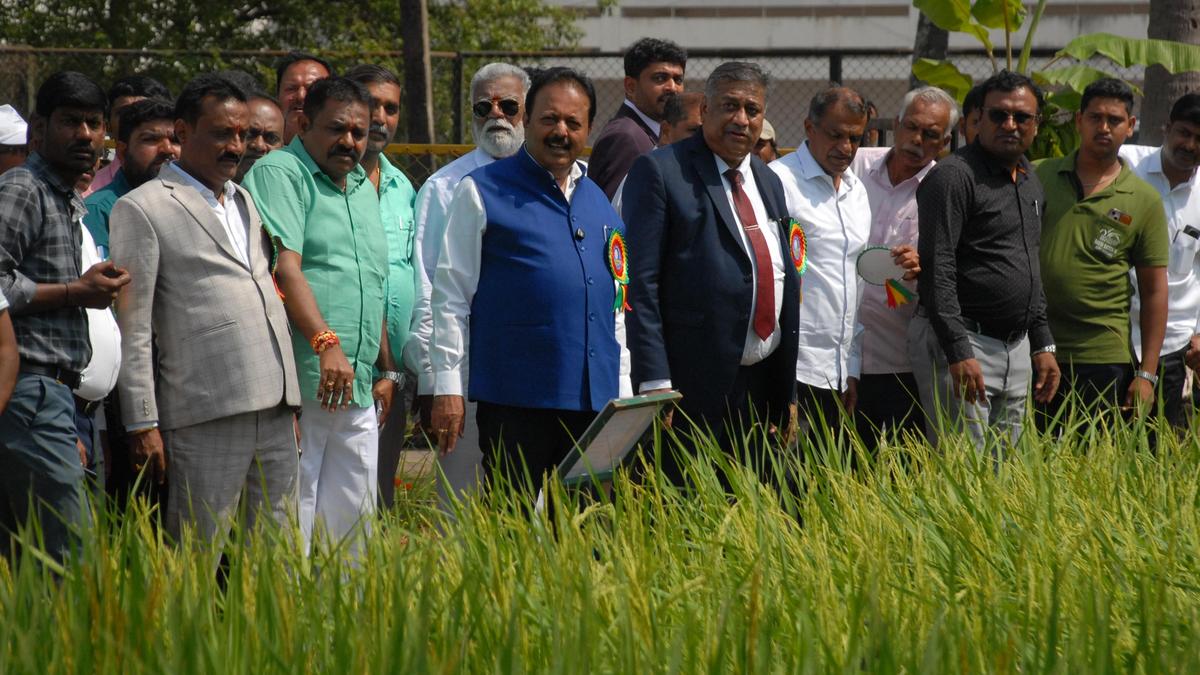

The Sahyadri Sindhura red rice variety, developed by a team headed by Dr. B.M. Dushyantha Kumar, Director of Research of the university, was launched by Agriculture Minister N. Cheluvarayaswamy on November 7, 2025.
| Photo Credit: The Hindu
The fine-grain red rice variety – Sahyadri Sindhura – recently introduced by the Keladi Shivappa Nayaka University of Agricultural and Horticultural Sciences in Shivamogga has been in high demand.
The rice variety developed by a team headed by Dr. B.M. Dushyantha Kumar, Director of Research of the university, was launched by Agriculture Minister N. Cheluvarayaswamy earlier this month.
After the university revealed the salient features of the rice, including high protein, iron and zinc content, and a low glycaemic index, requests have poured in from the public. The officials from the Governor’s office in Bengaluru, ministers and many elected representatives too have reached out to the university.
Rigorous research
The research team has spent five years coming up with this variety after a rigorous experiment at different levels. This rice variety is a cross between popular Jyothi and Biliya varieties. They cultivated the variety, which matures in 120 days, in the demonstration plots of the university in Shivamogga initially. They then expanded to the irrigated area in the Bhadra command area and also the Malnad area. Later, they cultivated it in Davangere. In the third stage, they cultivated it in different research centres spread across the State. The variety has been registered with the National Bureau of Plant Genetic Resources in New Delhi.
Mr. Dushyanth Kumar told The Hindu, “The trial results recorded an impressive yield of 53-54 quintals per hectare in the irrigated land. The farmers get anywhere up to 50 quintals per acre, which is better than the traditional varieties that yield around 40-45 quintals per hectare,” the scientist said.
The variety, according to the research team, is resistant to blast disease and tolerant to insects and pests, including leaf folders and stem borers. The growers benefit because of the high-quality straw, which serves as fodder.
Good price
The university and the farmers, who have already cultivated the rice variety, are selling the rice at ₹70 to ₹80 per kilo. “The response from consumers is very impressive. The taste is good, and it is also healthy. We are getting requests from the Governor’s office, ministers and many elected representatives. There are a few farmers who have already grown the variety,” he said. The university has sent the seeds to Tamil Nadu, Goa and other places, where farmers were keen to grow the variety.
Sitaram Bhat, a native of Sagar Taluk, who has grown the variety organically in Hosanagara, said that he had been satisfied with the yield. “When traditional varieties of rice are grown organically, the yield is only around 11-12 quintals per acre. However, the new variety’s yield is anywhere between 18 and 21 quintals. We have been selling rice at ₹75 per kilo, and demand continues to rise,” he stated.
Published – November 23, 2025 03:58 pm IST