


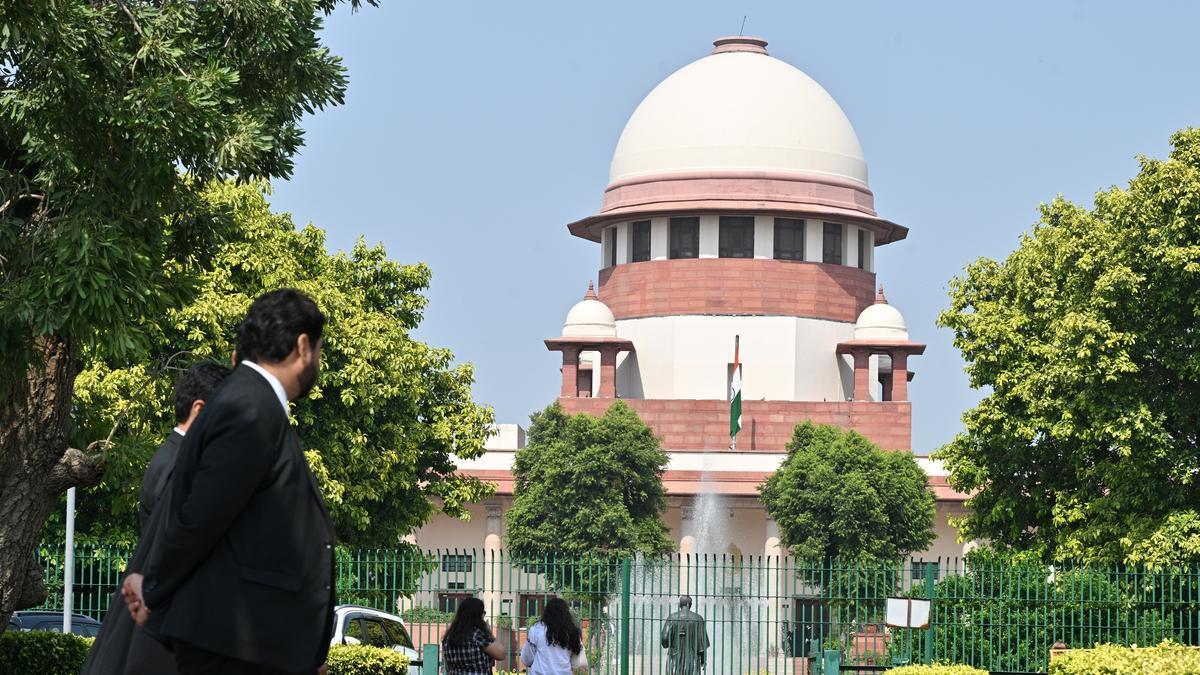

The Supreme Court on Wednesday (November 26, 2025) tested the role of Aadhaar in the Special Intensive Revision (SIR) exercise, asking whether a foreigner, who has already managed to use the document to access welfare benefits such as subsidised ration, should be further allowed to exploit it to gain automatic entry into the electoral roll.
The question was posed despite the court having ordered Aadhaar to be included as a “12th document” during the Bihar SIR hearings.
“Aadhaar is the creation of a statute. Nobody can dispute the use of Aadhaar card to avail welfare benefits. But suppose a person comes from a neighbouring country to India, works as a labourer or a rickshaw puller, he accesses Aadhaar to provide subsidised ration for his children — that is our constitutional ethos and morality, but does it mean that since he has got Aadhaar, he should be made a voter also?” Chief Justice of India Surya Kant asked senior advocate Kapil Sibal, appearing for the petitioners.
The query from the Bench came shortly after Mr. Sibal opened arguments challenging the very constitutionality of the SIR exercise undertaken by the Election Commission of India (ECI).
Mr. Sibal said the view, if necessary, might be true in the case of some border States, but it could not be true for States like Kerala and Bihar. After Bihar, the second phase of SIR covers 51 crore people in 12 States and union territories, including Tamil Nadu, West Bengal, Kerala and Puducherry.
Justice Joymalya Bagchi, the Associate Judge on the Bench, observed that EC has an inherent jurisdiction to verify and vet entries in electoral rolls which are of “doubtful integrity”. Enumeration forms are part of that enquiry or a survey by the EC to check voters’ credibility. The ECI cannot be expected to operate like an “inert post office”.
“Any exclusionary step or attempt taken by the EC is against the constitutional scheme. Asking the elector to fill up and submit an enumeration form is an exclusionary measure. Don’t you think there are millions of illiterate women in this country? Will they not be excluded from the voter list? Any exclusion of a name from the electoral roll must follow a reasonable process. These are the real issues that Your Lordships need to decide. We celebrated Poorna Swaraj for inclusion, equality and universal suffrage. The ECI had played a crucial role in that post-Independence,” Mr. Sibal argued.
He questioned the power given to booth level officers (BLOs) under the SIR notification to decide whether a person was a citizen or not. The petitioners have argued that SIR was only a thinly-veiled “citizenship screening” in which the burden of verification has been shifted from the ECI to an already registered elector, who has to fill up enumeration forms.
Justice Bagchi observed that the inherent jurisdiction of the ECI to “examine, vet, verify” documents submitted to it was traceable to Section 21 of the Representation of the People Act and Article 326, which required a voter to be a citizen.
“The EC says there are certain entries which are of doubtful integrity. In that spirit, the EC makes an endeavour. How can we say that there was a complete lack of jurisdiction? There is always a residual jurisdiction afforded to a constitutional authority to go into a preliminary enquiry as regards credibility,” Justice Bagchi observed.
Mr. Sibal said he was not challenging the jurisdiction of the ECI, but the “hasty, unreasonable and exclusionary” process adopted by the poll body.
“I accept the ECI has the power. Revisions have been done before. I am saying the process of the SIR is unreasonable, both procedurally and substantively. There is no earthly reason to have to complete the process in two months,” he clarified.
However, Chief Justice Kant asked whether the court could stop the SIR because of doubts that the exercise cannot be completed within the specified period. The ongoing enumeration phase would continue till December 4.
Indicating that there was always a possibility of extending the time, Chief Justice Kant said, “on the argument whether it is humanly possible to do SIR in two months, that chance has to be given to them”. The court said that, in the Bihar case, the petitioners had apprehended that crores of voters would be excluded, but a little over three lakh were deleted finally. Exclusions in the Bihar SIR barely saw any objections from the concerned individual voters.
The Bench said lakhs of legal aid volunteers were mobilised by the court in the Bihar SIR to reach out to voters in far-flung areas.
“We cannot have volunteers for crores of electors. Do you think women who work in the fields, labourers know how to fill up enumeration forms?” Mr. Sibal argued.
Chief Justice Kant said it cannot be just assumed that the people in rural areas and marginalised sections were clueless about their voting rights. “They are more vigilant than the urban voters… The day of voting is a cause for celebration in rural areas,” the top judge observed.
Mr. Sibal said that was a matter of opinion. “My point is if you want to take away my rights, you take it away by means of a process… We had brought here electors who were declared dead by the BLOs,” he said.
Published – November 26, 2025 10:00 pm IST