


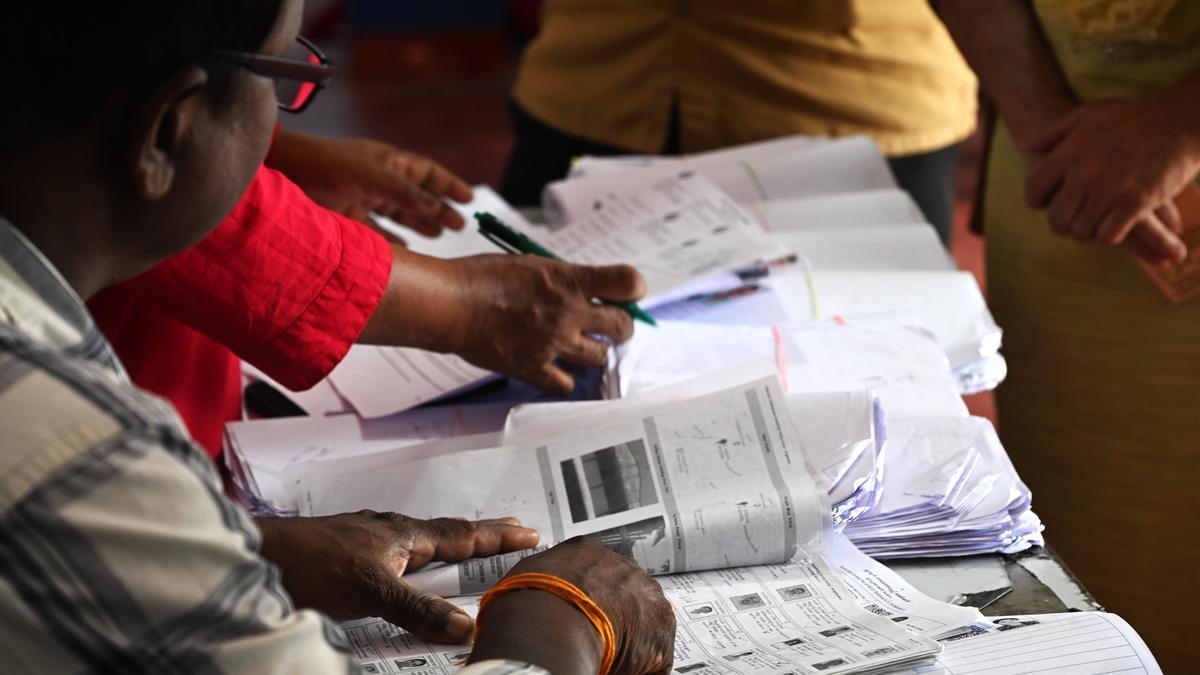

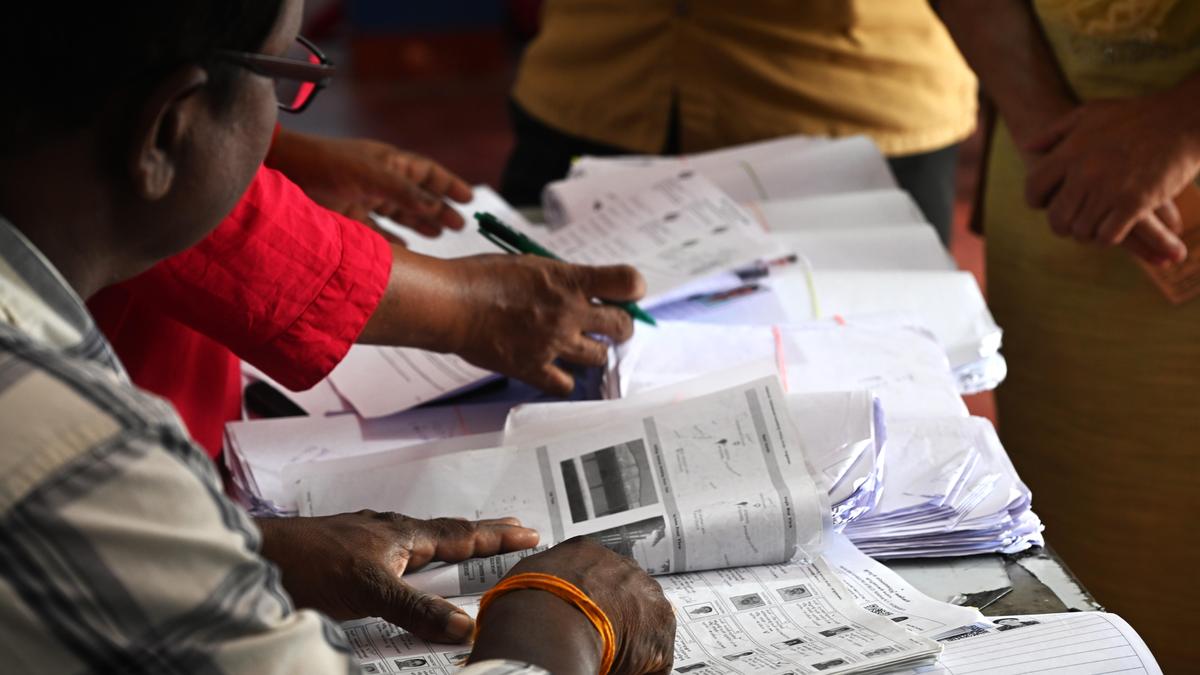
ECI dismissed claims by the Opposition that there was up to 30% voter exclusion in West Bengal. It said 70.14% completed forms had been received. File
| Photo Credit: The Hindu
The Election Commission (EC), in separate affidavits in the Supreme Court, submitted that 95.65% of electors in Tamil Nadu and 99.77% in West Bengal have already been supplied with pre-filled enumeration forms, dismissing allegations of “mass disenfranchisement”.

The commission said it had already received back 58.7% enumeration forms and digitised them.
The top poll body dismissed claims by the Opposition that there was up to 30% voter exclusion in West Bengal. It said 70.14% completed forms had been received.

It said these statistics “demonstrate that errors, under-inclusiveness and mass disenfranchisement claimed by the petitioner are highly exaggerated”.
The EC said Section 21(3) of the Representation of the People Act, 1950 vested it with discretionary powers to conduct special revision of the electoral rolls “in such a manner as it thinks fit”.

The poll body said it had undertaken “intensive revision of special nature” of electoral rolls for all or some parts of the country in the years such as 1952-53, 1957, 1961, 1965, 1966, 1983-84, 1987-89, 1992, 1993, 1995, 2002, 2003 and 2004.

“The last special intensive revision in Tamil Nadu was conducted by the EC in the year 2002 for 197 Assembly constituencies, and in the year 2005 for 37 Assembly constituencies with reference to January 1, 2002 and January 1, 2025 as the qualifying dates, respectively,” the affidavit said.
The EC noted that significant changes had occurred in the last 20 years. These included additions and deletions in the electoral rolls on a large scale over a long period. Urbanisation, and migration had become a regular trend.
“Some electors obtain registration in one place and shift their residence and register themselves at another place without getting their names deleted from the electoral roll of the initial place of residence. This has led to repeated entries in the electoral roll. Thus the EC came to the conclusion that the situation warrants conduct of a pan-India SIR, beginning with the State of Bihar,” the affidavit explained.
The EC said it had appointed 68,470 booth level officers and national and State political parties had 2,38,853 booth level agents in Tamil Nadu.
Published – December 01, 2025 10:38 pm IST